A very interesting debate between progressive thinkers on Peak Oil going down -- Greg Palast and Richard Heinberg:
Why Palast Is Wrong
An Open Letter to Greg Palast on Peak Oil
I guess this is in anticipation of a new book from Palast -- the BBC reporter who did so much work to get at the facts of the Florida Election debacle (in his earlier book, "The Best Democracy Money Can Buy "). It sounds like Greg is splitting hairs on this, but it reminds me a lot of the spin-spin and counter-spin that added to the confusion around, for example, Global Warming (oh, it's not real, scientists disagree about it, it's effects are exaggerated for political reasons, etc.).
Cause it sounds like they agree on the big issues: conservation, alternative energy sources, environmental impact of a fossil fuel economy. Palast simply seems not to buy the fact that we are quickly running out of crude -- the rest appears to be a conspiracy (oil co's, govt, etc).
It's clear: the last barrel of oil is gonna be a whole lot harder to get than the first. Peak Oil is the point at which we have consumed as much as is left in the ground -- but we'll never get the total of the "second half". It seems important to understand this if we are to plan and manage a better scenario for the future. Even if we don't agree with an "oil crash" or other slightly more "apocalyptic" future-views, we can see the very serious implications of a country like China or India driving energy markets to price extremes that will make our economy strain.
While it's important to manage our fears, and check our businesses and government; it's more important to stay clear about the facts and focus on the truth. Eyes open folks; keep em open.
Monday, July 17, 2006


Saturday, June 17, 2006
A Movie with Gore
Went to see "An Inconvenient Truth" tonight. A great movie and a great story. I had discussed the movie previous to seeing with a friend who was rather annoyed by two things: that it was "all about Al Gore" and that Gore used a Mac -- the constant product placement. Well, of course, Al Gore happens to be on the board at Apple Computer, so the product placement is rather a given (especially since the movie is basically about the "slide show" he has on his computer). But the personal stuff is the story in the movie -- I don't think the movie would have felt like a movie without that narrative. It would have felt like a slide show.
The scariest thing was the data graph showing the rising levels of CO2 -- when Al Gore gets on this electric lift so he can point out the "spike". Here is the study, conducted by a group from the University of Bern, specifically cited by Gore:
From a BBC News article:
"We find that CO2 is about 30% higher than at any time, and methane 130% higher than at any time; and the rates of increase are absolutely exceptional: for CO2, 200 times faster than at any time in the last 650,000 years." (Thomas Stocker, study leader)
CO2 levels are higher than at any time in the last 650,000 year. Ack! And not just a little bit higher, but nearly 30-percent higher than at any time during that period. This is not a piddling look back a few hundred years, or even a few thousand years -- but over half a million years. Our civilization is just over 2000 years old. Our species is likely about 200,000 years old. We have never ever faced a crisis like this. Ever.
These are recorded levels (the lift is used to get to the predicted increase over the next fifty years); it gets pretty vertical!
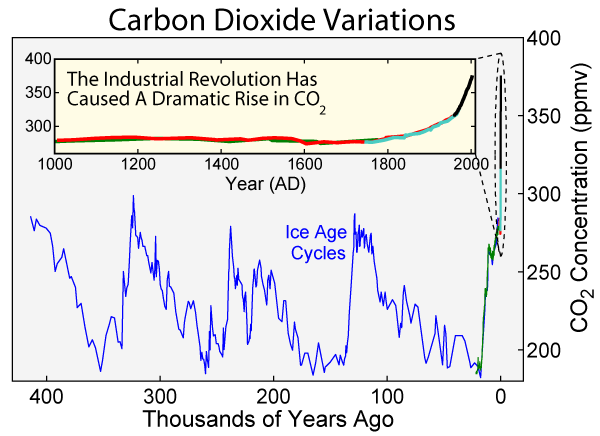 Reading some of the blog posts in reply -- some millions or billions of years ago, CO2 levels were thru the roof. Al Gore is a nut case; he's Chicken Little. But the 650,000 year time frame is pretty much coincident with the appearance of our "species branch": modern man. Homo sapiens heidelbergensis dates back to approximately 800,000 years at the extreme. We have never lived through a geologic change of this scale.
The question is: why should we not do everything we can to assure that our species survives? That civilization can move forward beyond the next two generations? Why dismiss this?
One scene in the movie, Gore shows a slide that he says was from a Republican "slide show". It shows a scales with the word "Balance", and in one pan is a pyramid of gold bars, and in the other is the globe (I think representing "environmentalism"). Economy vs. ecology. Will some please explain to the Republicans how this is supposed to balance?
In the end, this is a very personal story; the movie was right about that. Even though it is a story that may touch and affect more than 9 billion people in less than fifty years, it is personal on a global scale. Each of our actions will have an intense and direct affect on everyone else. The politics of this are clear, too; as Robert Green Ingersoll famously said, “In nature there are neither rewards nor punishments; there are consequences.” The scale of those consequences are now readily apparent.
So I take the story very personally, too. And, hey, I get to write this blog on my very own PowerBook -- looks just like Al's.
The scariest thing was the data graph showing the rising levels of CO2 -- when Al Gore gets on this electric lift so he can point out the "spike". Here is the study, conducted by a group from the University of Bern, specifically cited by Gore:
From a BBC News article:
"We find that CO2 is about 30% higher than at any time, and methane 130% higher than at any time; and the rates of increase are absolutely exceptional: for CO2, 200 times faster than at any time in the last 650,000 years." (Thomas Stocker, study leader)
CO2 levels are higher than at any time in the last 650,000 year. Ack! And not just a little bit higher, but nearly 30-percent higher than at any time during that period. This is not a piddling look back a few hundred years, or even a few thousand years -- but over half a million years. Our civilization is just over 2000 years old. Our species is likely about 200,000 years old. We have never ever faced a crisis like this. Ever.
These are recorded levels (the lift is used to get to the predicted increase over the next fifty years); it gets pretty vertical!
 Reading some of the blog posts in reply -- some millions or billions of years ago, CO2 levels were thru the roof. Al Gore is a nut case; he's Chicken Little. But the 650,000 year time frame is pretty much coincident with the appearance of our "species branch": modern man. Homo sapiens heidelbergensis dates back to approximately 800,000 years at the extreme. We have never lived through a geologic change of this scale.
The question is: why should we not do everything we can to assure that our species survives? That civilization can move forward beyond the next two generations? Why dismiss this?
One scene in the movie, Gore shows a slide that he says was from a Republican "slide show". It shows a scales with the word "Balance", and in one pan is a pyramid of gold bars, and in the other is the globe (I think representing "environmentalism"). Economy vs. ecology. Will some please explain to the Republicans how this is supposed to balance?
In the end, this is a very personal story; the movie was right about that. Even though it is a story that may touch and affect more than 9 billion people in less than fifty years, it is personal on a global scale. Each of our actions will have an intense and direct affect on everyone else. The politics of this are clear, too; as Robert Green Ingersoll famously said, “In nature there are neither rewards nor punishments; there are consequences.” The scale of those consequences are now readily apparent.
So I take the story very personally, too. And, hey, I get to write this blog on my very own PowerBook -- looks just like Al's.
Monday, June 12, 2006
Tech Support Guaranteed to Frustrate
From today's Boston Globe, an article by Keith Reed -- what's wrong with this concept:
"Next time your cable service is on the blink, log on to your computer instead of picking up the phone to get a little customer satisfaction. You might have to wait less to chat with a human being who can fix your problem than to talk with an agent on the phone. And they may be better equipped to help you."
What you don't see is the half-page photo-illustration in the paper edition: a man with a a notebook computer says, "My cable stopped working". Below, a service rep replies on another laptop, "Your cable modem appears to be swtiched off". An impossible scenario. Think.
You also don't see that on the front page is a little banner ad that reads "Online technical chat sessions are allaying computer angst".
Yeah, that's right. What if your cable service is your internet service? If your cable is out, how ya gonna chat? Wait less? Man, you are gonne be waiting a real long time. Didn't anybody catch this in editorial? I hate reading illogical twists like this -- especially since I've provided tech support on some fairly large scales. I know some nutty executive is going to try to convince his/her company to do away with phone support based on articles like this (I know cause it has happened to me).
What's worse is that the article is about ComCast, a company that I have to deal with almost daily, and a company that has just awful tech support. They are almost telling you that you need DSL or some other ISP if you expect support on your cable TV or phone service.
Stop the insanity.
"Next time your cable service is on the blink, log on to your computer instead of picking up the phone to get a little customer satisfaction. You might have to wait less to chat with a human being who can fix your problem than to talk with an agent on the phone. And they may be better equipped to help you."
What you don't see is the half-page photo-illustration in the paper edition: a man with a a notebook computer says, "My cable stopped working". Below, a service rep replies on another laptop, "Your cable modem appears to be swtiched off". An impossible scenario. Think.
You also don't see that on the front page is a little banner ad that reads "Online technical chat sessions are allaying computer angst".
Yeah, that's right. What if your cable service is your internet service? If your cable is out, how ya gonna chat? Wait less? Man, you are gonne be waiting a real long time. Didn't anybody catch this in editorial? I hate reading illogical twists like this -- especially since I've provided tech support on some fairly large scales. I know some nutty executive is going to try to convince his/her company to do away with phone support based on articles like this (I know cause it has happened to me).
What's worse is that the article is about ComCast, a company that I have to deal with almost daily, and a company that has just awful tech support. They are almost telling you that you need DSL or some other ISP if you expect support on your cable TV or phone service.
Stop the insanity.
Sunday, June 11, 2006
Planet TV on Global Climate Change
I got hooked on this video podcast show some months ago cause it was funny and truly interesting. I was discussing global dimming with some colleagues, and one of my co-workers suggested I check out the show.
Admittedly, sometimes, they have crazy robot projects or people retrofitting jet engines on motor scooter. But Episode 172 was different -- an editorial on Gloabl Climate Change.
There’s a lot of head-in-the-sand behavior going on about so many things. The legacy we’re leave to the next generation is shameful — and I mean our environmental, ecomonic, and political legacy. And more so because we have been *consciously wreckless*.
If this doesn't explain the issue and the imperative for a change in our behavior as a species, then nothing will. Check out this show:

Click to watch the QuickTime movie
Transcript here.
Admittedly, sometimes, they have crazy robot projects or people retrofitting jet engines on motor scooter. But Episode 172 was different -- an editorial on Gloabl Climate Change.
There’s a lot of head-in-the-sand behavior going on about so many things. The legacy we’re leave to the next generation is shameful — and I mean our environmental, ecomonic, and political legacy. And more so because we have been *consciously wreckless*.
If this doesn't explain the issue and the imperative for a change in our behavior as a species, then nothing will. Check out this show:
Click to watch the QuickTime movie
Transcript here.
Thursday, April 20, 2006

Tuesday, April 18, 2006
You're Not the Decider of Me
Bush: 'I'm the decider' on Rumsfeld
"I hear the voices, and I read the front page, and I know the speculation. But I'm the decider, and I decide what is best."
What an idiot. Does anyone else think he sounds like Ralph Wiggum?

Well, I guess so!
"I don't appreciate the speculation about Don Rumsfeld; he's doing a fine job; I strongly support him."
Don't appreciate? Didn't he say nearly the same thing about "Brownie"? So what is a decider, you ask?
Machine that always halts
It's almost funny.
"I hear the voices, and I read the front page, and I know the speculation. But I'm the decider, and I decide what is best."
What an idiot. Does anyone else think he sounds like Ralph Wiggum?
Well, I guess so!
"I don't appreciate the speculation about Don Rumsfeld; he's doing a fine job; I strongly support him."
Don't appreciate? Didn't he say nearly the same thing about "Brownie"? So what is a decider, you ask?
Machine that always halts
It's almost funny.
Saturday, March 18, 2006
Kunstler's Long Emergency
Just finished reading "The Long Emergency" by James Howard Kunstler, a very-very dark look forward to a time when we begin to run out of oil; ie. in about thirty years.
We will soon (or have already) gone past the point of "global oil peak" -- the halfway mark when we have consumed as much oil as is left in the ground. but, as Kunstler points out, the half we got is the easy half, the second half is going to be harder to extract and of much lower quality. There are no "hybrid" airplanes. Everything that's made from plastics or machined with power tools is about to become much more scarce. Our global economy is about to hit a giant speed bump.
When oil was first pumped in 1859, the poluation of the US was around 30 million, and the world population was around 1.2 billion. The population of the US has increased ten-fold in 150 years. The world population has about tripled. Kunstler makes it clear: these increases are sustained only by the massive use of cheap oil. The loss of fossil fuel on a population totally dependent on it results in: famine, disease, strife, and unrest. The past gave hints of the future: remember the gas lines? rolling black-outs? What happens to people working or living in 30-story skyscrapers when the power goes out?
Before we started pumping it, there were about 2 trillion barrels of oil in the planet. The world currently consumes about 84 million barrels per day; it will consume 103 million barrels per day by 2015, and 119 million barrels in 2025. At some point it will take more energy to extract the oil than is recovered; at which point we will be, essentially, out of oil -- we will never really recover all the oil in the planet. This oil was like an endowment; we could have invested it in something that would generate some kind of return -- we could have developed and built wind, solar, or geothermal technologies. Instead, we basically drove around a lot and burned away our inheritance.
Which sucks cause I really do like driving around a lot.
Kunstler takes it a step further -- a return to a regional economy, regional self-reliance, and regional governance. It sounds a bit like the Dark Ages run with computers. The loss of plentiful oil is double-compounded by the environmental legacy of our oil consumption: both the natural environment (global warming, industrial farming) and our built environment (suburbia, lack of mass transit). In 30 years, by the time the Long Emergency is in full swing, the world's population is expected to surpass 8 billion. One of the most thought-provoking books I've read in some time. Here's a good sampler:
An exceprt on the Rolling Stone Web SIte
Don't believe Kunstler? -- how about believing Chevron:
 "It took us 125 years to use the first trillion barrels of oil. We'll use the next trillion in 30."
We will soon (or have already) gone past the point of "global oil peak" -- the halfway mark when we have consumed as much oil as is left in the ground. but, as Kunstler points out, the half we got is the easy half, the second half is going to be harder to extract and of much lower quality. There are no "hybrid" airplanes. Everything that's made from plastics or machined with power tools is about to become much more scarce. Our global economy is about to hit a giant speed bump.
When oil was first pumped in 1859, the poluation of the US was around 30 million, and the world population was around 1.2 billion. The population of the US has increased ten-fold in 150 years. The world population has about tripled. Kunstler makes it clear: these increases are sustained only by the massive use of cheap oil. The loss of fossil fuel on a population totally dependent on it results in: famine, disease, strife, and unrest. The past gave hints of the future: remember the gas lines? rolling black-outs? What happens to people working or living in 30-story skyscrapers when the power goes out?
Before we started pumping it, there were about 2 trillion barrels of oil in the planet. The world currently consumes about 84 million barrels per day; it will consume 103 million barrels per day by 2015, and 119 million barrels in 2025. At some point it will take more energy to extract the oil than is recovered; at which point we will be, essentially, out of oil -- we will never really recover all the oil in the planet. This oil was like an endowment; we could have invested it in something that would generate some kind of return -- we could have developed and built wind, solar, or geothermal technologies. Instead, we basically drove around a lot and burned away our inheritance.
Which sucks cause I really do like driving around a lot.
Kunstler takes it a step further -- a return to a regional economy, regional self-reliance, and regional governance. It sounds a bit like the Dark Ages run with computers. The loss of plentiful oil is double-compounded by the environmental legacy of our oil consumption: both the natural environment (global warming, industrial farming) and our built environment (suburbia, lack of mass transit). In 30 years, by the time the Long Emergency is in full swing, the world's population is expected to surpass 8 billion. One of the most thought-provoking books I've read in some time. Here's a good sampler:
An exceprt on the Rolling Stone Web SIte
Don't believe Kunstler? -- how about believing Chevron:
"It took us 125 years to use the first trillion barrels of oil. We'll use the next trillion in 30."
Subscribe to:
Posts (Atom)