Showing posts with label technology. Show all posts

Thursday, April 02, 2026

Apple Turns 50


Apple was founded as a company on April Fool's Day, 1976. David Pogue chronicles those five decades in his terrific book, "Apple: The First Fifty Years". Reading its pages, I became increasingly nostalgic because there is no company (or collection of products) that has shaped my view of technology or affected my life as much as Apple.

I was introduced to the Apple IIe in my student-teaching days (early 1980's), when I taught classes in Logo at the Wheeler School. I recall reading the friendly user manuals as well as Seymour Papert's incredible book, "Mindstorms"(free download). My role was to explain the system and provide support, but the kids did the teaching by programming the 'turtle' and telling it what to do. The computers and the company seemed to espouse an optimistic sensibility: the technology was accessible, egalitarian, and consequential.

Before I finished my architecture degree at RISD, the School asked me to install their new Graphics Lab. The Lab consisted of a small number of Macintosh Plus computers and a LaserWriter printer. For this project, I had to not only figure out the computers and the graphics software (installing fonts!), but how to network everything – a skill I would take into professional practice.
(I have this vague memory of naming the Macs Huey, Dewey, and Louie after the drones from the movie "Silent Running"; the printer may have been the Valley Forge. It was a long time ago. By contrast, the Architecture Department had MS-DOS PC's with Wordstar; there was no CAD for PC's yet. I did learn to use those, and may have been one of their heaviest users. But they weren't 'fun', though we did race the office chairs from the Computer Room down the hallway cause the building sloped to the river.)
The Mac was a revelation: its GUI, its mouse, its industrial design. Though strapped for funds, I desperately wanted and bought one after graduation. I carried my MacPlus to work in my 'MacPack' (backpack) and installed a Thunderscan device in my ImageWriter. I used these in some of my earliest professional projects, writing planning studies for the State and the City. At home, I spent hours organizing my life with Hypercard stacks, thus making more time to play Dark Castle,

In addition to architecture, I was configuring and connecting computer equipment at various firms around Boston. And I was active in the Boston Computer Society, teaching classes in MS Word and helping to run the BBS (bulletin board system). Realizing there was much more money in tech than architecture, my 'hobby' became my job and my career: system and network administration, interactive software, educational technology.

I remember those fledgling days affectionately, when computers drove curiosity, creativity, and new opportunities. Above all, the community that grew around the tech was generous, more 'socialist' than 'capitalist'. As activists for the BCS, it felt like we were at the center of a new movement: attending Macworld Expos, showing off the latest shareware, trading swag, and exchanging power-user tips (like how to use ResEdit).


With the company's fiftieth birthday Apple turns decidedly middle-aged. It may still have a fandom, but chiefly it has stockholders. It is such a big business. Nowadays, personal computers are commodities with spec sheets and prescribed expectations. The customer base is no longer a community – people freak out when Siri can't tell what time the game starts.

On the other hand, Apple's gestation was in the 'hobbyist culture' of the Homebrew Computer Club, that's where Apple and its 'cult' of users inherited their world-changing, 'crazy ones' ethos. For my part, I still love their 'insanely great' products (below), but then I don't use or expect anything from Siri or any of the vulturous social media apps. Faced with a world full of addictions and complaints, I wonder if Apple (or any company) will ever recover that glorious, youthful, rebellious spirit. That's what makes me nostalgic, that and all the grey hair.

A list of all my Apple products through the years – updated from a decade ago, and basically the same as two years ago:

MacPlus (4MB RAM, 20MB HD, MacPack)
> ImageWriter (wide carriage)
Newton Message Pad (original)
Pippin (developer edition)
PowerBook G3 Series
iBook (Tangerine)
PowerBook G3 (Pismo)
iPod (original)
iPod nano (gen 1)
iPod shuffle (gen 1)
iPod video (black)
MacBook (polycarbonate, black)
AppleTV (original)
iPhone 3GS (black)
AppleTV (black)
MacBook Pro 15 (unibody)
iPad (original)
iPhone 4S (black)
iPad (retina, black)
MacBook Pro 15 (retina)
iPad mini (black)
iPhone 5S (black)
MacBook (Al, 2nd gen, m7/8GB/512GB)
iPhone 6S (Product Red)
Apple Watch Series 2 (42mm, stainless)
Apple Pencil (1st gen)
BeatsX (White)
iPad Pro 11 (A12X/256GB, grey) *
Apple Pencil (2nd gen)
Apple Watch Series 5 (44mm, stainless)
iPhone 11 (256/Product RED)
Beats Fit Pro (Sage Gray)
MacBook Pro 14 (M1 Pro/16/512GB, grey)
iPad Pro 11 (A12X/256, new-old stock) *
iPhone 15 Pro Max (A17Pro/512/Blue Ti)
Magic Mouse (black, USB-C)
> retired, no longer possessed
* replacement unit, same spec

Thursday, January 25, 2024

The Mac at 40


Forty years ago, Apple launched the Macintosh. Let's use the categories from the Upgrade podcast to look back and consider this break-through technology product:
First Mac Owned: (1986) MacPlus
It used to travel to work in an enormous squarish, dark-blue backpack, and also played a lot of Dark Castle.

Favorite or Best Mac: (2001) Power G4 "titanium"
It represented a huge design shift, the transition from a 4:3 to a 3:2 'wide' screen (Steve Jobs intro).

Favorite or Best Mac Software Ever: (1987) Hypercard and (1997) Riven
Hypercard was a creation tool for the early Mac that provided a platform for immersive games like Myst, and thus laid the foundation for its stunning sequel Riven.

Favorite or Best Mac Accessory: (2001) iPod (original) and (2005) iPod nano
The breakout device that took Apple to the next level (Steve Jobs intro); just a few years later the 'nano' was super tiny and portable (Steve Jobs intro).

Hall of Shame (worst accessory or Mac): (2001) iPod Earbuds
They had awful fit and came with little foam covers that held dirt and got lost, and yet somehow became iconic – did not like them (ended up with so many pairs that were never used).

A list of all my Macintosh-related (Apple) products through the years – updated from a decade ago, the same as two years ago:

MacPlus (4MB RAM, 20MB HD, MacPack)
> ImageWriter (wide carriage)
Newton Message Pad (original)
Pippin (developer edition)
PowerBook G3 Series
iBook (Tangerine)
PowerBook G3 (Pismo)
iPod (original)
iPod nano (gen 1)
iPod shuffle (gen 1)
iPod video (black)
MacBook (polycarbonate, black)
AppleTV (original)
iPhone 3GS (black)
AppleTV (black)
MacBook Pro 15 (unibody)
iPad (original)
iPhone 4S (black)
iPad (retina, black)
MacBook Pro 15 (retina)
iPad mini (black)
iPhone 5S (black)
MacBook (Al, 2nd gen, m7/8GB/512GB)
iPhone 6S (Product Red)
Apple Watch Series 2 (42mm, stainless)
Apple Pencil (1st gen)
BeatsX (White)
iPad Pro 11 (A12X/256GB, grey) *
Apple Pencil (2nd gen)
Apple Watch Series 5 (44mm, stainless)
iPhone 11 (256/Product RED)
Beats Fit Pro (Sage Gray)
MacBook Pro 14 (M1 Pro/16/512GB, grey)
iPad Pro 11 (A12X/256, new-old stock) *
iPhone 15 Pro Max (A17Pro/512/Blue Ti)
> retired, no longer possessed
* replacement unit, same spec 

Thursday, March 09, 2023

The Wayback Machine

Oct 23rd, 1999 – menu with tiny icons, including my old Powerbook G3

A recent podcast on 99-Percent Invisible reminds me that there are archives of 'the OG internet' – an invitation to see if my old 'web 1.0' site is still out there. And it is!

In the late 1990's, BCS-Mac closed its offices (in Porter Square), ending my volunteer work as an activist and system administrator. Prior to that, most of my 'online time' was spent inside BCS-Mac's First Class bulletin board system. About the same time, HMI (my old employer) had some kind of partnership with MindSpring, and they gave me a complimentary account (still just $8.95/mo at the end). At HMI, we were developing a product called Web Workshop Pro (for kids to publish web pages), so this was also a place to test products and ideas.

In 2020, and without warning, Earthlink killed the mindspring.com domain. My web hosting account opened in 1998 – so it ran for over twenty years. After all that, my old site disappeared.

Thus, 2023 is the twenty-fifth anniversary of my presence on the 'internets'. So very odd to be looking at these ancient graphics and these hand-coded pages that had been lost – odd in a good way.


UPDATE (Mar 11th): John Gruber and Jason Kottke discuss anniversaries, the birth of blogging, and the Wayback Machine on The Talk Show. They even discuss suck.com, which is linked on my archived site.

Thursday, July 22, 2021

"You guys paid for all this"

Jeff Bezos holds Amelia Earhart's aviation glassesJuly 20, Van Horn, Texas – photo by Joe Raedle/Getty Images

We live on this beautiful planet. We saw this – you can’t imagine how thin the atmosphere is when you see it from space. We live in it and it looks so big. It feels like this atmosphere is huge and we can use it and disregard it and treat it poorly. When you get up there and you see it, you see how tiny it is and how fragile it is.

We need to take all heavy industry, all polluting industry, and move it into space, and keep Earth as this beautiful gem of a planet that it is.
Jeff Bezos wants us all to know that by flying into 'space', he is now enlightened.

I wonder if Bezos recognizes all these are connected: capitalism, droughts, industrial pollution, insurrections, tax rates, pandemics, wildfires and floods, inequality, callousness. We now know it doesn't take brains to win a presidential election, and it doesn't take vision to fly into space. In America, all it takes is money and ego.

Bezos should ask himself: how do we move all heavy industry into space without polluting? even if we got those industries into space, how do we supply them with parts and resources, or return their products to 'this beautiful gem' without polluting?

Bezos is not thinking straight. That, or he's thinking of all the money to be made shuttling people and materials up and down.

Bezos is proposing we treat our celestial shores the way we treated the waterways and oceans during the industrial revolution. History tells us there were some seriously bad consequences. Some of these are 'stabilized' now – to a point – but only after the world suffered, and continues to suffer from: diseases, human subjugation, chemical contamination, inequitable wealth distribution, environmental destruction.

Instead of prioritizing a sustainable power grid, or emissions-free transportation systems, or fair-minded global banking, or low-carbon construction and manufacturing methods – or generally reducing the amount of crap we buy on Amazon – we should just shoot all the polluted stuff into the sky. And we should listen to Bezos cause he's been there.


It's a matter of understanding all the parts before we see the whole, or consider solutions - big picture stuff. Take the recent example of Miami: the inhabitants of Miami experience increased 'sunny-day flooding', so they install pumps. The flood waters rise and the drainage system becomes a flooding system, so they add back-flow valves and treatment plants. They extend the seawall. They elevate the streets. And on it goes. Yet, the water continues to rise.

Thus, a common through-line for these species-level challenges is our inability to perceive them at scale. In terms of climate change, NY Times columnist Charlie Warzel describes our view this way:
[O]ur 21st century existence is characterized by the repeated confrontation with sprawling, complex, even existential problems without straightforward or easily achievable solutions. Theorist Timothy Morton calls the larger issues undergirding these problems “hyperobjects,” a concept so all-encompassing that it resists specific description. … We understand the contours of the problem, can even articulate and tweet frantically about them, yet we constantly underestimate the likelihood of their consequences. It feels unthinkable that, say, the American political system as we’ve known it will actually crumble.
Climate change is a perfect example of a hyperobject. The change in degrees of warming feels so small and yet the scale of the destruction is so massive that it’s difficult to comprehend in full.
One attempt to provide a high-level, long-term view is this eye-opening study: "Update to Limits to Growth", by Harvard researcher and KPMG analyst Gaya Herrington. It reexamines and appears to confirm the projections of a fifty-year-old model developed at MIT ("Limits to Growth"). The model plots several broad variables (population, food production, industrial output, resources) out forty years, and expresses the risk of a global collapse during the 21st century. The study refreshes those metrics, comparing current empirical data to the original model's 'scenarios':
BAU2 (business as usual) and CT (comprehensive technology) scenarios show a halt in growth within a decade or so from now. Both scenarios thus indicate that continuing business as usual, that is, pursuing continuous growth, is not possible. Even when paired with unprecedented technological development and adoption, business as usual as modeled by 'Limits to Growth' would inevitably lead to declines in industrial capital, agricultural output, and welfare levels within this century. 

I suspect both the model and the study are intended more as a warning light than a predictive tool. Herrington comments that 'collapse' …
… does not mean that humanity will cease to exist, … economic and industrial growth will stop, and then decline, which will hurt food production and standards of living, … the BAU2 scenario shows a steep decline to set in around 2040.
However, there are other scenarios, such as "SW (stabilized world)", in which growth does not hit the same peak industrial output, but plateaus at a lower level and does not 'collapse'. Unfortunately, the scenarios that avoid collapse do not align as well with the current data. 

The study does not preclude the BAU2 scenario from generating some amazing technologies or accomplishments, like an Alexa factory in space. It simply shows that less-managed growth will likely result in a more-damaged planet, accompanied by increased inequality and human suffering. If we build cheaper, cleaner launch vehicles to orbit communications and weather satellites, or platforms for basic science (so we can invent, say, the next transistor), or find any other useful purpose for the journey – that could be a net-gain. Why don't we just try to do that? what is the point of traveling up and down just for the hell of it?

Less growth is fine. Less money is fine. We should consider quantities that are sustainable and equitable. What more does Bezos need to fulfill his bald, evil, supervillain fantasies? isn't Amazon already printing enough money? isn't he already the richest man in the world?

I want to thank every Amazon employee, and every Amazon customer, because you guys paid for all this.
I'm an uneasy Amazon customer of twenty-five years. As a benefactor, let me say – Jeff, you know where you can go.


One of the saddest stories yet of this pandemic (there have been so many) is given by Dr Brytney Cobia, of a young patient, about to intubated, begging for a vaccine. As the world approaches two hundred million total cases, it's hard to know if anyone is counting them correctly any more.

For example, recently while Georgia's published case counts are less than half the counts in Portugal, the death counts, just today, fall lower than Portugal's (a lag of about two months). How can the case counts be so much lower? is it the vaccination rates (GA: 45%, PT: 64% with at least one dose)? Recall that back at the beginning of June, Georgia was just ahead of Portugal (GA: 40%, PT: 38%). Looking at the graphs of cases and deaths, the correlation in Georgia, especially during this calendar year. is much less clear than in Portugal.

 cases: 193,375,410 global • 35,213,594 USA • 943,244 Portugal
deaths: 4,150,990 global • 626,172 USA • 17,248 Portugal

Wednesday, April 14, 2021

The Legend of Pilla the Gorilla


It's raining in Lisbon. I ate something that upset my stomach, and I can't sleep. No pandemic stats today, I need a short break from them. Laying half-awake, my brain fixes on an old story from my early days as an intern architect. I'm trying to sift out all the names, all the old friends, from some dreamy, nostalgic memory hole …

I spent my youth being angry at the world. I had a long list of excuses for this behavior: the middle-child thing, the violin lessons, the racist bullying, all the other bullying. I carried my anger to boarding school, where I began to channel my anger into subversive, though (I thought) creative, outlets. I made a set of prison bars from packing tape, cardboard, and black paint, and installed it over my dorm window. I designed a (subjectively) pornographic poster for a black-box theater production called "Rubbers", and hung them all over campus. I went to the communist bookstore in Harvard Square, brought back a bunch of leaflets for Bob Avakian's presidential campaign, and filled the student mailboxes – annoying non-sense like that.

I was angry when I arrived to college (art school), though I knew enough to make an effort. A student on my floor failed an early art history test. Believing that art school should be 'about the studio work', he expressed himself by shouting down the hallway and scrawling on the bathroom stall: "How can you learn what you don't want to know?" Well I thought that was just childish – also, I may have aced the test. So later, when I saw what he had written on the stall partition, I switched his words: "How can you know what you don't want to learn?" And I snidely added: "Get it?" That night, after dinner, a crowd from my dorm gathered at my door and asked if I had made the correction. I admitted that I had and asked how they knew it was me. They said, because the gesture seemed so angry. Still, I think they appreciated the word-play, even the student who wrote the original.

Art school was the best time of my life, but I was not my best. I did not want to be 'the angry kid', and I had some ground to cover. By the time I graduated and took a gap year, I was calmer, but a work in progress.

My first job out of school was at a small architectural firm in the old Russia Wharf in Boston. I chose the firm because they did public work, and I wanted to design things like schools and libraries – wholesome places to benefit the community. Valiant as that sentiment was, I soon realized that I had committed myself to a pauper's life toiling on small-scale, publicly-funded contract work.

My first project was an airport maintenance building in some small town south of Boston (I don't recall which one, it may have been near Weymouth or closer to the Cape). In most cases, engineers were subcontractors for architects, consulting on structural work, or heating and ventilation. In this case, we were subcontractors for a civil engineering company, as the 'design' work on an airport maintenance building took a backseat to its functioning: can the specialized trucks fit through the bay doors? are the safety bollards spaced to allows easy turns?

The engineer in charge of the project was, if i remember correctly, a fellow named Mark Pilla. I remember him as heavy-set, with short or thinning hair, a round head, and a messy mustache. Our office manager, Janice, nicknamed him 'Pilla the Gorilla', because of his foul mood. Janice was good with the nicknames, going so far as to give herself one that she proposed we use – 'Blonde Bombshell'.

I never got to know Pilla, as a junior team member, I was not invited to the project meetings. But I did get redlines from him. My drawings were returned with violent slash marks and big red letters: "NFG" (No Fucking Good). There was no other comment, just "NFG, NFG, NFG". I didn't know if that was an engineering thing or a military thing or what, but it was not practical or pleasant to get drawings back without any useful feedback. His anger was demoralizing and it was meant to be.

During lunch, the office staff would de-construct Pilla: why so angry? why spread misery? Janice mentioned that if we could turn the conversation to 'the beach', he would calm right down. A kind of mindless bliss would drop over his face, as if a movie screen had descended and he was watching a little show: "Oh yeah, the beach." This was an effect that I actually witnessed – Pilla went to his happy place. His shoulders slackened, the red sharpie at ease, and his brain drifted to some unknown shore.

Our lunch conversations evolved, and we shared our own happy places. Whether it was doing art, visiting museums, touring historic buildings, or gardening, I had this sense that the happy places of the other designers were 'architecture-adjacent'. We were doing what we loved, or very nearly so. On then other hand, we worked with Dan, at the time a recent BU grad who kept our books, and his happy place was fishing. And I imagined planning, preparing, and making an office-career as an engineer or accountant just so you could spend your free time on a beach or fishing.

To be fair, Dan wasn't miserable in his work, he wasn't cruel in his interactions, and he was contented to work on the ledgers. There may be engineers who enjoy designing airport maintenance buildings, but Pilla was not one of them. Perhaps Pilla had his excuses: maybe he was a middle-child, maybe he was bullied, maybe he was going through a rough patch. Acting as prime contractor, maybe his obscene acronyms were a form of emotional retribution for past wrongs by other vindictive architects. His example was a ghost of future-me, illustrating a lesson to avoid a professional life of anger (I was not always successful).

In the end, the project manager, Chris, and I pulled a couple of all-nighters to finish that airport project. It was a forgettable building, and an awful way to start my career. But we found a line in the office manual that said if we worked a certain number of hours in a day the company owed us a meal. So after we finished, Chris and I walked over the Fort Point Bridge to the floating restaurant there by the Children's Museum and across from the Boston Tea Party Ship, the 'Beaver' (Janice's nickname, 'The Beave'). We ordered lobster dinners. The day after we submitted our expense requests, the office manual included a price limit on meals. Chris and I became good friends.


I had more of a 'design' role in a later project, renovations to the Upham's Corner Municipal Building in Dorchester. The building included a Boston Branch Library, and a Community School with some athletic facilities. The grand arched-windows on one side were bricked up to hide some racquetball courts. There was nothing specifically in the contract regarding the exterior, but I pitched an idea to the City's Public Facilities Department to restore the look of the windows by painting them. I suggested that this would make the building look 'whole', and present a more gracious face to that side of the neighborhood.

… I snap from my languid napping with a lingering curiosity. I don't keep a bed-side notepad, so I shuffle to my MacBook. I drop into Google Street View, and search '500 Columbia Road'. After thirty-five years, I see the painted arched-windows. Russia Wharf is now a skyscraper, the floating restaurant is long gone, Chris is a partner in his own firm, who knows what happened to the airport maintenance building, but the painted windows are still there. I smile and hope that means something.

After a zigzag career, bouncing from architect, to IT guy, to tech entrepreneur, to museum staff, to teacher – I made it to my happy place. I'm exploring Portugal and Europe, touring old palaces and museums, and doing my drawings. Acknowledging that I leave my own trail of misery (I am human, and I am sorry), and trusting that I account for just as much joy, I hope my life is a net-positive. And I make a mental note to ask Chris what his office manual says about compensated meals.

I think of Chris, Janice, Dan, and everyone from that little architecture office, all their support. I can remember most of the others – I am really bad with names, but I think I got this: Gail, John, Larry, Susan, Odell, Laurie, Nancy, Robert, and especially my professional mentor Bill (who passed way too soon). I consider the shouting match(es) that might have occurred, the decibel levels that may have been reached, if I had to deal directly with our bosses. The person who my friends saved me from was, mostly, myself.

Though I did not tell them at the time, I am grateful for all the generosity. To Mark Pilla, wherever you are, you have my thanks, too. I hope you found the beach.

UPDATE (Apr 16th): The world passes three million deaths, so here are the pandemic stats, after all.

cases: 140,505,912 global • 32,305,912 USA • 829,911 Portugal
deaths: 3,011,554 global • 579,942 USA • 16,937 Portugal

Tuesday, July 28, 2020

Os Coches


The Museu Nacional dos Coches is a museum of coaches - royal coaches, hyper-ornamented wagons. But it's not what you think. In pictures that I had seen online, the Museu did not look inviting – dark, the vehicles lined-up and roped-off, little placards on stands. Plus, it's about coaches.

I should know better, because I spent some time working at the Larz Anderson Auto Museum. The Anderson Collection so effectively tells the story of the invention and development of the automobile during the early 1900's. The Museu's A Coleção tells the preceding chapter: how the coach developed during the 1500's, all the way through the 1800's. Of course, this also mirrors Portugal's rise during the Age of Discovery, and all the growth in technology that enabled that exploration.

First, the facilities are astounding – two football-field length galleries, clean, well-lit, and full of interactive technology. This new building opened at the end of 2015, lept over all those missing centuries, and gives these old coaches the best home imaginable. No annoying ropes, the coaches are protected by a frame on the floor, so you can walk around and see every level. I wonder if the old place, the Picadeiro Real, was even air conditioned. The website is informative and complete. There are touch-screen media panels, too. Yes, there's even an app. If only Larz Anderson could be nationally funded.

South Gallery

The first coach, Coche de Filipe II, is a big brute – given that this is a royal brute, it has a certain level of ornament and luxury, but the technology is basic. It is a studded leather box with facing velvet benches; two additional benches hang rather precariously, over the running boards (a pair of uncomfortable-looking spikes at either end). Some wooden windows are hung with belts to provide an enclosure. The most impressive feature of this coach is the interior ribbing for the roof, which is really impressive: a golden burst of blossoms and sunbeams set against the deep velvet.

The engineering is strait-forward. Two long 'logs', bound to each other between the axels, act as a central spine to carry the weight and motion. Atop this, a substantial wood frame holds the whole thing together. There's no real steering mechanism, as the coach is driven by riders on the horses (postillions). The wheels are covered with iron straps and round-head fasteners, which probably says something about the road technology of the 16th century.

The passenger compartment is held in place by a system of leather belts held up by wooden yokes at each end of the chassis. It all looks fairly questionable, but it is the coach of a king, Filipe II – who ruled both Spain and Portugal, so this coach is Spanish.

Nearby wall cases fill in some details: spare wheels, an old jack stand, some seriously heavy-duty boots (for safety near the wheels), olive-oil torches carried by attendants, and a long shaft (tongue?) that would be rigged beside the first pair of horses. The coach does not have brakes, so the first pair of horses (the wheelers) provide the braking, which requires a rigid connection to the coach.


Though the 17th century, the architecture of the coaches remains fairly standard, but the ornament begins to spill out in incredible abundance. The subsequent coach is a gift from Louis XIV of France, to his cousin, Dona Maria Francisca de Sabóia, for her marriage to rei Dom Afonso VI, in 1666. So this ceremonial coach, like the queen, is French.

As I'm trying to take a picture of the painted rear panel, I realize that the undercarriage is fascinating. A curving, laminated central beam again carries the weight. At the rear, additional pieces are laminated and protrude out the back; I assume this is where the footmen travel. The rigid, S-shaped braces may allow some give for the suspension system as well as space for the attendants. The yoke, now highly decorated, holds a slightly more elaborate system of leather straps, which seem go under the passengers and to the front.

Another French coach belonging to D. Maria Francisca de Sabóia is, I suppose, more of a 'daily driver'. Larger, but with the same type of engineering, the front suspension includes a simple, circular steering mechanism with an additional vertical axel, called a 'fifth wheel'. The connection linking this steering truck and the central beam is accomplished with a pair of hoops known as the 'swan's neck'; the offset, I surmise, allows the wheels to turn more sharply while keeping the center of gravity low. The truck and 'swan's neck' are visible on all the coaches of this era. The coachman (driver) can now sit on the lovely velvet bench provided on the vehicle.


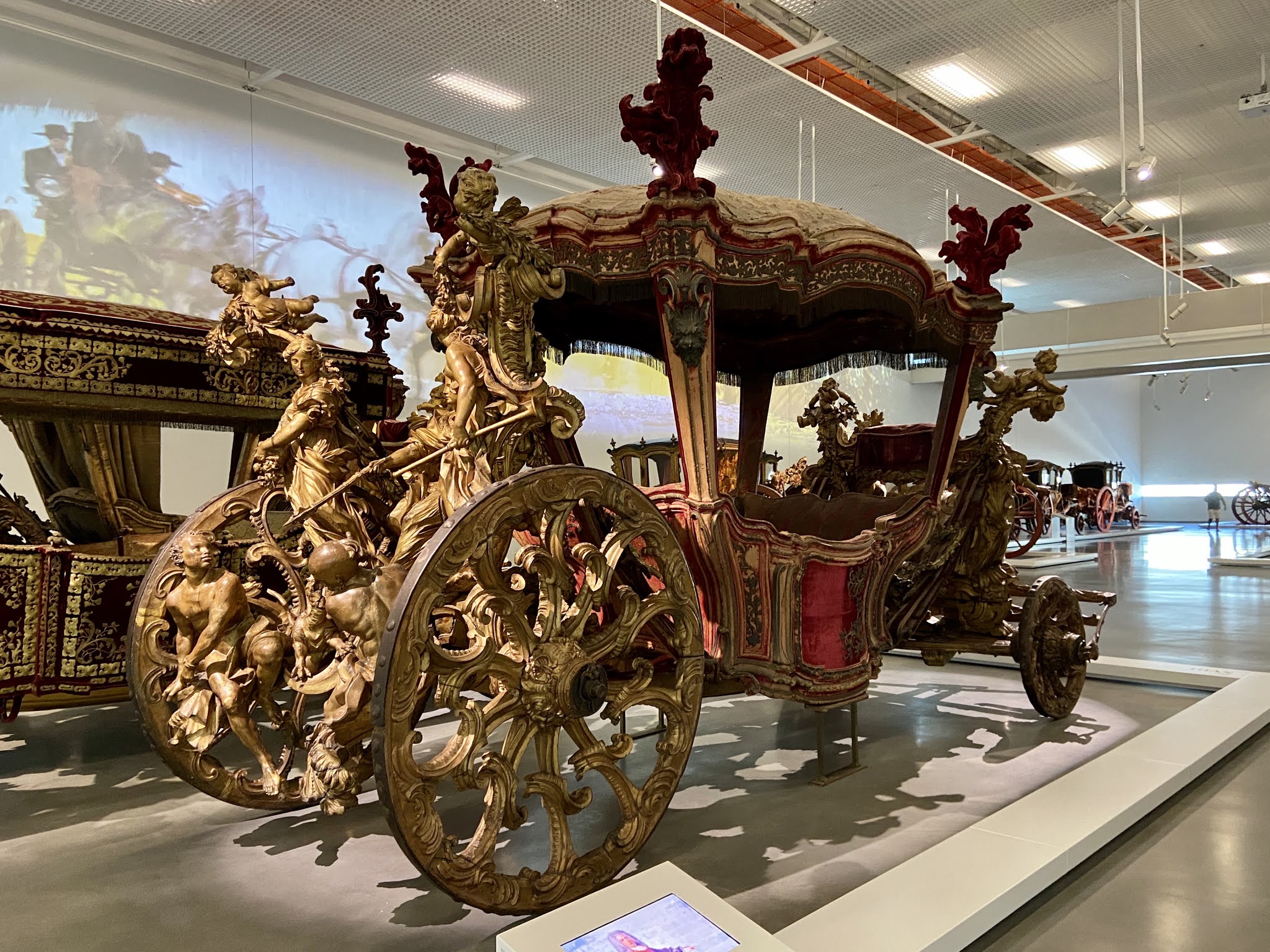
The neighboring carriage is, finally, from Portugal, 18th century, and is the ceremonial coach of D. João V. On this one, every inch is covered in sculpture, bronze trim, and paint. Even the front edge of the coachman's footboard is slathered with smiling women and gaping animals. Between the nude female figures, you can see a more intricate system of leaf springs joining the belts and the coachwork.


The next is Austrian (or possibly Dutch), and belongs to D. Maria Ana de Áustria, wife of D. João V. The decoration is all in textured relief, gilt woodwork, with a painted panel at the back (Minerva being crowned). The rear-facing sculpture is a cascade of (clothed) female figures holding the crown over the queen's monogram. At the front are more scary beasts to encourage the horse team on. And, again, the suspension springs are hidden among the lions and reclining figures.


The following two coaches are Italian, 18th century, and reflect the over-the-top Rococo period: the Coche da Coroação de Lisboa and the Coche dos Oceanos. The sculpture is not just applied, it is an end unto itself. These coaches, and a few others in the Coleção, are here after they were used in an ambassadorial procession in 1716 to honor Pope Clemente XI, who elevated Lisbon to a Patriarchate. The 'Roman-style' open coachwork adds to their parade-float character.

At the back of the Coche da Coroação de Lisboa, a female figure of Lisboa is being crowned by two attendants, one holding a cornucopia and the other a clarion, with a sea serpent snapping at their feet. Two lowly male figures, evidently representing Africa and Asia are trailing the group (thanks a lot Lisboa). Above all of them, two putti are hanging on for dear life.

At the back of the Coche dos Oceanos, a central male figure, holding a harp and kneeling on a globe, is attended by two females, one holding a bundle of wheat the other a bouquet of roses. Trailing them are two bearded gentlemen, shaking hands, evidently to symbolize the joining of the Atlantic and Indian Oceans. I'm not sure the globe is an accurate representation of those Oceans – made by Italians, of course, not Portuguese.

Playing above these 'triumphal coaches' is a cinema-scaled media piece, making great use of the empty wall space, and showing how the coaches looked in motion and on parade, etc. Accompanied by period-correct classical music, it ties things together and helps the coaches tell their stories.


The last coach in this first gallery is the Coche da Mesa, the Table Coach. This is Portuguese, with a wide, octagonal body, and somewhat less ornament – by comparison to its neighbors. It looks rather utilitarian, though it is trimmed in gold and velvet, but the wheels aren't even decorated. It is designed for a longer trip to the Spanish border, for the Troca de Princesas in 1729 - the Exchange of the Princesses.

As I walk the gallery, I appreciate the way the Museu utilizes the new building, but two useful things seem to be missing. Thinking out loud, I propose that one coach be rigged with a team of horses so we could see the full scale of a complete turnout (or it could be printed on the wall), with a call-out for all the parts. The other thing I might suggest is to illuminate the interiors of one or two of the coaches, as it's really hard to see.

Coming close to my second wish, the door to this Coche da Mesa is open, and we can easily see inside with help from the nearby ribbon windows. As the title suggests, there is a wonderful, round table with a well-weighted pedestal base. We imagine the princesses spilling a lot of tea as they are driven to their new husbands, or writing a few sloppy letters.


North Gallery

The next hall begins to illustrate some real innovation, for example, the Berlinda da Casa Real. A 'Berlin' is a German invention (those Germans!) from the late 1600's, and this is a French coach from the late 1700's – we understand these ideas were traded between countries much like princesses. The body looks much the same, but the chassis is formed by a pair of bowed through-beams set on either side, with a ratchet suspension system, called a cric, to tighten the strapping. It is simpler, lighter, faster, and evidently more comfortable for the passengers.


Down a few places is the Carruagem de Gala, a ceremonial coach built for the Patriarchs of Lisbon. So clean and simple, it is 19th century Portuguese. The body sits between ultra-light rails, which are suspended on elliptical leaf springs at each corner. The spokes of the wheels tell you this is efficient construction. There is also a brake pad operated by a crank above the driver's seat. This may suggest that a simpler harness is employed which eliminates the rigid shaft. On the downhill, the driver simply turns the crank to keep the carriage from rolling into the horses.


Then we have theme and lots of variation. The Berlinda da Cama is extra-long bodied and, we are told, there are beds inside for long trips as well as a sistema de evacuação (the Anderson Collection has a 1906 CVG with a toilet, too). The Berlinda da D. Maria I has fairly strait beams, so it's a simpler structure and rides much higher. Because of the lighter construction there may be less concern for its higher center of gravity. Compare this 'daily driver' to the one used by D. Maria Francisca de Sabóia one hundred years earlier.

The vehicles seem to shrink into the distance, except in this case, they really are shrinking. At the same time, they exhibit remarkable variety: two-wheeled chaises, carriages for kids, litters drawn by mules, sedan chairs carried by footmen. Several of the vehicles have lanterns mounted, allowing for easier travel any time of day, and some have fenders for foul-weather journeys. We consider all the varieties needed to move all classes of people, doing chores, shopping, and paying calls.


Now the Museu fulfills another wish with a full-scale, fully-rigged team and coach. It is not printed, and it is magnificent. The Carruagem da Coroa is a British-built state carriage from 1824 and really looks the part of a state carriage – clean shapes and lines, tasteful amounts of gold here and there, the marvelous velvet bench cover, proud eagles at the doors, and a royal crown on top.

Thoughtfully in the nearby wall displays, the coachman and other servants await. In another case are the harnesses and hardware. I admire the sliding glass doors on these displays, too, with the modern door hardware and 'English-style' coach hardware in juxtaposition.

The wheels have thick rubber bands over the iron straps, possibly indicating improved roads (some of the other nearby coaches also have rubber on their wheels). There are substantial, cylindrical lanterns mounted at each corner, adorned with gold swags and crowns. The coachman sits above roof-level and can see over the team, down the road. The curving lines of the suspension mounts and the shaped beams underneath the bodywork lend the coach a flowing quality. A pair of serpents trail behind like exhaust pipes.


The group across from the Carruagem da Coroa shows the variation in bodywork. The Landau de D. Pedro V has a two-piece, folding leather hood, and a suspension system that floats the passenger compartment above the chassis. The Carruagem de D. Maria II seems clean and compact, and incorporates a set of pincer springs at the front. These two British coaches date from 1834.

There are a few examples of a body-style known as a 'Clarence', which seems to integrate the chassis with the bodywork. The lower edge swoops downward to the entry and footwell, hinting at modern-looking wheel arches. The first, more simple specimen is 19th century French, and shows basic body-shape, with elliptical springs front and back, as well as rounded corner window glass. The second Portuguese example, with the monogram of D. Perdo V, features gothic windows and twisted snakes under the floorboard.


The image below is of the Carruagem de Porto Covo, and highlights the curvilinear forms where the 'tailgunner' sits. The last two coaches are for freight and postal work. The all-dark-green Mala-posta looks like Mad Max's mail-truck, with heavy-duty leaf springs, and footholds all over the body (eight passengers ride on top). I particularly enjoy the two big brass lanterns on each side, with the smaller three-eyed signal lantern fixed to the footboard, like a murder hornet. The last black-over-red Mala-posta has two compartments connected together, perhaps for first class and economy on the Lisboa-e-o-Porto run. I notice the rear-facing door with folding stair, and think of an old school bus.


Center Gallery

A small show room connects the two hangar-like galleries, and inside is a 1895 Panhard et Levassor automobile. This is the first car ever driven in Portugal. On the wall is a catalog which identifies this as the Voiture a quatre places, forme Phaëton. The information on the museum label says:
1300cc petrol engine, 2-cylinder V-engine and 3 horsepower at 750 rotation per minute. The gearbox has 3 speeds forward and reverse … and the car could reach a speed of 26 km per hour.
So, the Daimler engine replaces three horses; fun to consider while just a few feet from a team of six horses. In outstanding condition, it looks like it still runs, because it definitely drips oil (note the towel). Such a clean, compact shape, beautiful brass fittings, and an intriguing perforated tin-can cooling system. There are no cherubs or crowns here, no mud-flap girls or truck nuts either.


UPDATE / WEDNESDAY: Over seventeen million cases now; one million new cases every four or five days. The US passed one hundred and fifty thousand deaths. Portugal overtook fifty thousand cases a few days ago.

 cases: 17,135.016 global • 4,551,506 USA • 50,613 Portugal
deaths: 668,427 global • 153,477 USA • 1,725 Portugal