Saturday, September 01, 2012

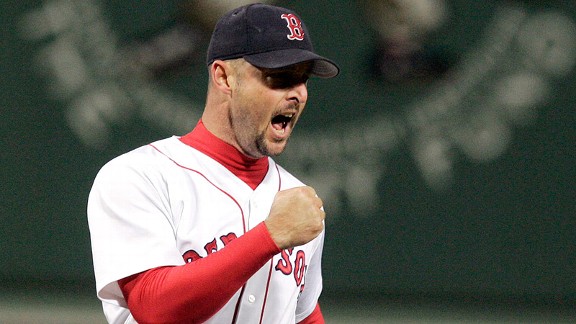
Red Sox Hit Bottom

Eventually, a test of allegiance becomes a celebration of Sisyphusian suffering. Red Sox fans too young to remember the lessons of the 1980's and 1990's, who became fans during the easy glory of the 2000's, should now "get it". Yes, October 20, 2004 was a great night, but mythic misery has always been part of what it means to be a Red Sox fan - and last night's game was a powerful dose.
Exercise: Sit in an opposing ballpark and score a defensive half inning during which your team's pitchers allow nine runs to nine opposing batters, while recording no outs.
Extra Credit: Execute above Exercise while sitting with loud, slightly drunk (possibly high?), and suddenly cocky, opposing fans.
Last night was "the" last night, and one of the worst nights, in a year that began on September 1, 2011, when the "greatest everSox were 31 games over 500, and owners of a 1.5 game lead in the AL East. Their epic 2011 collapse has been cataloged by many others, but as an eyewitness, I can tell you how the Red Sox completed a horrible night (L, 20-2), capped a truly horrible month (9-20), and ended an historically horrible year of baseball (.615 to .434 win pct).

Dire Forecasts. The Boston Red Sox arrived in Oakland after suffering a sweep in Los Angeles, of Anaheim. The Athletics returned from a 6-1 road trip, and a four-game sweep of the Tribe in Cleveland. One other team joined them on the field - the Petaluma Little League Allstars, recently feted by folks far and near for their stunning ten-run, last-inning rally in the US Championship game. Losers. Winners. Losers who felt like winners. Their gathering was a prelude.

The Quiet. The pitchers were Cook (BOS) vs. McCarthy (OAK). The first two Red Sox batters, Podsednik and Pedroia reached on singles. Ellsbury ground into a 3-4 double-play that advanced Podsednik to third base, where he was stranded by Ross. The A's went 1-2-3 in the bottom of the first.

Outer Bands. In the second, the Sox put runners on second and third with one out and could not score them. In the bottom half, the first four A's hitters reached and scored: Cespedes singled, Moss doubled scoring Cespedes, Gomes singled scoring Moss, Donaldson homered scoring Moss and himself. Athletics 4. Red Sox 0.

The Eye. The Sox went 1-2-3 in the top of the third; in the bottom, the A's plated two more, on doubles by Reddick and Moss, and chased Cook (L, 2.2-7-6-0-0) from the game. Saltalamacchia homered for the Sox in the top of the fourth, and Tazawa pitched a clean bottom frame (two Ks). The A's were up 6-1, but at least the Sox seemed to be playing baseball again.

Storm. The Sox went 1-2-3 in the fifth. In the A's half, Tazawa was lifted for Aceves, who hit Cespedes with a 2-2 cutter, then threw another 2-2 cutter to Moss. Moss knocked it around the right field pole, upper deck. A's 8-1. In the top of the sixth, Pedroia and Ross singled around an Ellsbury ground out, but they could not score the runner from third with one out. Bottom six, Bard spelled Aceves, got Donaldson to pop out, then threw five straight fastballs to Kottaras. Kottaras hit the last one over the right field wall. A's 9-1.

Levee Breach. In the seventh, the Sox offense eked out a run: Ciriaco singled, Iglesias was hit by a pitch, A's starter McCarthy (W, 6.1-8-2-0-1) was relieved by Figueroa, Gomez pinch hit for Podsednik, the runners moved up on a wild pitch, and Gomez hit a slow grounder down the third base line to score Ciriaco. In the bottom of the seventh, Breslow took over for Bard, and got Reddick to pop out. The next nine A's in succession would reach and score:
  1. Cespedes singled on a ground ball to left 
  2. Moss singled on a soft line drive to center
  3. Gomes walked
  4. Donaldson reached on fielding error by Gomez, Cespedes scored
  5. Kottaras singled on a ground ball to right,  Moss scored, Gomes scored; pitching change, Melancon for Breslow; pinch-runner Rosales for Donaldson
  6. Pennington doubled on a line drive to right, Rosales scored
  7. Crisp walked
  8. Drew singled on a line drive to left, Kottaras scored
  9. Reddick hit a grand slam to right, everyone else scored
Athletics 18, Red Sox 2.

Federal Relief Effort. Top eight, the Red Sox got a single and walk from Ellsbury and Ross. Loney ground into a 6-3 double-play, and Salty stranded Ells at third. Bottom eight, the A's got a double from Rosales and another homer from Kottaras. The Sox went 1-2-3 in the ninth. Final, A's 20, Red Sox 2.

After all that, my friend David pointed out, the A's left only three runners on base.

Before 2004, Red Sox fans were known as lovable losers: passionate, knowledgeable, able to absorb tremendous bone-headedness. If you were a fan, really, there was no choice but to absorb bone-headedness. And there was always next year. I've tried to live outside that image, and as I've read the posts of other Sox fans, I know many others have tried to do the same.

We never believed in the Curse and we never called ourselves a Nation. Writers in need of selling newspapers made that stuff up, spread it around, and now we all own it. We did not need the myths; the insane drama on the field was enough. When we lost, we lost big, and it hurt - but most other fans (Yankees fans can skip this part) acknowledged our pain: Sox fan? Yeah, I can respect that. But I did not want or welcome what seemed like pity, though it may have something more. From my experience, losing did not make me "cursed", nor did I want to be "lovable". Losing did not even make me sad - it made me angry. Sometimes, it made me physically sick.

We were told by the sports scribes that championships in 2004 and 2007 "changed" us from pitiable to pushy - Yankees fans without the pinstripes. We won, we won big, and we enjoyed it. No one acknowledged our pain cause there wasn't any, and I, for one, did not notice the loss of it.

But winning gave me only a sense of karma, not comfort. All the talk of burying ghosts? I still remembered '86. '99, and '03. From 2003-08, we had gone from losers who were winners, to winners who were losers. And then, at the end of 2011, we were just plain losers. I was not looking for sympathy. I did not get any sympathy. Other fans, who, in the past, may have offered a handshake, if not a shoulder, were gone.

Anyway, one doesn't support a team to seek solace from others. Condolence does not enter into one's thinking, and neither does self-pity. Donna and I moved to Boston in 1986 and got caught up in the energy of a pennant race and a playoff run. We became fans.

It just happens to you.

What is that tribal thing, that human quality that makes us align ourselves to a team, invest our emotion in a bunch of ball players? To root? To learn Sweet Caroline (I kinda hate that song, but I do know the lyrics)? To believe? And what do you do when that faith fails you?

I made a silent promise to myself to try ignore the Red Sox this year. Last year hurt a lot, and I needed a break - I live in Berkeley now, I should follow the Giants, or hey (forehead-slap), the A's. But I'm a loyal person; being a Red Sox fan is part of me. I could not stay away - but for this one game.

Please let this be the bottom.

I write this post not to wallow, but to sincerely try, with every fiber of being a fan, to put a very bad year behind; to try to clear my thoughts by them writing down. Like a bluesman singing it out, I'm looking for a catharsis - if not to start healing, to at least stop hurting.

Wednesday, July 04, 2012

Fireworks on the 4th - Higgs-like Particle Found at LHC

I've heard a lot of talk and chatter in the media about the loss of an active space program at NASA - that the real "heavy lifting" is being contracted to private partners like SpaceX. In particular, Dr. Neil deGrasse Tyson has made the rounds, including a hearing in Congress, to decry the loss of an active space program - the resultant loss of interest in in education of the STEM (science, technology, engineering, and math) topics.

I, too miss the discovery and excitement of, say, Apollo. At the Museum, we are now showing The 1968 Exhibit which features the Apollo 8 mission as a key, year-ending event that united the world - the reading of Genesis in lunar orbit on Christmas Eve. However, I am still excited by NASA's upcoming Curiosity Rover landing in a few weeks.

That said, I don't think mankind's only opportunities to challenge its ingenuity and spark its imagination are in the stars; neither does such an inspirational project need to be "American". The LHC is a scientific tour de force, and (like Apollo) the innovations and advancements in technology that it has spawned will benefit civilization for generations to come: with large scale "grid" computing, focused proton beam technology, advances in clean manufacturing, and much more.

This morning, looking deep into the fabric of matter, the good folks at CERN announced that they have found a new particle - a boson that exhibits all the properties of the Higgs boson as anticipated by the Standard Model. Two teams, represented by Dr. Fabiola Gianotti and Prof. Joe Incandela, using data collected in two separate experiments (ATLAS and CMS respectively), presented evidence of a new particle with a mass of about 125.5-126.5GeV, and with a statistical significance of 5σ, marking this as a "discovery". Boy, I hope I'm saying that right.

It was another Genesis moment, literally made by recreating conditions similar to those immediately after the Big Bang. But how do we use this event ignite new excitement in science, technology, engineering, and math? Does the general public even grok the basic concepts here? I really enjoyed watching all the physicist and other gathered "smart people" erupt in applause when the two 5σ announcements were made - but who else could possible get that? These two slides literally threw the crowd into fits:

Prof. Incandela:
Dr. Gianotti:
You know how, when you're a kid, the first time you go to the symphony, and people don't applaud until after all the movements for a piece are done? It's like that, right? When people first saw Earth-rise in lunar orbit, they understood the significance of the event. When people see oddball computer-generated fireworks and graphs that spike to 5σ at 125.5-126.5GeV, how do we know what that means?

In the vein, here's a quote from Stephen Wolfram in WIRED:
I think it could be justified almost just for the self-esteem of our species: that despite all our specific issues, we’re continuing a path we’ve been on for hundreds of years, systematically making progress in understanding how our universe works. And somehow there’s something ennobling about seeing what’s effectively a worldwide collaboration of people working together in this direction.

Indeed, staying up late to watch the announcement early yesterday morning reminded me more than a bit of being a kid in England nearly 43 years ago and staying up late to watch the Apollo 11 landing and moonwalk (which was timed to be at prime time in the US but not Europe). But I have to say that for a world achievement yesterday’s “it’s a 5 sigma effect” was distinctly less dramatic than “the Eagle has landed”. To be fair, a particle physics experiment has a rather different rhythm than a space mission. But I couldn’t help feeling a certain sadness for the lack of pizazz in yesterday’s announcement.


Links:
Latest update in the search for the Higgs boson (Geneva, 2012-07-04T09:00:00)
Press Conference: Update on the search for the Higgs boson at CERN on 4 July 2012

Friday, February 17, 2012

In Praise of Unnatural Acts and Tim Wakefield


Tim Wakefield announced his retirement from professional baseball earlier today.

When I came home from work, I watched the last three innings of Game 5, of the 2004 ALCS. I have the last four games saved on my iPad. Yankees at the Red Sox in Game 5; those were some of Tim's best moments. The Red Sox Manager, Terry Francona, had stayed with the starting catcher, Jason Varitek, into the extra innings. Normally Varitek would not be in there, the job of back-stopping Wakefield's knuckleball, notoriously hard to catch, usually fell to the other Sox catcher, Doug Mirabelli. But this was the League Championship, the Red Sox were down to the Yankees three games to one, and Francona stuck with Varitek.

In the top of the thirteenth inning, Yankees slugger Gary Sheffield took some wild, from-the-heels cuts at the knuckleball, and struck out. But Varitek could not make the put-out, and Sheffield reached on a passed ball. Next, Hideki Matsui, who had been killing the Sox up to that point in the Series, bounced a slow grounder to second, and the Sox could only get the lead runner, Sheffield. Then Bernie Williams flew out to right field for the second out. The next batter was the Yankees catcher Jorge Posada, well known as a patient hitter. On the third pitch, Varitek lost another passed ball, and Matsui advanced to second. With the count two balls and one strike, Francona elected to intentionally walk Posada and face Ruben Sierra - who had three hits in four at-bats that night.

The first pitch to Sierra was a slow knuckler over the inside part of the plate for strike one. Fenway erupted with approval. The second pitch was fouled back for strike two. The third pitch was low and inside, Varitek stabbing at the dirt to catch it. The crowd gasped and grew silent. The fourth pitch was also fouled back, and the count held at one and two. The next pitch danced off the outside of the plate, and Varitek tried to simultaneously scoop and slap the ball, which bounced to the fence; crowd moaned in horror. Matsui took third and Posada second on the third passed ball of the inning.

So it was two and two to Sierra, two outs with runners at second and third. Wakefield's sixth pitch of the at-bat was high and outside, Varitek jumped up and blocked the ball, which popped out of his glove, but dropped down at Sierra's feet. More shouts and gasps, but the runners could not advance. The broadcast cameras flashed to Mirabelli in the Red Sox dugout, his head down, his hands pressed together, his body rocking with tension; he could not watch. On the seventh pitch Sierra swung thru a tight knuckleball on the inside half, inning over. As Varitek snapped his glove shut, he pumped his fist; Wakefield doing the same as he marched off the mound shouting at the dugout, and the crowd roaring.

In my opinion, this was the key Yankee at-bat in the Series; it was the last close moment, and as close as the Yankees would come to winning the pennant that year, after they raced out to a 3-0 Series lead. Wakefield and Varitek gutting it out, disaster one fluttering knuckleball away. But they trusted each other, and made enough outs (four) to finish the inning unscathed.

It's a baseball cliche: pitching is an unnatural act. The motion contorts your arm and requires constant attention and effort to prevent injury. But any kid who throws a snowball, or a rock, or a baseball can tell you it feels pretty natural. You just haul back and throw. But throwing a knuckleball, that really is an unnatural act. Like other physical acts that defy logic - skydiving, car racing, ski jumping - one part of your brain has to convince another part of your brain that this is a good idea, that this is what you want your body to do and it's going to work out. I want you to: push the baseball, using just the fingertips, take the spin off the ball, push it towards home plate where stands Gary Sheffield, or Alex Rodriguez, or Hideki Matsui, and let them try to hit a ball traveling 60 miles per hour when they are accustomed to a ball traveling 95. I want to do this. I think this is a good idea. If the hitter should make good contact, it is likely the ball will travel a long distance, and the hearts of your teammates, coaches, and the millions of fans that make up Red Sox Nation will be crushed. I will throw this pitch.

This is unnatural. Wakefield made a 19-year career of this.

Sitting in the stands and watching Wakefield pitch was other-worldly. I last got to see Wake pitch in 2009, his All-Star year, when he beat the As in Oakland 8-2, with a complete-game 4-hitter. Lobbing pitch after pitch, when he should be throwing peas, shooting bullets, firing BBs, whatever. It sure looked unnatural. How could the As hitters not crush every one of those meatballs, even if they weren't spinning? The infielders were making pegs to first faster than Wakefield threw to the plate. He was 42 years old in 2009, very close to my own age. He was 11-5 that year, and helped the Sox make another playoff appearance.

In his farewell today, Wakefield spoke about his youthful dreams of playing in the majors. Unlike so many who make it to the majors, Wakefield made it there and stayed for so long because he could do this one thing that very-very few can do. He was not a good hitter. A converted infielder, he was a pretty good fielder, though, as a pitcher, got few opportunities. His fastball, when the hitter knew it was coming, was a gopher-ball; and he threw a curveball only occasionally - those pitches would not have existed but for the knuckler.

My friend Rob and I used to take lunch breaks and play catch in front of the Federal Reserve Bank in Boston, and he could throw a knuckleball. I tried, but never could quite get the ball to float the right way - I could never completely remove the spin. But when Rob threw one you could tell he had to force himself to do it. He had to concentrate, think really hard about how to coordinate his arm and his fingers. Rob was a coordinated guy, a good athlete, and had run the Boston Marathon a few times, but only one knuckleball in a dozen was really any good. And he could not really throw it hard enough to use it, say, in a beer-league game. But when he got it to work, it was really strange to try to catch it.

I've racked my brain trying to find an equivalent to Wakefield specifically, and knuckleball pitchers in general, in other sports. It's really difficult - to execute some basic move in a sport in a way that is so wrong that it's right. Jim Furyk in golf? I don't know.

Thank you Tim Wakefield and congratulations on a unique and unforgettable career.

Bonus: Joe Posnanski wrote a nice piece on 'poetry and knuckleball pitchers' on his blog at SI.

Sunday, June 05, 2011

Pacific Grove

We were able to spend a marvelous week on the Monterey Peninsula, in the town of Pacific Grove. This was our first visit to the area, and we enjoyed the wondrous views, the wildlife, and the calming pace. With the ice plants in bloom and the fleet squid fishing near the shore, we benefited from an active, glowing coast. After arriving, we walked back along the shore, through rows of Victorian bungalows, to the downtown area along Lighthouse Avenue; galleries, shops, and restaurants line this "main street", made wide by the parking strip in the median. But the traffic and the crowds were light, and the walking easy. We spent the afternoon exploring the shore, walking the path by the sea wall along Ocean View Boulevard.

There's a small beach area tucked behind a rocky jetty called Lover's Point. Walking westward, the path opens to large patches of ice plants, thick with small pink blossoms that edge the rough coast. Cormorants fly in formation over the kelp beds, past the fishing boats waiting for nightfall, when lights are used to attract squid.

The next morning, we walked further west toward the light house. It got really windy in this stretch, and that slowed us down a bit; all the better to take in the scenery. Along the path, we pass two large, roundish rocks with a thin gap between them - known as the kissing rocks. Past these rocks, the chop was heavier and the spray more prevalent. As we got closer to the lighthouse, we ran into a large crowd of school children, who had apparently bused in for a end of school outing. Well, we were ready to turn around anyway.

After lunch we drove down to Point Lobos, a State Nature Reserve just south of Carmel - the most beautiful coast I think I've ever seen: bright and dark rock formations covered with succulents and grasses, the shadowy kelp and the splashes of seafoam. And there was, of course a soundtrack, too: the kick of the spray, the droning barks of the sea lions, and the constant rush of air over the outcrops and in the little inlets and caves.

Famed for its sea lion population as well as its harbor seals - we saw plenty of both. It was our first chance to really test the telephoto lens; boy I was not sure any of our pics would come out, it was so windy and my eyes are so old. But the monopod did its job and the zoom lens compensated for my own marginal optics. We were happily surprised when we got home and downloaded the images, as nearly every picture we took was a winner.

From Sea Lion Cove, we drove across the Reserve and found a small group of harbor seals "pupping". Whaler's Cove is a large, sheltered semi-circle with shallow, sandy beaches where the seals could easily slide on shore; when we got there there was a stray pup yipping away in a kelp bed about a dozen feet from shore. The barking went on for quite some time; the ranger commented that the pups were about a month old and that he had never seen a pup left alone for such a long stretch. Regardless, the adults were happy to stay put on the beach, but no more than 100 feet away. It was quite a treat to have this group of seals so close and all to ourselves.

The next day the forecast called for rain, so we made a day of it indoors at the Monterey Bay Aquarium. My goodness, what a place! The big tanks were astonishing, and the smaller displays were all impressive, too. The attractions were mesmerizing; we must have spent twenty minutes just watching the otters. We wanted to see the giant octopi, but they had crammed themselves into the corners of their tanks. One lady, claiming to have "finally" found herself alone at the Aquarium, parked herself by the larger octopus and refused to move. At one point the octopus decided to rush to the other side of the tank - a gasp flashed through the crowd, and then he was hidden again. And the octopus lady had followed her friend to the other side, too.

With our Membership passes, we were able to take a "behind the scenes tour" with only one other guest and a small group of new Aquarium staff. Tara, an Aquarium biologist (?), acted as our guide and showed us, quite literally, the internal plumbing: wet suits and gear, fish food, solitary for cephalopods (the trick is to surround them with astroturf), a medical bay and nursery for otters, and the top of the big tank with a craneway for the large fish.

We finished our day with the sea horses. What a way to wind down: just enjoy the zen of being with the Syngnathiformes (Tara challenged us to use that word in a sentence). The experience was hypnotic in the best possible way; in contrast to the action of the penguins and the murres, the otters, and the divers in the big tank, this was calming. Plus, you had to get right in to see anything, and once you saw the animals, it was hard to pull yourself away. The flow was slow. And that was fine. We were especially taken, as were so many others, with the leafy sea dragons; hard to believe those things were alive. They were exotic and gorgeous.

Restaurants reviews: PassionFish in Pacific Grove gets three stars. Yummy. Also, the sit-down restaurant in the Aquarium was terrific (there are field glasses on the tables so you can spy on the shore scenes out the windows).

Oh - and the Red Sox won four in a row while we were away; we listened to the games when we could. Back in first place and me on vacation; the world is good again. Our thanks to Shelby and Erich.

[Click here for the whole slide show.]

Wednesday, April 20, 2011

Road Win

The Red Sox came to town last night and lost ugly: they argued calls, ran into outs, wasted a great effort by Lackey (6-4-1-1-3, 93), and managed only four hits vs Oakland's Brett Anderson who was on his game (8-4-0-1-8, 109). The Red Sox had not won a road game all year, and I did not expect to go see them, but for an e-mail form donna. Somehow she scored free tickets by posing for a picture with Stomper, the As elephant mascot.

So I took a day off and invited my neighbor David (an As fan) to join me. We got a matchup of two young guns: Gio Gonzalez and Clay Buchholz. Gio made quick work of the Sox int he top of the first (striking out JD Drew and Adrian Gonzalez). Buchholz's first pitch to Coco Crisp went over the wall at the 367 mark in right. It looked like it would be a long day.

But the 4-5-6-7 batters for the Sox put together a couple of great innings. Youk (4), Scutaro (6), and Crawford (7) all singled in the second, and the game was tied. Then Youk hit a solo shot over the left field wall in the fourth, and the Sox were up 2-1. In the sixth, after A-Gon singled, Youk struck out, and the skies opened up. Jed Lowrie (5) hit a long home run into the rain. He now leads the Sox with 11 RBIs; he's been amazing.

In the bottom of the sixth, Buchholz started to run out of steam. Ryan Sweeney doubled, then Landon Powell and Conor Jackson both walked. Bases loaded with one out. Bard came in and shut the door: he struck out Pennington, and got Coco to pop out to short.

In the seventh, JD Drew added a homer of his own, just over the glove of DeJesus in right. Bobby Jenks came in to pitch for the Sox in the eighth, and did not look sharp. He gave up a run on a walk and three singles before Papelbon closed the frame by striking out DeJesus.

The As added another in the ninth off Bot, but that was it. The As left 15 on base. A frustrating day for my friend David, but also an anxious day for me as I had to endure all those base-runners. Plus, Ellsbury struck out. Three times. All looking. How does that happen? Anyway, the Red Sox got their first road win and split the two-game set.

Friday, April 08, 2011

On How Technology Encourages Wandering and Helped Me Find "Smitten"

I was watching "The Civil War" on PBS last night cause - well, cause it's really great TV (and it's a sesquicentennial). As is my habit, I researched some relevant war factoids on my iPad as I watched, and found myself clicking into the PBS app to get a preview of the next episode. My eye caught a glimpse of a sculpture by Viola Frey in a thumbnail for another show. Posing in from of the sculpture was Rene di Rosa; the preview was for a documentary about art collecting called "Smitten".

During the episode break, I checked out the preview. What a character! The preview follows an older fellow in a green trucker cap and a spectacularly loud dinner jacket wending through a gallery opening crowd - completely out of place among the dark suits, the hors d'oeuvres, and the high heeled set. But when he starts talking about art, and his drive to collect new art, you know this guy very serious and very real.


Of course, the Museum has a large Viola Frey, a seated, female nude, at our entrance - she watches you as you buy your tickets. The other piece that I glimpsed, while watching another clip that I tracked down on YouTube, from KQED's "Quest", was the cuckoo clocks by Paul Kos, which we also have here in the Museum (look for the hammer and sickles at about the 9:17 mark). diRosa's vision, like our own vision here at the Museum, is to give voice to those artist who are really pushing the definition of art, and investigating how those "pushes" give narrative to our Californian community.

It's very easy for the staff at the Museum to take the Frey nude for granted, we walk by this material everyday as we work, but it is an amazing assemblage of contrasts - simultaneously garish and serene. Once you start thinking on it, it's kind of hard to stop. Similarly, the new Michael McMillen show, "Train of Thought", elevates the seemingly low experience of sitting in a tin shack on a rainy night, and makes you wonder at our way of making the world. You got to try it to know what I mean. The staff is particularly curious about the eponymous piece which involves several hundred pounds of dry, alphabet pasta. The McMillen show open in two weeks, but most of it is visible and working now.

The moral of the story is that like good TV, stimulating art takes work to search out and find. You got to keep wandering.

According to KQED's web site, Smitten will air Tuesday, April 12, 2011 at 7:30pm, and repeat on Wednesday, April 13, 2011 at 1:30am. Here are a couple of choice quotes to whet your appetite:
"It occurred to me that all of the art should be shown, and it should be shown to more than just weekend party people. It should be shown to a larger population."

"Artists are wildflowers. They enhance our landscapes and sometimes free us of them."

"To hell with wall labels."
Here's a little clip from the show.
Here are some more background vids.

Monday, November 29, 2010

New Shoes

The old wheels on the TT, SSR Comps, cracked - that's what I get for buying the lightest wheels I could find. Plus they're no longer made. Dang. So time for new shoes: Enkei RPF1 18x8. They're about two pounds heavier (18 pounds vs 16 pounds), but I wanted to keep the graphic, 6-spoke appearance. The center caps are late, and better pics will be posted after the weather warms up and I can wash the car.