A cool, misty Friday in December, in Portugal, is not the best time for a day trip, but we plan to meet our friends in the coastal town of
Setúbal, southeast of Lisbon, where the
Rio Sado joins the Atlantic. To get there, we take the
Fertagus commuter rail, which travels under the Ponte 25 de Abril road deck, just over the Rio Tejo, and down the peninsula to the next river.
It takes about an hour. Luckily, the railcars are not crowded, and despite the weather, the views to the port are captivating.
We arrive at the
estação in Setúbal amidst a string of construction zones. Signs of a pre-pandemic mini-boom follow us down to the Praça de Bocage, the main town square. The streetscape reminds me of
Porto from a few years ago, with cranes and hard-hat crews working on monotone, modernist mid-rises, next to blown-out, stone husks. Unfortunately, the architecture is not really inspiring, as we walk south and west along the edge of the Parque do Bonfim to the Avenida 5 de Outubro.
Taking a left at the Novo Banco, suddenly, we leap back in time. Strait, tree-lined
avenidas are now slender, cobbled alleys. The scale shifts, I assume, to stay below the
Igreja de São Julião's cross, which I can see past the the Câmara Municipal's stone portico. The
Praça do Bocage glows with pastel tones and details, even in the mist and with the holiday lights off. My spirits are lifted, and I already want to come back to explore the
igreja, with its magnificent, Manueline portal.
But today we need to meet our friends at the
Mercado do Livramento, so we cross the street to the
esplanada within the Avenida Luisa Todi. The
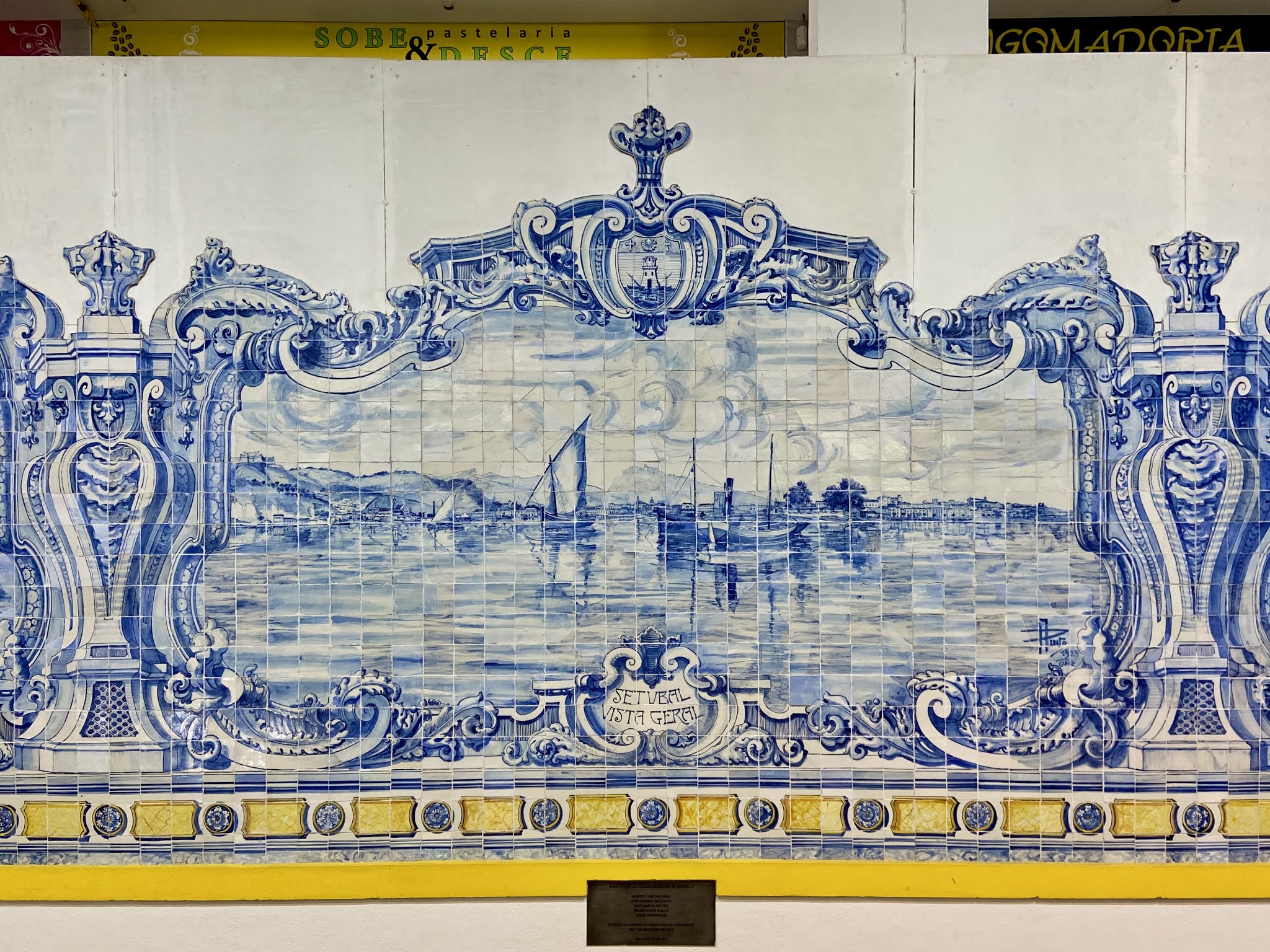
mercado is marvelous; stepping inside is like a another kind of time warp. Though everyone is masked and (generally) staying distant, the aisles are full of color and life. The central corridor is marked by larger-than-life statues of butchers and merchants, leading us back to the fishmongers's stalls in front of a stunning, building-length
azulejos panel.
The hammering from the talhos (butcher counters) around the perimeter cuts through the din of the mid-morning customers. There is abundance and diversity here: some scary-looking spider crabs, slithering eels, a colossal swordfish being trimmed into steaks. We collect some batatas doces (sweet potatoes), alcachofras (artichokes), and louro (laurel). But there are also, in the middle of December, fresh local morangos (strawberries) and lojas (stores) filled with brilliant bouquets.


Energized from our shopping, we head through the
Parque Natural da Arrábida in search of two well-known tile kilns. The first kiln is the
Cerâmica Lapidário (Quinta do Laidário Porto de Cambras) between the Arrábida and the town of
Azeitão, another oasis in the drizzle. The front court of the
quinta is simply filled with pottery, the work of a mother and father, and two daughters, so there are several distinct styles on display. When I ask about the kilns, the mother takes us to the studio on the lower level, where shocking quantities of tile panels, pots, and sculptures are warehoused – each piece unique, with its own personality.
We visited Azeitão last fall, but I was calling it São Lourenço. São Lourenço is a village of Azeitão, which is a
freguesia of Setúbal. We are very happy to return and become better acquainted with this small town.
We rediscover the narrow streets of São Lourenço, driving through to the east side of town and the Vila Fresca de Azeitão. We reach the
Leiveira-Azulejos, which is a bit more of a factory setting than an atelier. But the work is astonishing in its attention to historical processes and craftsmanship – and, again, there is so much of it around in all stages of production. Almost better than the
Museu Nacional do Azulejo, we can see how even artistically complex compositions are duplicated and manufactured. They employ a pin-hole stencil, paint-by-number, slide it in the oven system.
Behind the workshop is a charming and exhaustive showroom. The walls, tables, and cases are covered in every type of ceramic tile, and offer hours of browsing. It is hard to leave without a smile on your face, and wonder in your heart.
cases: 71,421,490 global • 16,296,344 USA • 340,287 Portugal
deaths: 1,600,477 global • 302,773 USA • 5,373 Portugal
UPDATE (December 13th): The US passed three hundred thousand COVID-19 deaths (302,773) and Georgia passed ten thousand deaths (10,031) on Friday. When last we checked the graphs,
on November 28th, it seemed that both Georgia and Portugal had hit a second wave peak, and both were headed down.
But today, Georgia's seven-day new-case average (5,919.0) is above Portugal's peak from November 19th (5,817.1); Portugal's average continues falling (3,752.9). The Y-axis has been incremented yet again.
cases: 72,553,083 global • 16,681,510 USA • 348,744 Portugal
deaths: 1,617,526 global • 305,974 USA • 5,559 Portugal