14 de Janeiro – Lisboa
My error, I now see, had been believing I was Free, that freedom had long ago been won for me. My error was in exercising a freedom I did not, in reality, possess. For in reality, I am not Free but rather Freed, a guest in the places—we might just as easily call them institutions—where freedom is professed. Hence, the many cruel things a few people said. Hence the few true things left unsaid. All those words, all that silence, and how much and how little any of it managed to change.
The Freed—people like me—descend from histories of subjugation. Violence, enslavement, forced migration, and other such acts committed in the names of men, women, and even little children whose freedom has long been accepted as an a priori condition. For the Freed—people like me—nothing that is ours defies contestation. Nothing that is ours has not, at one time or another, been regarded, handled, pocketed, and tossed begrudgingly back by the people presumed to have always been Free. (Tracy K. Smith, To Free the Captives, Knopf, 2023)
Rui selects this day for the tour, as Lisbon is in
the process of installing a series of plaques and statues that commemorate and illuminate this history. The story is otherwise hidden, as there is almost no physical evidence of the slave trade, except the population of Lisbon itself. One the way out of the Alfama, we pass two stone markers with ships of the
descobrimentos.
The tour ends at the statue of
Pai Paulino (Paulino José da Conceição), which was unveiled yesterday (January 13th); Pai Paulino was a freed slave, ironically,
a caiador (whitewasher) by trade, and a popular community and civil rights leader. This is still his community, as reflected by the many skin tones of the laughing people seated at the nearby benches, and the faces in the architectural details.


Paulino José da Conceição - Pai Paulino
Bahia, 1798 - Lisboa, 1869
Popular figure in nineteenth-century Lisbon, a freed slave born in Brazil, participated in the landing of Mindelo in 1832 as a soldier of the liberal troops and was a perpetual judge in the Franciscan Black Brotherhoods of Jesus Maria José and the Magi until 1864. The brotherhoods acted as mediators of conflicts in which Africans were involved and denounced situations of illegal slavery in Portugal. Caiador by profession made his services available in Largo de São Domingos and participated as a bagpiper in the procession of the Corpo de Cristo and in the bullfighting events of Campo de Sant'Ana.
CMC/Programa Bipzip Batoto Yetu Pt JF Sta Maria Maior 2020
15 de Janeiro – Sintra
An errand to collect paperwork for residency brings us to Sintra's
Segurança Social office. The errand itself takes no time, so we are free to explore. Near the office is the
Sintra Marmòris Palace, a gorgeous boutique hotel – the front garden is filled with peacocks, water features, and
azulejos.
Just past the center of town is the
Palácio e Parque Beister (late nineteenth century), featuring the beautiful
chalet designed by
José Luís Monteiro (also designed
Rossio train station) for Frederico Biester (German railroad-industrialist) and his wife Amélia de Guimarães Chamiço (banking family). The completion of the house dates to 1890, but by 1900 both Frederico and Amélia are gone, and
house passes to Claudina Ermalinda Chamiço – the widow of Francisco Chamiço, the founder of the Banco Nacional Ultramarino. Claudina is thus "
a mulher mais rica do reino" (
the richest woman in the kingdom).
It is
recently reopened (from April 2022) and has been on our list to see. The Cascata dos Platanos spatters as we ascend through the tangled tress and fog. Past the Parque das Merandas, the conical turret of the house comes into view.
Inside the rooms are colorful and well-scaled. On the main level is the
Biblioteca, which extends into the turret, though we can barely see. Winged chimera and vegetal motifs adorn the walls and coffered ceiling. Next, the
Sala da Música features a 'wedding cake' cornice of Gothic trefoil arches.
Through a large wooden door arch, we arrive in the
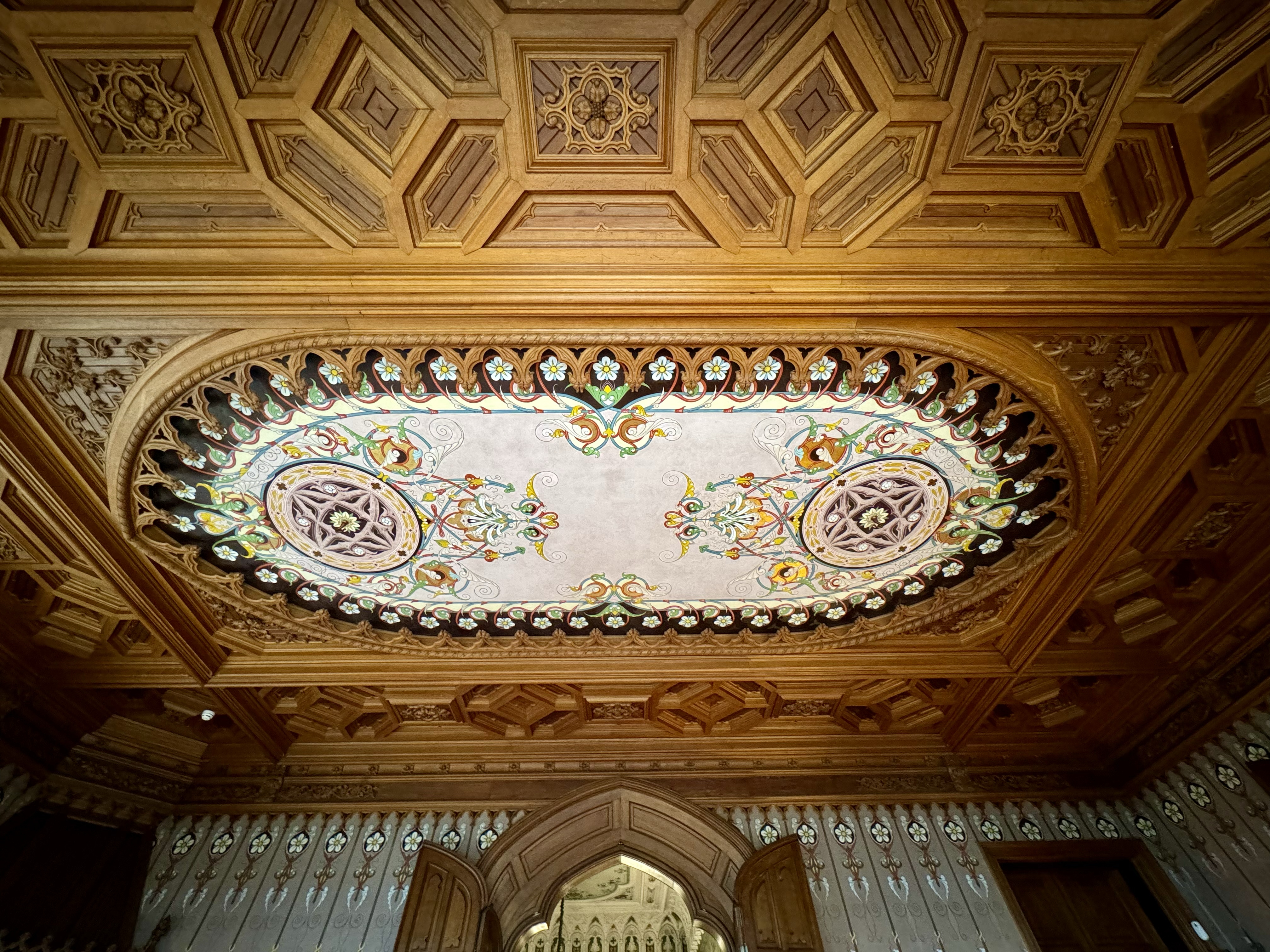
Sala de Estar. Here, the Gothic arches meet the floral wall pattern to create a vertical rhythm, matching the 'inverted trefoil' wooden rail and paneled wainscot. The oval ceiling medallion echoes these themes. The shuttered, double-arched windows and the corner fireplace complete this extraordinary room.
The
Salão de Festas is currently a dining room but is properly the ballroom. Here, a large fireplace, with its
Bordallo Pinheiro tilework, faces a large step-out bay. The walls are lined with curling vines. The built-in furnishings are a dimensional extension of the rail and wainscot seen in the Sala de Estar, providing an unexpected sense of continuity and integration.
From the Salão de Festas, we turn the corner to the
Escadaria Principal. Against expectations, the main stairway is overflowing with decoration. A wind-blown beauty greets us, sitting in a garland of roses, unaffected by the thorns. A glorious six-sided, stained glass lantern illuminates the archway. Next to the carved stairs is the
elevador.
The staircase splits two further arches, the newell post rising to form a small column. At the base of the column, a snarling dragon guards the upper levels. The
lord and
lady of the house stand on opposite sides of the upper landing holding their monograms.
The double-doors lead to an outdoor balcony. but are not in use. We step just down the hall to a sitting room, and the around into a small lobby (Sacristy?), where we enter the
Capela on a diagonal. The seating is also on the diagonal. The literature attributes the decoration of the room to
Luigi Manini, who also designed the neighboring
Quinta da Regaleira (early twentieth century).
The layout places the altar in the round turret, between two pairs of figures in stained glass. They appear to be: (left to right)
São Francisco (with stigmata),
Santa Teresa d'Ávila (book and quill),
Raina Santa Isabel (bread and roses in her apron), and
Santo António (with lilies). The glass carries the mark:
Hubert-Paris 1889, rue du Chemin Vert 47.
The cornice is again surmounted by a line of painted trefoil arches, each with a cross-roundel, and further decorated with orchids is a bubbly red edge. Above the columned arch, in a burst of stars, is the dove of the Holy Spirit. The stars radiate across to two large, painted angels, set apart by their checkerboard trim. The angel on the left holds a
naveta (incense holder) and the one on the right holds a
turíbulo (incense burner). The paintings are by
Paul Baudry.
There a number of plain bedrooms and bath rooms, but the
Quarto Principal (above the Salão de Festas) features more painted decorations: kissing doves and cherubs.
Down the service stair, we get a different view into the Salão de Festas, and note the two fantastic, neo-gothic built-in armoires that we could not see from the Sala de Estar. Continuing down, we arrive at the fully tiled Cozinha, with its enormous fireplace and stove.
We step onto the north terrace with these tangled stories, and the remarkable connections to yesterday's tour – the Banco Nacional Ultramarino. The story of this money and its 'human value' is still embodied in the Chalet Biester as well as the Quinta da Regaleira (
Carvalho Monteiro's money from coffee and mining in Brazil).
Looking up, we see the timbers form another trefoil, with dragon heads carved at the ends. The amazing details at the eaves and overhangs, and the stunning oriel window at the upstairs sitting room, it is all so, so lovely.
We explore the grounds as the fog slowly clears. An easy climb takes us to the top of the Parque and the Miradouro das Descobertas. Descending past the chalet, we encounter the Tanque das Faias, covered in more Bordallo Pinheiro tile.
At the Estufas (hothouse), we find a small cafe run by a local pastry shop,
Casa do Preto – their logo, another image connecting Portugal's past. But instead, upon a neighbor's recommendation, we buy some
travesseiros at the
Casa Piriquita.
(UPDATE, January 16) Here are images of the signage mentioned in this blogpost: