
It's a gorgeous day in Emilia-Romagna, our first full day in Parma (pop 199,598 in 2026). We head to breakfast near the Torre di San Paolo (Monumento ai Caduti, 18th century) on the Strada Camillo Benso Conte di Cavour, a lively, pedestrian shopping street and plug into the energy of the city.
Our walk takes us past art museums, the Pinacoteca Stuard (Monastero Benedettino di San Paolo, 19th century), art galleries and studios, and artists' homes. Our new neighborhood is full of vibrant colors; it's comfortable, clean, and active.
It's Sunday, but we think it'll be a good day to visit the Duomo complex, which comprises the museum, bishop's palace, and baptistery (we checked the hours last night); hopefully there's no long mass, or wedding, or obscure holy day.


Though the Piazza Duomo is crowded, the Museo Diocesano "Benedetto Antelami" is not, and makes a great starting point. The first object is "L'Angiol D'Or" (1350), the original that stood atop the Gothic torre campanaria (13th century) until 1960; it now stands in the stairwell.
We descend the stairs into a crypt-like space connected by a tunnel; we must be under the Palazzo Vescovile (11th century). "Re Salomone e la Regina di Saba" (Antelami, 13th century) greet us as we exit the tunnel, the first of several pairs of tall relief figures that once adorned the Battistero – in this case, in the wide niche on the northwest side (facing the Piazza). "I Due Profeti" (Antelami, 13th century), the prophets Davide and Abacuc, are right behind them; they would have occupied a wide niche on the northeast side. Though labelled as reliefs, these figures are almost fully in the round, and feel relaxed, present, and life-like – lacking the 'stiffness' and 'starkness' often associated with medieval sculpture.


The large gallery is filled with objects that were once in the Cattedrale, such as the remarkably sharp "Lastra con Decorazioni Fitomorfe", the pair of "Telamoni", and the "Lastra con Tralcio Abitato" (all 12th century).
Looming at the back of the gallery is the incredible "Il Mosaico del Museo Diocesano" (6th century), a paleo-christian floor mosaic unearthed from the Piazza in 1955. The Mosaico is animated with geometric patterns but includes the "Kantharos" (two-handled vase) with dolphins and fish, and a dedication to "CLARUS" and "DECENTIUS" (patrons).
Another mosaic, known as "Il Primo Mosaico" (4th century), is in the opposite corner – this was found during the same excavation though at a greater depth. The floor area around the Mosaico and between the central exhibits is covered in glass, exposing the excavated Roman walls (3rd century).


Nearby, the "Lastra com San Martino che Divide il Mantello con un Pellegrino" and the "Lastra con Sansone che Smascella il Leone" (12th century) make another nice pairing, with similar coloration and border-work.
Other marvelous pieces that had various uses in the Duomo complex, among them the "Leone" (12-13th centuries), and the "Fronte d'Altare" (6th century) which was used a flooring material in the presbytery.
The installation of the "Frammento di Sarcofago Romano 'Delle Stagioni'" (3rd century) adds a mirror so we may read the message that the entombed would also be able to read (flip horizontal, translation):
QUAT UOR HAC ARCA SANCTORUM CORPORA CLAUSASUNT ABDON SENES AC MARTIRIS HERCULIANIET CORPUS MEDIUM SACRI NICOMEDIS HUMATUMHIS EST CONIUNCTA SACRA VIRGO PUDENTIANA"how many bodies of saints are closed into this arkthere are the old Abdon and the martyrs of Herculeand the body of Saint Nicomed is buried in the middlethe holy virgin Pudentiana is joined to them")


"Gli Arcangeli Michele e Gabriele" (13th century) is the final pair by Antelami; these are from the individual niches on either side of the "Portale della Vergine" and complete the statuary sequence from the north side of the Battistero. They are however in reverse of their original positions, "Arcangelo (quadro Gabriel)" is from the left niche and "Arcangelo Michele" is from the right.
The "Arcangelo Michele" is also an example of reimpiego (reuse), since it is thought to use the body of a Roman statue (head & feet by Antelami) as evidenced by the dissimilar "pannegio bagnato" (wet drapery).
Opposite the Arcangeli are "I Quattro Leoni" (stilofori, 12th century), four lions and column bases that once supported the Cathedral's 'ambone antelamico', which included Antelami's famous "Deposizione" (see below).


An upper corridor of the Museo is adorned with vinyl prints of the Baptistery's cupola, which only serves to egg us toward the real thing across the Piazza.
The Battistero di Parma (12th-13th centuries) is octagonal in plan (we took a close look at the porte and the exterior yesterday). However, on the interior, there are sixteen sides (hexadecagon). But the eight sides are not simply split in two (that would result in a centered column). Here, the doors and the altar nicchione are centered, so there is a rotation in the structure. To stay oriented, we note the alignments by using the central register in the dome, "Cristo tra la Vergine e San Giovanni Battista; Profeti", which has the largest figures.
There are three porte (north, west, south) and thirteen nicchioni along with the altare maggiore (east). We can also find the compass points by looking for the three vertical openings. In the middle register of the cupola, a trio of full standing figures aligns with each compass point. A pair of oculi faces northwest and southeast, and a pair of rectangular openings faces northeast and southwest, shortening the images in those leaves.
Upon entering from the north, we are facing south, and the figure centered there is "Re Davide" (crown, red robe); "San Geremia" (long white hair) is on the left and "Re Salomone" (crown, blue robe) is on the right. The altare is under the "Deesis": Cristo (right hand blessing, alpha-omega book), La Vergine, (dark robes to His right), and San Giovanni Battista (brown robes to His left).


facing south from public entrance / facing east to the altare
Behind us, over the north entrance (note the fanlight) is "Barlaam" (white head-cover, pink robes), with "Mosè" (goatee, white robes) on the left and "Abacuc" (green robes, detail below). We conclude that when entering from the south, the "Portale della Vita" and the "Leggenda di Barlaam", the figure opposite in the cupola is, appropriately, Barlaam (top image).
Finally, over the west porta, is "San Daniele" (dark hair, no beard), with "Sant'Osea" (pink robes) on the left and "Sant'Amos" (green and white robes) on the right. So, we have the following landmarks:
- south: "Re Davide" ("Portale della Vita")
- east: "Cristo" (from the Deesis, altare)
- north: "Barlaam" ("Portale della Vergine")
- west: "San Daniele" ("Portale del Giudizio")
To complete the cycle, the half-height figures are: "Sant'Isaia" (southeast oculus), "Sant'Ezechiele" (southwest window), "Sant'Abdia" (northwest oculus), and "San Giovanni Evanglista" (northeast window).


facing north opposite the entrance (fanlight) / facing west to the porta
Leaving the cupola for the moment, we begin to inspect the lunette. These are the shallow half-domes over each nicchione and create a continuous, unbroken cycle. The lunette are separated from the cupola by two stories of stacked, three-bay logge; the upper level corresponds to the lowest level of the exterior logge. However, over the three porte, where there are no nicchioni, and each lunetta contains a group relief rather than an affresco with a single relief (typically an angel); this applies to the altare as well. Thus, they also mark the cardinal points.
Over the south door, is the monchromatic "Lunetta della Circoncisione di Gesù", with nine white figures on a dark background, including the Bambino Gesù and an angel. Over the altare at the east is the "Lunetta del Pantocratore" (see detail), Cristo enthroned in a mandorla with the symbols of the Quattro Evangelisti (St John's eagle, St Luke's ox, St Matthew's angel, and St Mark's lion).
Over the north door is the "Lunetta della Fuga in Egitto"; the Sacra Famiglia make their escape by night on the back of a donkey, accompanied by an angel. Over the west door is the "Lunetta di Re Davide"; as a mirror to the Pantocratore, King David, enthroned, plays his harp with other musicians. This dome incorporates a tiny backlight behind the King.


The three porte leaves thirteen nicchioni. Between the north and the south porte, there is a continuous line of seven, then three each on either side of the west porta. We start with the seven, with the altare in the middle, from left to right (north to south).
The affresco (14th century) in the nicchione next to the north porta (14th nicchione by the guidebook) includes one large panel in the upper register, the "Incoronazione di Maria", and an image of "San Michele Arcangelo" (with scales) in the lower register. The wood access panel leads to the north stairs. The neighboring nicchione (15th, northeast) appears almost bare, with only faded affreschi, though the larger "Madonna col Bambino" is still legible; the column on the right is fascinating for its 'split' shaft.
The affresco of the next nicchione (16th) also features a "Madonna col Bambino" along with San Gabriele Arcangelo, San Giovanni Battista, and the patron, Cardinal Gherardo Bianchi; the rendering of the faces here suggests the influence of Giotto. Oddly, there is a lobster just above the center of the arch; it symbolizes the astrological sign of Cancro and corresponds to Antelami's sculpture for Giugno.
The altare (1st nicchione) shows an image of the "Battesimo di Gesù", with its striking gold halos against the blue sky, though some of the facial features are faded; the column capital on the left shows "Daniele in Mezzo ai Leoni", while on the right, a lion takes down an ox.
A grainy, red marble predella forms the front face of the retable and holds a relief of San Giovanni Battista wearing his wavy, camel-hair robe (detail below).


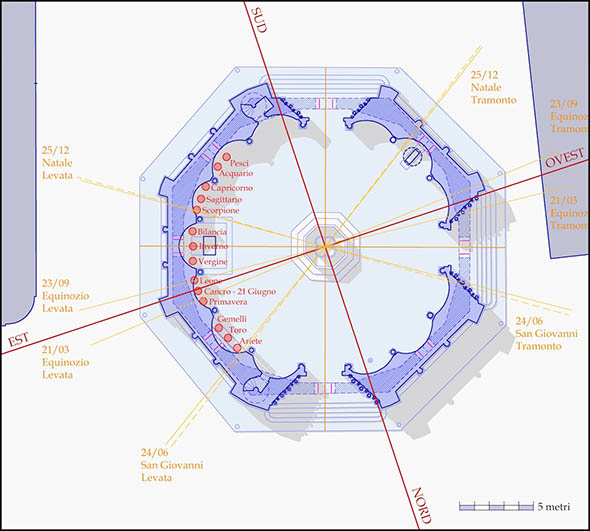
In the next (2nd), the affreschi of the "Crocifissione" above the "Madonna della Misericordia" (mercy & charity) are vibrant and uncomplicated, with a strong, symmetrical composition. The southeast nicchione (3rd) shows the "Madonna in Trono" in a glorious, late Gothic setting, adding depth to the architectural space. Three relief panels from the show "Il Tempo della Terra" by Antelami also fill that space in front of the affresco: "Febbraio" (with the fish of Pesci), "Gennaio" (with two faces, detail below), and "Dicembre" (cutting wood).
The guidebook says these panels ("I Mesi Antelamici") are usually arranged in the lower logge; they would start above the northeast ('faded' 15th nicchione) and roughly align with the embedded square reliefs just below the floor of the logge; they are at floor level for this special show. The sunlight from the cupola window activates the reliefs according to the seasons (as explained here) such that during the equinoxes (including Holy Week and Easter), the "Battesimo di Gesù" in the altar is illuminated.
The affresco in the next nicchione (4th) depicts the "Madonna del Latte" along with other saints, including "San Giovanni Battista in Meditazione" (in the wilderness) in the lower register. The riveted panel hides access to the aouth stair; this completes the line of seven nicchioni. There are three more Mesi Antelamici: "Novembre" (with an archer for Sagittario), "Ottobre" (with the symbol for Scorpione), and "Settembre" (with scales for Bilancia).
By the guidebook's counting system, the south porta is the fifth nicchione. The affresco in the next nicchione (6th) is a large scene of the "Natività di Gesù" with shepherds and angels. There are three more Mesi Antelamici: "Agosto" (with a cooper), "Lugio" (farmer with horses and grain), and "Giugno" (harvesting wheat with scythe).


To the southwest, the affreschi in the nicchione (7th) incorporates two larger panels, "Cristo Risorto" and the "Battesimo di Cristo". In the register below, we see the "Battesimo di Costantino" in a font like the one on display. The 'second' baptismal font, with carved vegetal motifs and on a stand with a lion and hare (representing the "Triumph of Christ").
In the next nicchione (8th), the primary affresco repeats the "Madonna in Trono" in the upper register and saints in the lower register, including "San Giovanni Battista", like the fourth nicchione. The final three Mesi Antelamici are here: "Maggio" (with a cavaliere), "Aprile" (holding a lily for Easter), and "Marzo" (musician with an olifante).
The west porta is the ninth nicchione, so the next nicchione is the tenth. The affreschi, in three registers, shows scenes from the "Passione di Cristo": "La Pregheira nell'Orto degli Ulivi", "La Flagellazione" (upper regiser), "L'Incoronazione di Spine", "Il Dolore di Maria", and "Cristo Sbeffeggiato dai Soldati" (middle register).
The last two figures in Antelami's "Il Tempo della Terra" show are not mesi but stagioni (seasons): "Inverno" and "Primavera". They are beautifully rendered, almost fully in the round, and seem more natural and solid than their Romanesque origins would suggest.


The northwest nicchione (11th) has an irregular quilt of affreschi, which includes: the "Imago Pietasis" (baptism in an octagonal font), the "Volto Santo di Lucca" (a vision of the Crucifixion in Lucca), and "Santa Caterina d'Alessandria" (with wheel).
The affreschi in the next nicchione (12th) features "San Giorgio a Cavalho nell'Atto di Uccidere il Drago", and in the middle register, the "Battesimo di Gesù" and the "Decollazione di San Giovanni Battista". There is also a tiny basin installed here, but the guidebook does not mention a third font beside the central octagonal font and the one in the southwest nicchione (7th).


Returning now to the cupola, we can appreciate the stunning work involved. The central panels are called, "Paradiso" (detail below), and burst in a geometric array of lossini e stelle, enclosed by a 'three-dimensional', maze-like meander.
The "Apostoli ed Evangelisti" form a ring around these stars. The most notable are the Quattro Evangelisti whose portraits take the guise of their symbols: "San Matteo" (as an angel to the east above Cristo"), "San Giovanni" (with an eagle's head to the right of San Matteo), "San Lucca" (with an ox's head to the west above San Daniele), and "San Marco" (with a lion's head to the right of San Lucca).
Additionally, "San Pietro" (with keys) is to the left of San Matteo and "San Paolo" is to the right of San Giovanni, seemingly stacking the most important saints around the Deesis.


The outer (lower) register above the pointed arches tells "La Vita di San Giovanni Battista". Orienting ourselves east to the altare and the image of Cristo from the Deesis, we realize there are windows at compass points, so the "Giovanni Batteza Gesù al Giordano" (detail below) is one panel to the left, under La Vergine. At this distance, the story is difficult to read, but the scenes are labelled in Latin, "HIC BATIÇATUR XPS".
As this is the 'middle' of the Vita if we look across to the west window, we see the Annuncio della Nascita di Giovanni" (San Gabriele Arcangelo and Zaccaria) with the caption, "PEOQUOD NO CREDIDISTIS VERBIS"; then on the other side of the west window, "NATIVITAS SCI IONIS BATISTE".
Continuing to the right, next the north window, we find the "Battesimo di Penitenza di Giovanni" (detail below), with a trio of men in a cup-like baptismal font. And in the next panel, we see the announcement "ECCE AGNUS DEI ECCE QUI" (detail below) just before the Baptism of Jesus.
To the right of the south window, we discover the "Decapitazione di Giovanni" and the "Banchetto di Erode", where Salome present the Saint's head to King Herod.


Back outside, the mid-day sun is strong, and we cross the Piazza for the residual shade near the west facade of the torre campanaria (13th century) and the Cattedrale di Parma (12th century). The lunch-hour has thinned the crowd. Up close, the stonework varies wildly, as suggested by the objects in the Museo, this has been rebuilt and amassed with pieces over time.
However, the "protiro" (porch, Giambono da Bassone, 1281) is an enchanting assemblage. The columns and upper arches appear to be in the same pink Verona marble as the Battistero, though the archivolts in the door jambs seem to be replaced with paler stone. The two popular leoni stilofori at the bases of the columns are also red and white; the white leone has captured a dragon and the red on a calf. Curiously, the guidebook says they represent "the risen Christ's overcoming evil and death". The intricately carved "portone d'ingresso" (doors, Luchino Bianchino, 1494) are signed by the artisan on the upper rail of the left-hand leaf.
The bas-reliefs in the cornice above the doors are filled with spritely grotesques. And the underside of the outer arch is populated by small figures representing the months and the town's annual activities (Nicolò, pupil of Wiligelmo, 1120) – like Antelami's Mesi. Here are some examples: (halfway up the left side) May is a horseman, June sharpens a scythe, July harvests wheat, August prepares a barrel, (face of the sun-? at the top & down the right side) October raises a glass, and January is seated with two faces.


To the right (south) of the protiro is the "Lastra Tombale di Biagio Pelicani" (c1416), a memorial containing the urn of the fourteenth century natural philosopher, mathematician, and native son. Just to the side of the door, we also enjoy the small figure emerging from the brackets under the twin column bases.
The visitors' entrance to the Cattedrale is to the left (north). The archway and the doors there are also detailed and captivating. In the capitals on the right, the beaks of the griffins meet at the corner. And on the left, mermaids float in front of lions whose head is shared by two bodies. The archivolts twist with vine-like patterns and a tongue-and-leaf course lined with dentils in the outer band.


Though pretty, the porte don't really prepare us for the interior. We step inside and the sunlight dims to a flaxen shine, filtered by the arched openings in the clerestorio and the artwork in the vaults and the gold-toned cross-ribs (Gerolamo Bedoli Mazzola, 1555-57).
There are three square major bays to the base of the stairs to the elevated chancel; each square bay is divided in half-square minor bays, with an additional minor bay to the top of the stairs – so seven bays to the crossing. The navata is separated from the aisles by semi-circular arcades with a tall triforio. But there are ample wall surfaces above and below the triforio for the incredible Mannerist fresco cycle, "La Vita di Cristo" (Lattanzio Gambara , 1567-73). Gambara renders the images with drama and, in contrast to the vaults, with a cool, flat cast; the subjects in the clerestory tympanum are in grisaille and push that distinction.
We can see the start in the upper left corner (northwest, Evangelist side) with the first three bays: the "Annunciazione dellArcangelo Gabriele a Maria", the "Adorazione dei Pastore" (Nativity), and the "Circoncisione di Gesù i l'Imposizione dei Nome". Then, turning to the right (south, Epistle side), we see the last four bays: the "Entrata di Gesù in Gerusalemme", the "Ultimate Cena", "Cristo Vienne Innalzato sulla Croce", and the "Risurrezione di Gesù".
On the back of the facade, the controfacciata, the cycle concludes with Gambara's spectacular "Ascensione di Cristo" (1571-73), with its trompe-l'œil balustrade and astonished onlookers rocked by the whirlwind.
The "Capitella della Madonna" (12th century) is a Romanesque-era detail that retains its surprising pigment.


Exploring the cappelle on the north aisle, the Capella del Sacramento (c1470) is in the third bay and features a low canopy and an image of "Cena di Gesù in Emmaus" (19th century) the statues on the facing sides represent "Fede" and "Fortezza" (19th century).
The Capella Valeri (c1423) is in the fifth bay and is covered in Gothic affreschi, top to bottom (Bartolino de' Grossi, early 15th century). The pilasters are decorated with vines and birds up to the arch, which features the portraits of eight sour-looking saints inside their own faux vaults, involving lots of personalized headgear. The interior faces add small pockets for bird-themed heraldry reliefs – possibly in honor of the Valeri family, with small allegorical frescos for the virtues, "Prudencia" (three faces" and "Iusticia".
Seven radial ribs descend from the deep blue vault and subdivide the walls into six vertical segments. THe affeschi tell the stories of the "Vite dei Santi Andrea, Catarina d'Alessandria, e Cristoforo" (for the patron and namesake saints of the family) and partly based on the "Legenda Aurea" (from yesterday's story of Barlaam). These stunning affeschi illustrate gruesome scenes of martydom.
On the left we see San Sebastiano pierced with arrows and beaten with sticks, San Andrea is crucified upside down like San Pietro; and at the near left, a woman is attacked by beasts. In other panels, there are winged beasts and sailors lost at sea. On the right we see Santa Catarina at the breaking wheel (back right), and two large scenes of decapitations, including San Cristoforo's in the lower panel. The near-right image depicts San Cristoforo's torture on the iron stool, with hot oil poured into his helmet – (ouch!) so beautiful and so violent.
The north-side cappella laterale, the Cappella di San Fermo, is roped off at the stairs, but we can zoom into the fresco of the half dome, "Mosè e il Serpente di Bronzo" (Orazio Samacchini, 1570-74), as well as the altarpiece, "La Deposizione" (Antonio Pasini, 1815). The stairs to the cripta are also roped off; a real shame since we understand some of the oldest and best artworks are down there.


As with the left transetto, the stair to the chancel is roped off, and we can't get a good, straight-on look at Correggio's 'affresco a cupola'. We can see the abside behind the altar, at a distance and angle, with the fresco of "Il Cristo in Gloria" (Mazzola, 1538-44). Cristo sits on clouds in golden light among the Arma Christi (Cross, crown of thorns, column, rope); Maria (blue robe) and San Pietro (keys) is to His right and San Giovanni Battista (pointing) and San Paolo (green robe) are to His left.
We can also make out the images in the front-facing trombe (squinches): on the left is San Giovanni Battista (with Agnus Dei) and to the right is Sant'Ilario (pastorale and scriptures). And we realize that the cross vaults are almost all trompe-l'œil – the meander under the arches, the statuary on the cornice, and the Ionic pilasters.
However, the stairs to the right-hand transetto are open. This cappella laterale is called the Capella Montini, with the corresponding 'Moses-themed' affresco by Pomponio Allegri, son of Correggio, "Mosè sul Monte Sinai" (1560-62). The apse to the south is the Cappella della Madonna della Neve and its half-dome fresco is by Cristoforo Caselli with the "Busto di Dio" (1505-06), painted to resemble a mosaic. The decorative vault overhead is by Michelangelo Anselmi (1548).
The other attraction in the south transetto is Antelami's "La Deposizione" (1178), the final piece in the "Il Tempo della Terra" show. This is the primary panel from the old 'ambone antelamico' (along with I Quattro Leoni from the Museo) and one of Antelami's earliest works. It lacks the naturalness and ease of the later pieces, like I Mesi, but the fullness and the craftsmanship are readily apparent, as well as the emotion. The background is filled with vegetal patterns and Latin script:
ANNO MILLENIO CENTENO SEPTVAGENO:OCTAVO SCULTOR PAT (RA)VIT MEN)SE SECU(N)DOANTELAMI DICTUS SCULPTOR FUIT HIC BENEDICTUS
The snapshot is taken from Cristo's being removed from the Cross. The angel on the left is helping Giuseppe d'Arimatea hold His one loose arm, while Nicodemo climbs the ladder on the right to remove the other nail. The angel on the right holds the head of the female figure as she prays in sorrow. Four seated soldiers on the right cast lots for His robe. The wreathed faces at the far left and right are the sun (male) and moon (female), and the unusual cornice with the snail shells is also worth noting.


From the south transetto, we finally can look at the "L'Assunzione della Vergine" (Antonio Allegri da Correggio, 1526-30); keep in mind that, for the images below, the navata is to our left (west) and the altare maggiore to our right (east). Cristo arrives to accompany Maria (pink & blue robes) but unexpectedly descends feet-first while looking down (other sources say this is San Gabriele Arcangelo ascending). A mob of putti envelop and lift Her up, creating a massive swirl of bodies, twisted clothes, and mist; the upward perspective and foreshortening is utterly convincing.
Turning the scene and remember our previous view, Maria is just left of center from the navata and Cristo just right of center (a black dot is center of the cupola); we could not see Cristo from the bottom of the stairs. Eight oculi light the drum of the dome and become part of the trompe-l'œil balustrade, as the Apostoli look on in amazement. San Tommaso (red cape & staff) and San Bernardo (grey robes & pastorale) are visible in the west trombe, thus completing a quartet of Parma's patron saints.
We can also see across to the north chapel of the north transetto and find Samacchini's other half dome, "Mosè che fa Ccaturire l’Acqua dalla Rupe" (1570-74), as well as "L’Assunzione della Vergine" (Giambattista Tinti, 1589-1591).


Walking now westward, we investigate the cappelle along the south aisle. In the fifth bay is the Cappella Centoni (c1465). The affreschi in the lower register are in grisaille and tell the "Vita di Sant'Antonio Abate"; the two upper panels are in color and tell the "Fatti della Passione di Gesù" with the Crocifissione centered between the windows (Francesco Maria Róndani, 1530).
The base of the cross seems to carry right into the altar paintings, the "Madonna col Bambino, Santi Antonio Abate e Paolo" and "Santi Antonio Abate e Catarina d'Alessandria" in the altar front (Alessandro Araldi, 1516).
The Cappella del Comune (c1411-17) is in the fourth bay, and the affreschi depicts the lives of San Fabiano (left side) and San Sebastiano (right side, de' Grossi, early 15th century).
The Cappella del Comune (c1411-17) is in the fourth bay, and the affreschi depicts the lives of San Fabiano (left side) and San Sebastiano (right side, de' Grossi, early 15th century).


In the third bay, the Cappella dei Caduti is dedicated to the fallen of World War I. At the center is "Il Re dei Re" (Biagio Biagetti, 1922), the rare contemporary image in the building. Formerly the Cappella Baiardi, the affrechi are detailed and weathered to blend the images of 'modern' soldiers and attendants with the artwork in the adjacent chapels.
Similarly, the affrechi of the neighboring Cappella Cantelli are from the nineteenth century (Girolamo Magnani, 1881-82). They are in a Neo-Byzantine style but feel over-saturated, though any freshly executed frescos would obviously appear clear and bold.


Before we leave, we stop for a good long look at gli affreschi rinascimentali and especially Gambara's "Ascensione di Cristo". The 'hot spot' from the south-facing windows is now below the triforio and the spatial effect of the dim faux-gallery is unmistakable, with the shadows of the logge and the upper cornice line adding to the illusion. The large figures at ground level and the painted architecture present as if to match the adjoining arcades' they underscore, 'this area is part of the building and the area above is not'.
Then studying the large figures, we meet another set of figures behind the figures, as if to say, 'okay, those weren't real, but this back here is real'. And there are more (painted) attendants standing behind either side of the (real) curtain, looking down at the 'inside leoni' that have rematerialized from the 'outside leoni'.
The stained-glass in the transom light and the arched window pile on the confusion – where the art hardens the surface, where the art dissolves the surface, where the actual surface dissolves, and where the surface dissolves into art.


Back in the real world, Parma continues to enchant with the theaters, the churches, even the post office. But we can think of few art and architecture experiences that are as moving as Il Duomo di Parma (Museo, Battistero, & Cattedrale) – the Sagrada Familia comes to mind, and the Exeter Library. Locally, Modena's Cathedral and Bologna's Santo Stefano are also up there, too.
We love visiting these churches and civic institution because they are an investment by the locals, and by some craftspeople, often over quite a long time. They are all beautiful and impactful in their way, but there is a shortlist. Some places tell touching stories, some showcase amazing artistry, and some hold a place in history. And other places are just loved, used, and are part of a community. Very few buildings or places do all these things.



No comments:
Post a Comment