Friday, October 11, 2013

Trip to Europe - Part 5: The Uffizi Is Really Big

More rain in Florence today, so we spend the day indoors wandering around the Uffizi. No pictures allowed. We walk up to the second level (that's the third level for us Americans - Europeans don't count the ground level),  and even that's a chore. The scale of this place is nuts.

We arrive in a long, wide corridor lined with sculptures, the ceilings all decorated with fancy little paintings. Turn into the first gallery room and you are immediately greeted by Giotto's Madonna and Child, and that is also way bigger that expected. Next to that is a smaller, five-panel piece known as the Polittico. There are other pieces, but the two by Giotto really stand out (below is a linked third party picture).


Then begins the wander: gallery after gallery of Early and High Renaissance alter pieces, portraits, and other panels. We wander, separate, rejoin and continue on. The Botticelli Room is certainly a highlight, as it is by far the largest gallery room except the sculpture corridor: the Venus dominates one wall, and the Primavera another (again, a found picture).


The wandering continues for about three and a half hours before we all tire and make a dash through the last few galleries (sorry Caravaggio fans). In all, we walk just less than three miles.

We end the day back at San Lorenzo, and Brunelleschi. It is a gorgeous cathedral, with a flat coffered ceiling and a wonderful gold dome at the center of the cross plan. We especially enjoy the Old Sacristy (yet another borrowed image below) with the simple, banded main dome - and the unusual dome with constellations above the adjoining alcove. It's a wonderful comparison to the New Sacristy by Michelangelo, and a wonderful way to end our sightseeing.


Thursday, October 10, 2013

Trip to Europe - Part 4: The Oltrarno


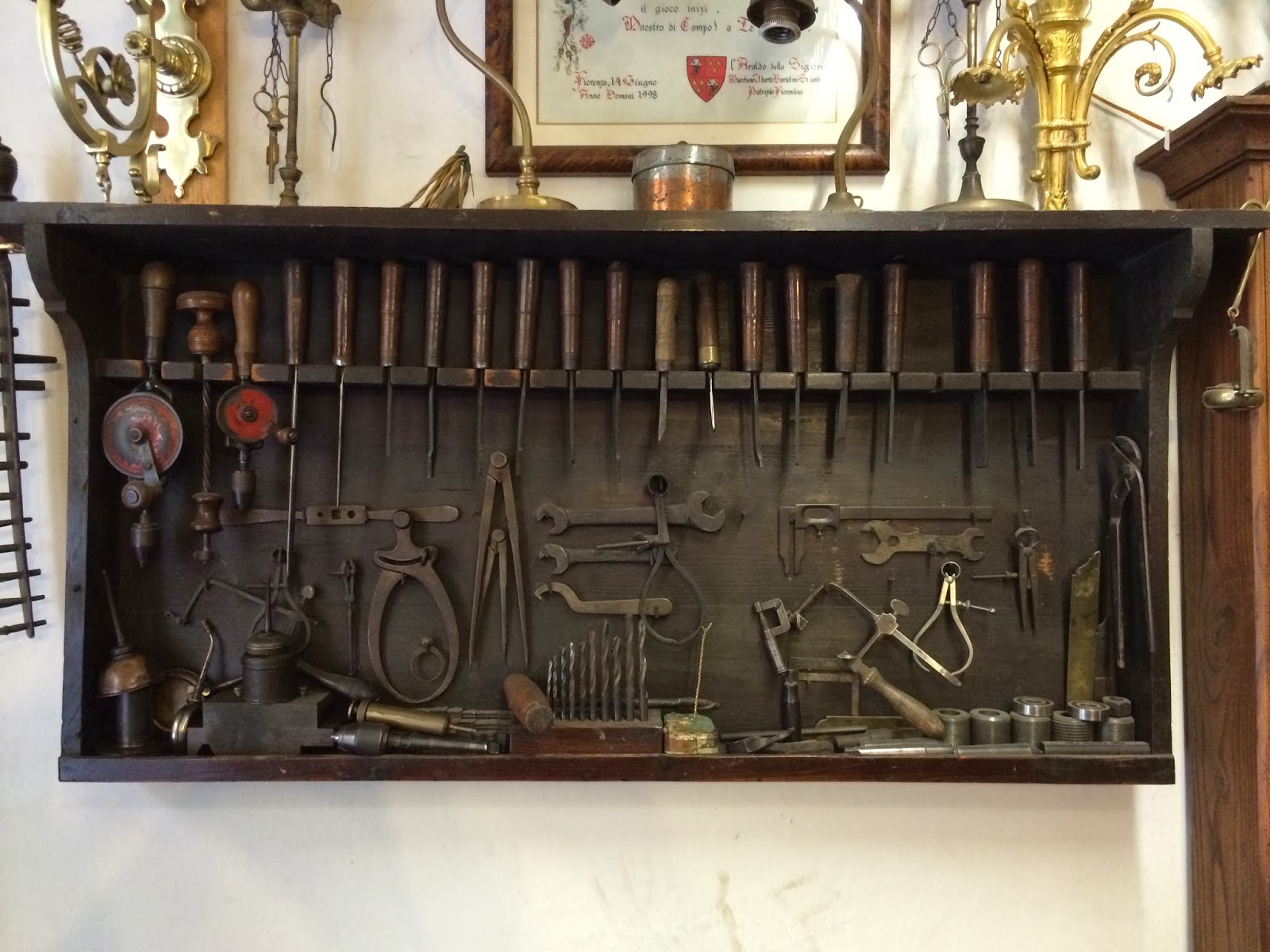
On the southern bank of the Arno is the Oltrarno, though really it feels like all the same city to me. We start the day with a brisk walk to Santa Maria del Carmine. The Oltrarno, we are told, is home to many artisans and craftspeople. We happen into the shop of one such person, a metal smith specializing in brass and the inheritor of a multi-generation family practice. His shop is clean and kept, as is the man himself. His tools have the gravitas of an authentic patina of work; they are as interesting as his handiwork. A small frame costs about $400. We are truly appreciative, but we move on.


We soon arrive at he Brancacci Chapel, a wonderful alcove in one corner of the cathedral that holds a cycle of frescoes primarily by Masaccio. Access to the chapel is thru a convent designed by Brunelleschi, one of many we've seen already. Remarkable for their simplicity and clarity, the frescoes have colorful warmth and amazing life. Our art history books are coming alive.


Then, we catch a city bus to San Miniato al Monte, a gorgeous little thing on the top of the hill overlooking the river and the city beyond. Fantastic. But the real treat here, it turns out, is the church: carefully decorated wood trusses, and column bays arranged in triads. It is full of amazing rhythms and patterns. At the far end from the entry, there is a mezzanine for the priest and choir, and a crypt below for "former" parishioners. In fact the whole church seems to be surrounded by a cemetery, laid within the walls and battlements of an old Roman fort.


We descend from the sacred to the profane - they have jammed a copy of David into a parking lot, surrounded it with food trucks and call it Piazzale Michelangelo. A wonderful view of the city, and you can buy it on a plate.


Another short bus ride to the Porta Romana, we hit the art school crowd - literally, as hordes of art students from the nearby art academy jam their way on as we depart. We walk down the Via Romana, which appears on the map to be a major roadway, but is actually a thin strip where tourist buses go wizzing by narrow side walks. We try to walk quicky (though a pizza shop delays our progress).

We soon reach the Palazzo Pitti and the Boboli Gardens; we want to see the gardens. Not sure why, but I am picturing fun sculptures and flower beds, manicured greens and lively structures. Arriving in a large, grassy amphitheater surrounded by sculptures, my hopes rise. But beyond the formal area behind the palazzo, we get a (very) big, (very) hilly forrest with a few big boulevards cut through. The place is just enormous. And hilly. There are a few fun sculptures and a few fountains, but not really much more to see, and the distance is just tiring.


We finish the day at dinner, at a trattoria near the Brancacci Chapel. I have one a truly memorable meals: artichoke salad, Florentine streak, chocolate mouse at Pandemonio. Over ten miles of walking, but we leave the Oltrarno smiling.

Tuesday, October 08, 2013

Trip to Europe - Part 3: Brunelleschi and Michelangelo


The day starts early, and sunny, but with some anxiety of more rain. We get to the reserved ticket queue (we have city-wide passes) for the ascent to the Cupola at the top of the Duomo only to find that we need tickets - you get those at "number seven on your right" (so says the guard). So we convert the passes into tickets and return to begin the climb.


It starts out with a basic stone stair case, with wonderful small view holes along the way. And it goes on for a while.


After some minutes, you reach the base of the dome, and you cross the interior of the cathedral on the inside, via a gallery at the base of the fresco by Vasari - though you're right up close it's very hard to see cause the gallery is very narrow and the angle is very difficult.


Using the gallery to get from one side of the dome to the other, you then take a set of tight, spiraling stairs that untwist for a while, the re-twist.


The view holes do re-appear, however, and the sights are starting to look real good. I'm not sure what the fork is supposed to do, but there is one at each opening.


Then the stairs start to get steep, and then worse, they flatten out into ladder-like paths. You need the railings at this point, but it's not terribly difficult.


Up the last short flight to this:


You can see the Palazzo Vecchio on the left, and the Piazza della Republica (and our hotel) closer to the center. The Campanile is in the middle, and that's San Lorenzo on the right.

We spend the rest of the morning at Santa Maria del Fiore: the cathedral and the baptistry are both full of interesting details.

We then go to spend some time with Michelangelo - first at the The Academia Gallery to see the "unfinished marbles" and the original David. No pictures allowed, but we really enjoy the galleries (very crowded!). The David is bigger than you think, way up on a plinth, and protected by a clear surround; the others marbles are surprisingly intimate.

Next, to the New Sacristy at the Medici Chapel - again, no pictures allowed (but I've added some from other sources). The Medici Chapel itself is under reconstruction, and is a hodge-podge scaffolding and strange geodesic rooms. The dark stone chapel is a visual mess compared the the Sacristy, with it's clean lines and beautiful coffered dome.


We end the day with Brunelleschi again, and the Pazzi Chapel. A wondeful contrast in its simplicity and clean geometry.


The Chapel itself is at the end of a courtyard a feels almost like a (very) large garden structure, as it is basically empty with a kind of dirt floor. The light within is amazing.


[ <<< Back to Part 2 ] [ On to Part 4 >>> ]

Monday, October 07, 2013

Trip to Europe - Part 2: Walking in the Rain in Florence


We used up all our good weather in Amsterdam; we walk eight miles through light and heavy showers. Luckily, we can rest in our rooms at the south end of the Piazza della Repubblica, with a knock-out view of the Duomo and the Campanile of Santa Maria Fiore. We meet our friends Peter and Pam, also celebrating an anniversary, and spend the day getting to know the Old City.


Florence is easily the most beautiful city I've every visited. The streescapes are full of colors and texture: narrow alleys open into wide piazzas, tall vistas end with archways and obelisks. We start at the Duomo, entering the piazza near the Baptistry, the shapes and towers are layered upwards. It's very hard to capture the colors of the stone in the clouded light.


The cornice gallery of the dome itself appears to be half apart; Peter and I wonder at exactly how such a dismantling is achieved when we find the one section of the archway still intact at the base of the tiles (Later we find out from old pictures that the cornice was never completed). It's also hard to capture the scale, but of course, that strucure is enormous - how did they get all that stone up there?


The cathedral and the surrounding buildings are a bit of a surprise; the church does not stand as an object in the square, but forms the sides of a series of long, wide, and winding streets. Crowds form a series of perpetual queues to enter the Duomo, enter the Baptistry, or climb to the cupola.


From the Duomo, we walk to San Lorenzo, and take refuge in the courtyard during a downpour. The market stalls surrounding the cathedral also provide some protection as we try to move ahead.


We then walk to Santa Maria Novella, a beautiful facade fronts a large open piazza. Donna insists we visit the pharmacy around the corner, and we are amazed to find one the most stunning retail spaces you might ever wish to see.


We cross the Arno just ahead of another deluge, and make our way slowly, dodging raindrops: Santa Maria del Carmine, Santo Spirito, the Palzzo Pitti. We stop for gelato before we cross back over the Ponte Vecchio, surprisingly intimate compared to some other sites of the city.


We finish our walk down the arched gallery along the Arno, through the courtyard of the Uffizi and into the Piazza della Signoria, with the statue of David at the base of the Palazzo Vecchio. We had hoped to spend the day getting to know Florence. Our feet are soaked, but our hearts are full.

Trip To Europe - Part 1: The Flavours of Amsterdam


Twenty years late, Donna and I are off to Europe for our honeymoon. Though we did have an actual honeymoon to Block Island, it was our dream to go to Florence - so we are finally fulfilling that dream for our twentieth anniversary.

Our first stop is a ten-hour layover in Amsterdam to visit with Emily and Arjen, who are newly married in August. The "flavour of Amsterdam" is lively and beautiful: incredible variety in the colors and geometries. Perhaps the one over-riding impression is that of too many vehicles, and paths for those vehicles - cars, canals, bikes, boats, buses, scooters, street cars. And lots of each.


Our day starts with a tram to the Rijksmuseum; we walk through the building, as we simply don't have time on this trip to wander the galleries, targeting instead the Van Gogh Museum. The Van Gogh is a treat, with an intimate look at a single artist. A good view does not take too long, and we are soon outside walking the city.


It's wonderful to see Emily and Arjen, and it's such a treat to have a real vacation. We are lucky to have have such a beautiful late summer Sunday together. But a short layover probably doesn't do Amsterdam justice. Our plans allow only a quick taste.

[ On to Part 2 >>> ]

Sunday, February 03, 2013

Culture Hunting

I'm avoiding the Super Bowl today. I'm not at the same level in terms of football as I am for baseball, and my teams dropped out of the playoffs is the championships (The Pack and Pats). So while I'm cleaning the house - I'm taking breaks.

I have a few favorite jumping off points for wandering the internet. The Verge is a great technology blog and podcast - the tagline is that it's about technology-culture and culture-culture. Digg was an old favorite that was growing stale, but was relaunched and has, recently, provided many a great starting links. All Things D is the New York Times tech blog, and has a Must Read section which aggregates tech writing from others. So where did I end up?

About a year ago, Google launched a video aggregator along the lines of TED - it's called Solve for X, which is full of inspiring techie video presentations. The one that I connected yesterday was by Anthony Sutera, who may lack something in the area of charisma, but his company's research and product sure sound pretty cool: "The nanoparticles in the spray act as nanocapacitors that work without producing the heat waste that make normal antennas less efficient." I've been having no end of problems with the Wi-Fi at the Museum and can only imagine how we might increase the efficiency of our wireless tech while minimizing the impact on our urban landscape and architecture.


I had found Solve for X some months ago when a TED Talk by Max Little was cross-posted there - a video about how to test for Parkinson's Disease by making a phone call. Which got me thinking about my Dad, which got me thinking about where we might go on our next outing, which got me thinking about Taiwanese food - I'm hoping to try Street Food in San Mateo. Then I caught a bit of an interview with Eddie Huang on NPR and found this series of video about Taiwanese street food called Fresh Off the Boat (FOB - NSFW warning):


I truly enjoyed the videos, crude as they were, and I loved the pay-off in the third part where Eddie and his Dad get some food, play some basketball, and visit his grandfather's tomb. Eddie has a Taiwanese street food place in New York call Baohaus, where he makes pork buns and other specialties.

My friend Peter has a license plate that says BOWHAUS, cause his dogs are often passengers in his mini-van. We were were in Boston in December, we had a great lunch at Myers + Chang in the South End, a Taiwanese-Asian-fusion place that we really enjoyed. While watching the FOB video embedded above, he sent me the car video embedded below - and recalling his penchant for Dan Dan noodles, I sent him the FOB link. I'm afraid he did not enjoy the Eddie Huang show. Oh well.


We're planning a trip to Italy, and Peter wants to take a side trip to Maranello to visit the Ferrari Museum. The Ferrari video reminded me that the Audi TT Car Club is about to shut down. It's been about a decade since I started posting there and almost nine years since I bought the TT. When the shutdown notice went up, I took a few minutes to go through some of my old posts and remember all the conversations and the community we had there. A bit sad, but the TT marches on.

I thought back on my time at the Larz Anderson Auto Museum and how that got me into teaching. How the teaching moved me to Berkeley, and then I ended up back in a museum in Oakland. We are working on a refresh of our web site, so I am constantly on the lookout for cool museum web sties - and this one is a way up there:


It's about how technology can extend the art experience, and create something similar enough and different enough that it is a complimentary thing. It's about collecting culture, high culture or low culture, and sharing those stories - which is not all that different than car experiences or food experiences.

Friday, December 21, 2012

The End of Time


It's the last day of civilization, and there are a few things I'd like to get off my chest.

First, let me credit The Verge for this article. There are a lot of doomsday articles out there, but this one allows the voices of the survivalists to come though without too much bluster - they are not voices that I take seriously, but they are interesting voices. Two things that I truly enjoyed: 1) the comments made by Larry Hall at about the 5:30 mark, affirming his belief that climate change is the result of the cyclical movement of our solar system through the Milky Way - the evidence is in the ice core samples, and 2) at 11:50, the walk we take with Edward Peden down a long corrugated steel tube to a doorway with faux stonework, porch lights, and a brass knocker - I'm trying to picture someone using that knocker.

"Hey Edward. It's me. I brought pie."


I don't believe in paying for TV, so I get all my stations over the air. When we moved to Berkeley, one of the first local images I saw was Harold Camping's, the guy who infamously predicted the end of the world on May 21, 2011. His broadcast company, Family Radio, ran (runs) a local TV station on which he would sit and sermonize to the camera; and since the East Bay is home base to his company (and him) we got rather a full dose of his nuttiness. Though he now admits he was wrong regarding the end of days, I'm thinking he may have really helped ease the panic and drama that the world might have felt today had we not already experienced an appointment with the apocalypse.

Anyway, I've been considering him today. While the Mayans are all gone, this guy is still around, still living with the thought that he was completely wrong about something he sold as a certainty. It's one call you don't want to get wrong; he did not have the foresight to pick a date beyond his lifetime.


At the Museum here in Oakland, we have an installation called Aristotle's Cage by Michael McMillen. Enter a small, dark room through a tattered screen door, and a diorama is presented behind a wire cage: in the foreground is a small trailer with an intense internal light, cars and debris are purposefully stacked into the distance, a far-off tiny town and the mountains beyond glow with the red dawn, and hovering above are the skeletons of a man and a dog. You hear the faint tones of a fuzzy radio.

The Museum provides a single wooden chair in the small viewing space, and when the Museum is quiet, I like to sit there in secret and silent isolation; it's a great place to answer email.


I don't think it's ironic that the world should end during the holidays, astronomical and prophetic days. Plus, I guess folks will be in a better mood, so that works out. I like the way music selections that you hear in stores, on TV, and even around the office suddenly shift for Christmas. It's an artificial mood shift delivered on airwaves and PA systems everywhere. I've decided that  What Child is this? / Greensleeves by the Vince Guaraldi Trio is the best holiday song ever. I like the solemn melancholy and the thoughtfulness of the show, A Charlie Brown Christmas, and this song seems to sum it up. Digging into the recording's history, we learn that the longer Greensleeves track was an alternate take added to the soundtrack re-release in 1988, which appears to be the version of the album I have. Digging further, we find that the original lyrics for Greensleeves list (possibly) the protestations of a man rejected by a prostitute. Take that Handel.

I'm not familiar either set of words, and that helps me, perhaps, sense the spirit of the song. Maybe that's why I tire so quickly of other Christmas songs. The words are running through my head: flying reindeer, talking snowmen, and fat elves making toys, who have all conflated "holy" with "magical" and have been endowed by their savior Jesus Christ with these incredible holiday super powers. Those are the worst.