Monday, October 07, 2013

Trip to Europe - Part 2: Walking in the Rain in Florence


We used up all our good weather in Amsterdam; we walk eight miles through light and heavy showers. Luckily, we can rest in our rooms at the south end of the Piazza della Repubblica, with a knock-out view of the Duomo and the Campanile of Santa Maria Fiore. We meet our friends Peter and Pam, also celebrating an anniversary, and spend the day getting to know the Old City.


Florence is easily the most beautiful city I've every visited. The streescapes are full of colors and texture: narrow alleys open into wide piazzas, tall vistas end with archways and obelisks. We start at the Duomo, entering the piazza near the Baptistry, the shapes and towers are layered upwards. It's very hard to capture the colors of the stone in the clouded light.


The cornice gallery of the dome itself appears to be half apart; Peter and I wonder at exactly how such a dismantling is achieved when we find the one section of the archway still intact at the base of the tiles (Later we find out from old pictures that the cornice was never completed). It's also hard to capture the scale, but of course, that strucure is enormous - how did they get all that stone up there?


The cathedral and the surrounding buildings are a bit of a surprise; the church does not stand as an object in the square, but forms the sides of a series of long, wide, and winding streets. Crowds form a series of perpetual queues to enter the Duomo, enter the Baptistry, or climb to the cupola.


From the Duomo, we walk to San Lorenzo, and take refuge in the courtyard during a downpour. The market stalls surrounding the cathedral also provide some protection as we try to move ahead.


We then walk to Santa Maria Novella, a beautiful facade fronts a large open piazza. Donna insists we visit the pharmacy around the corner, and we are amazed to find one the most stunning retail spaces you might ever wish to see.


We cross the Arno just ahead of another deluge, and make our way slowly, dodging raindrops: Santa Maria del Carmine, Santo Spirito, the Palzzo Pitti. We stop for gelato before we cross back over the Ponte Vecchio, surprisingly intimate compared to some other sites of the city.


We finish our walk down the arched gallery along the Arno, through the courtyard of the Uffizi and into the Piazza della Signoria, with the statue of David at the base of the Palazzo Vecchio. We had hoped to spend the day getting to know Florence. Our feet are soaked, but our hearts are full.

Trip To Europe - Part 1: The Flavours of Amsterdam


Twenty years late, Donna and I are off to Europe for our honeymoon. Though we did have an actual honeymoon to Block Island, it was our dream to go to Florence - so we are finally fulfilling that dream for our twentieth anniversary.

Our first stop is a ten-hour layover in Amsterdam to visit with Emily and Arjen, who are newly married in August. The "flavour of Amsterdam" is lively and beautiful: incredible variety in the colors and geometries. Perhaps the one over-riding impression is that of too many vehicles, and paths for those vehicles - cars, canals, bikes, boats, buses, scooters, street cars. And lots of each.


Our day starts with a tram to the Rijksmuseum; we walk through the building, as we simply don't have time on this trip to wander the galleries, targeting instead the Van Gogh Museum. The Van Gogh is a treat, with an intimate look at a single artist. A good view does not take too long, and we are soon outside walking the city.


It's wonderful to see Emily and Arjen, and it's such a treat to have a real vacation. We are lucky to have have such a beautiful late summer Sunday together. But a short layover probably doesn't do Amsterdam justice. Our plans allow only a quick taste.

[ On to Part 2 >>> ]

Sunday, February 03, 2013

Culture Hunting

I'm avoiding the Super Bowl today. I'm not at the same level in terms of football as I am for baseball, and my teams dropped out of the playoffs is the championships (The Pack and Pats). So while I'm cleaning the house - I'm taking breaks.

I have a few favorite jumping off points for wandering the internet. The Verge is a great technology blog and podcast - the tagline is that it's about technology-culture and culture-culture. Digg was an old favorite that was growing stale, but was relaunched and has, recently, provided many a great starting links. All Things D is the New York Times tech blog, and has a Must Read section which aggregates tech writing from others. So where did I end up?

About a year ago, Google launched a video aggregator along the lines of TED - it's called Solve for X, which is full of inspiring techie video presentations. The one that I connected yesterday was by Anthony Sutera, who may lack something in the area of charisma, but his company's research and product sure sound pretty cool: "The nanoparticles in the spray act as nanocapacitors that work without producing the heat waste that make normal antennas less efficient." I've been having no end of problems with the Wi-Fi at the Museum and can only imagine how we might increase the efficiency of our wireless tech while minimizing the impact on our urban landscape and architecture.


I had found Solve for X some months ago when a TED Talk by Max Little was cross-posted there - a video about how to test for Parkinson's Disease by making a phone call. Which got me thinking about my Dad, which got me thinking about where we might go on our next outing, which got me thinking about Taiwanese food - I'm hoping to try Street Food in San Mateo. Then I caught a bit of an interview with Eddie Huang on NPR and found this series of video about Taiwanese street food called Fresh Off the Boat (FOB - NSFW warning):


I truly enjoyed the videos, crude as they were, and I loved the pay-off in the third part where Eddie and his Dad get some food, play some basketball, and visit his grandfather's tomb. Eddie has a Taiwanese street food place in New York call Baohaus, where he makes pork buns and other specialties.

My friend Peter has a license plate that says BOWHAUS, cause his dogs are often passengers in his mini-van. We were were in Boston in December, we had a great lunch at Myers + Chang in the South End, a Taiwanese-Asian-fusion place that we really enjoyed. While watching the FOB video embedded above, he sent me the car video embedded below - and recalling his penchant for Dan Dan noodles, I sent him the FOB link. I'm afraid he did not enjoy the Eddie Huang show. Oh well.


We're planning a trip to Italy, and Peter wants to take a side trip to Maranello to visit the Ferrari Museum. The Ferrari video reminded me that the Audi TT Car Club is about to shut down. It's been about a decade since I started posting there and almost nine years since I bought the TT. When the shutdown notice went up, I took a few minutes to go through some of my old posts and remember all the conversations and the community we had there. A bit sad, but the TT marches on.

I thought back on my time at the Larz Anderson Auto Museum and how that got me into teaching. How the teaching moved me to Berkeley, and then I ended up back in a museum in Oakland. We are working on a refresh of our web site, so I am constantly on the lookout for cool museum web sties - and this one is a way up there:


It's about how technology can extend the art experience, and create something similar enough and different enough that it is a complimentary thing. It's about collecting culture, high culture or low culture, and sharing those stories - which is not all that different than car experiences or food experiences.

Friday, December 21, 2012

The End of Time


It's the last day of civilization, and there are a few things I'd like to get off my chest.

First, let me credit The Verge for this article. There are a lot of doomsday articles out there, but this one allows the voices of the survivalists to come though without too much bluster - they are not voices that I take seriously, but they are interesting voices. Two things that I truly enjoyed: 1) the comments made by Larry Hall at about the 5:30 mark, affirming his belief that climate change is the result of the cyclical movement of our solar system through the Milky Way - the evidence is in the ice core samples, and 2) at 11:50, the walk we take with Edward Peden down a long corrugated steel tube to a doorway with faux stonework, porch lights, and a brass knocker - I'm trying to picture someone using that knocker.

"Hey Edward. It's me. I brought pie."


I don't believe in paying for TV, so I get all my stations over the air. When we moved to Berkeley, one of the first local images I saw was Harold Camping's, the guy who infamously predicted the end of the world on May 21, 2011. His broadcast company, Family Radio, ran (runs) a local TV station on which he would sit and sermonize to the camera; and since the East Bay is home base to his company (and him) we got rather a full dose of his nuttiness. Though he now admits he was wrong regarding the end of days, I'm thinking he may have really helped ease the panic and drama that the world might have felt today had we not already experienced an appointment with the apocalypse.

Anyway, I've been considering him today. While the Mayans are all gone, this guy is still around, still living with the thought that he was completely wrong about something he sold as a certainty. It's one call you don't want to get wrong; he did not have the foresight to pick a date beyond his lifetime.


At the Museum here in Oakland, we have an installation called Aristotle's Cage by Michael McMillen. Enter a small, dark room through a tattered screen door, and a diorama is presented behind a wire cage: in the foreground is a small trailer with an intense internal light, cars and debris are purposefully stacked into the distance, a far-off tiny town and the mountains beyond glow with the red dawn, and hovering above are the skeletons of a man and a dog. You hear the faint tones of a fuzzy radio.

The Museum provides a single wooden chair in the small viewing space, and when the Museum is quiet, I like to sit there in secret and silent isolation; it's a great place to answer email.


I don't think it's ironic that the world should end during the holidays, astronomical and prophetic days. Plus, I guess folks will be in a better mood, so that works out. I like the way music selections that you hear in stores, on TV, and even around the office suddenly shift for Christmas. It's an artificial mood shift delivered on airwaves and PA systems everywhere. I've decided that  What Child is this? / Greensleeves by the Vince Guaraldi Trio is the best holiday song ever. I like the solemn melancholy and the thoughtfulness of the show, A Charlie Brown Christmas, and this song seems to sum it up. Digging into the recording's history, we learn that the longer Greensleeves track was an alternate take added to the soundtrack re-release in 1988, which appears to be the version of the album I have. Digging further, we find that the original lyrics for Greensleeves list (possibly) the protestations of a man rejected by a prostitute. Take that Handel.

I'm not familiar either set of words, and that helps me, perhaps, sense the spirit of the song. Maybe that's why I tire so quickly of other Christmas songs. The words are running through my head: flying reindeer, talking snowmen, and fat elves making toys, who have all conflated "holy" with "magical" and have been endowed by their savior Jesus Christ with these incredible holiday super powers. Those are the worst.

Saturday, September 01, 2012

Red Sox Hit Bottom

Eventually, a test of allegiance becomes a celebration of Sisyphusian suffering. Red Sox fans too young to remember the lessons of the 1980's and 1990's, who became fans during the easy glory of the 2000's, should now "get it". Yes, October 20, 2004 was a great night, but mythic misery has always been part of what it means to be a Red Sox fan - and last night's game was a powerful dose.
Exercise: Sit in an opposing ballpark and score a defensive half inning during which your team's pitchers allow nine runs to nine opposing batters, while recording no outs.
Extra Credit: Execute above Exercise while sitting with loud, slightly drunk (possibly high?), and suddenly cocky, opposing fans.
Last night was "the" last night, and one of the worst nights, in a year that began on September 1, 2011, when the "greatest ever" Sox were 31 games over 500, and owners of a 1.5 game lead in the AL East. Their epic 2011 collapse has been cataloged by many others, but as an eyewitness, I can tell you how the Red Sox completed a horrible night (L, 20-2), capped a truly horrible month (9-20), and ended an historically horrible year of baseball (.615 to .434 win pct).

Dire Forecasts. The Boston Red Sox arrived in Oakland after suffering a sweep in Los Angeles, of Anaheim. The Athletics returned from a 6-1 road trip, and a four-game sweep of the Tribe in Cleveland. One other team joined them on the field - the Petaluma Little League Allstars, recently feted by folks far and near for their stunning ten-run, last-inning rally in the US Championship game. Losers. Winners. Losers who felt like winners. Their gathering was a prelude.

The Quiet. The pitchers were Cook (BOS) vs. McCarthy (OAK). The first two Red Sox batters, Podsednik and Pedroia reached on singles. Ellsbury ground into a 3-4 double-play that advanced Podsednik to third base, where he was stranded by Ross. The A's went 1-2-3 in the bottom of the first.

Outer Bands. In the second, the Sox put runners on second and third with one out and could not score them. In the bottom half, the first four A's hitters reached and scored: Cespedes singled, Moss doubled scoring Cespedes, Gomes singled scoring Moss, Donaldson homered scoring Moss and himself. Athletics 4. Red Sox 0.

The Eye. The Sox went 1-2-3 in the top of the third; in the bottom, the A's plated two more, on doubles by Reddick and Moss, and chased Cook (L, 2.2-7-6-0-0) from the game. Saltalamacchia homered for the Sox in the top of the fourth, and Tazawa pitched a clean bottom frame (two Ks). The A's were up 6-1, but at least the Sox seemed to be playing baseball again.

Storm. The Sox went 1-2-3 in the fifth. In the A's half, Tazawa was lifted for Aceves, who hit Cespedes with a 2-2 cutter, then threw another 2-2 cutter to Moss. Moss knocked it around the right field pole, upper deck. A's 8-1. In the top of the sixth, Pedroia and Ross singled around an Ellsbury ground out, but they could not score the runner from third with one out. Bottom six, Bard spelled Aceves, got Donaldson to pop out, then threw five straight fastballs to Kottaras. Kottaras hit the last one over the right field wall. A's 9-1.

Levee Breach. In the seventh, the Sox offense eked out a run: Ciriaco singled, Iglesias was hit by a pitch, A's starter McCarthy (W, 6.1-8-2-0-1) was relieved by Figueroa, Gomez pinch hit for Podsednik, the runners moved up on a wild pitch, and Gomez hit a slow grounder down the third base line to score Ciriaco. In the bottom of the seventh, Breslow took over for Bard, and got Reddick to pop out. The next nine A's in succession would reach and score:
  1. Cespedes singled on a ground ball to left 
  2. Moss singled on a soft line drive to center
  3. Gomes walked
  4. Donaldson reached on fielding error by Gomez, Cespedes scored
  5. Kottaras singled on a ground ball to right,  Moss scored, Gomes scored; pitching change, Melancon for Breslow; pinch-runner Rosales for Donaldson
  6. Pennington doubled on a line drive to right, Rosales scored
  7. Crisp walked
  8. Drew singled on a line drive to left, Kottaras scored
  9. Reddick hit a grand slam to right, everyone else scored
Athletics 18, Red Sox 2.

Federal Relief Effort. Top eight, the Red Sox got a single and walk from Ellsbury and Ross. Loney ground into a 6-3 double-play, and Salty stranded Ells at third. Bottom eight, the A's got a double from Rosales and another homer from Kottaras. The Sox went 1-2-3 in the ninth. Final, A's 20, Red Sox 2.

After all that, my friend David pointed out, the A's left only three runners on base.

Before 2004, Red Sox fans were known as lovable losers: passionate, knowledgeable, able to absorb tremendous bone-headedness. If you were a fan, really, there was no choice but to absorb bone-headedness. And there was always next year. I've tried to live outside that image, and as I've read the posts of other Sox fans, I know many others have tried to do the same.

We never believed in the Curse and we never called ourselves a Nation. Writers in need of selling newspapers made that stuff up, spread it around, and now we all own it. We did not need the myths; the insane drama on the field was enough. When we lost, we lost big, and it hurt - but most other fans (Yankees fans can skip this part) acknowledged our pain: Sox fan? Yeah, I can respect that. But I did not want or welcome what seemed like pity, though it may have something more. From my experience, losing did not make me "cursed", nor did I want to be "lovable". Losing did not even make me sad - it made me angry. Sometimes, it made me physically sick.

We were told by the sports scribes that championships in 2004 and 2007 "changed" us from pitiable to pushy - Yankees fans without the pinstripes. We won, we won big, and we enjoyed it. No one acknowledged our pain cause there wasn't any, and I, for one, did not notice the loss of it.

But winning gave me only a sense of karma, not comfort. All the talk of burying ghosts? I still remembered '86. '99, and '03. From 2003-08, we had gone from losers who were winners, to winners who were losers. And then, at the end of 2011, we were just plain losers. I was not looking for sympathy. I did not get any sympathy. Other fans, who, in the past, may have offered a handshake, if not a shoulder, were gone.

Anyway, one doesn't support a team to seek solace from others. Condolence does not enter into one's thinking, and neither does self-pity. Donna and I moved to Boston in 1986 and got caught up in the energy of a pennant race and a playoff run. We became fans.

It just happens to you.

What is that tribal thing, that human quality that makes us align ourselves to a team, invest our emotion in a bunch of ball players? To root? To learn Sweet Caroline (I kinda hate that song, but I do know the lyrics)? To believe? And what do you do when that faith fails you?

I made a silent promise to myself to try ignore the Red Sox this year. Last year hurt a lot, and I needed a break - I live in Berkeley now, I should follow the Giants, or hey (forehead-slap), the A's. But I'm a loyal person; being a Red Sox fan is part of me. I could not stay away - but for this one game.

Please let this be the bottom.

I write this post not to wallow, but to sincerely try, with every fiber of being a fan, to put a very bad year behind; to try to clear my thoughts by them writing down. Like a bluesman singing it out, I'm looking for a catharsis - if not to start healing, to at least stop hurting.

Wednesday, July 04, 2012

Fireworks on the 4th - Higgs-like Particle Found at LHC

I've heard a lot of talk and chatter in the media about the loss of an active space program at NASA - that the real "heavy lifting" is being contracted to private partners like SpaceX. In particular, Dr. Neil deGrasse Tyson has made the rounds, including a hearing in Congress, to decry the loss of an active space program - the resultant loss of interest in in education of the STEM (science, technology, engineering, and math) topics.

I, too miss the discovery and excitement of, say, Apollo. At the Museum, we are now showing The 1968 Exhibit which features the Apollo 8 mission as a key, year-ending event that united the world - the reading of Genesis in lunar orbit on Christmas Eve. However, I am still excited by NASA's upcoming Curiosity Rover landing in a few weeks.

That said, I don't think mankind's only opportunities to challenge its ingenuity and spark its imagination are in the stars; neither does such an inspirational project need to be "American". The LHC is a scientific tour de force, and (like Apollo) the innovations and advancements in technology that it has spawned will benefit civilization for generations to come: with large scale "grid" computing, focused proton beam technology, advances in clean manufacturing, and much more.

This morning, looking deep into the fabric of matter, the good folks at CERN announced that they have found a new particle - a boson that exhibits all the properties of the Higgs boson as anticipated by the Standard Model. Two teams, represented by Dr. Fabiola Gianotti and Prof. Joe Incandela, using data collected in two separate experiments (ATLAS and CMS respectively), presented evidence of a new particle with a mass of about 125.5-126.5GeV, and with a statistical significance of 5σ, marking this as a "discovery". Boy, I hope I'm saying that right.

It was another Genesis moment, literally made by recreating conditions similar to those immediately after the Big Bang. But how do we use this event ignite new excitement in science, technology, engineering, and math? Does the general public even grok the basic concepts here? I really enjoyed watching all the physicist and other gathered "smart people" erupt in applause when the two 5σ announcements were made - but who else could possible get that? These two slides literally threw the crowd into fits:

Prof. Incandela:
Dr. Gianotti:
You know how, when you're a kid, the first time you go to the symphony, and people don't applaud until after all the movements for a piece are done? It's like that, right? When people first saw Earth-rise in lunar orbit, they understood the significance of the event. When people see oddball computer-generated fireworks and graphs that spike to 5σ at 125.5-126.5GeV, how do we know what that means?

In the vein, here's a quote from Stephen Wolfram in WIRED:
I think it could be justified almost just for the self-esteem of our species: that despite all our specific issues, we’re continuing a path we’ve been on for hundreds of years, systematically making progress in understanding how our universe works. And somehow there’s something ennobling about seeing what’s effectively a worldwide collaboration of people working together in this direction.

Indeed, staying up late to watch the announcement early yesterday morning reminded me more than a bit of being a kid in England nearly 43 years ago and staying up late to watch the Apollo 11 landing and moonwalk (which was timed to be at prime time in the US but not Europe). But I have to say that for a world achievement yesterday’s “it’s a 5 sigma effect” was distinctly less dramatic than “the Eagle has landed”. To be fair, a particle physics experiment has a rather different rhythm than a space mission. But I couldn’t help feeling a certain sadness for the lack of pizazz in yesterday’s announcement.


Links:
Latest update in the search for the Higgs boson (Geneva, 2012-07-04T09:00:00)
Press Conference: Update on the search for the Higgs boson at CERN on 4 July 2012

Friday, February 17, 2012

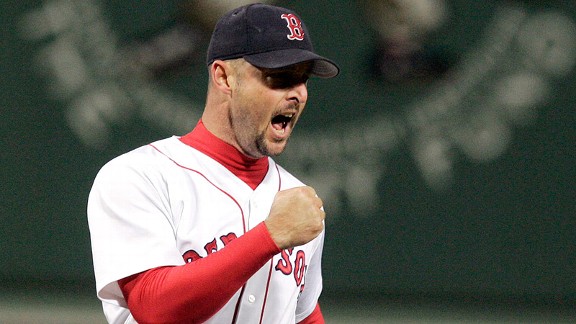
In Praise of Unnatural Acts and Tim Wakefield


Tim Wakefield announced his retirement from professional baseball earlier today.

When I came home from work, I watched the last three innings of Game 5, of the 2004 ALCS. I have the last four games saved on my iPad. Yankees at the Red Sox in Game 5; those were some of Tim's best moments. The Red Sox Manager, Terry Francona, had stayed with the starting catcher, Jason Varitek, into the extra innings. Normally Varitek would not be in there, the job of back-stopping Wakefield's knuckleball, notoriously hard to catch, usually fell to the other Sox catcher, Doug Mirabelli. But this was the League Championship, the Red Sox were down to the Yankees three games to one, and Francona stuck with Varitek.

In the top of the thirteenth inning, Yankees slugger Gary Sheffield took some wild, from-the-heels cuts at the knuckleball, and struck out. But Varitek could not make the put-out, and Sheffield reached on a passed ball. Next, Hideki Matsui, who had been killing the Sox up to that point in the Series, bounced a slow grounder to second, and the Sox could only get the lead runner, Sheffield. Then Bernie Williams flew out to right field for the second out. The next batter was the Yankees catcher Jorge Posada, well known as a patient hitter. On the third pitch, Varitek lost another passed ball, and Matsui advanced to second. With the count two balls and one strike, Francona elected to intentionally walk Posada and face Ruben Sierra - who had three hits in four at-bats that night.

The first pitch to Sierra was a slow knuckler over the inside part of the plate for strike one. Fenway erupted with approval. The second pitch was fouled back for strike two. The third pitch was low and inside, Varitek stabbing at the dirt to catch it. The crowd gasped and grew silent. The fourth pitch was also fouled back, and the count held at one and two. The next pitch danced off the outside of the plate, and Varitek tried to simultaneously scoop and slap the ball, which bounced to the fence; crowd moaned in horror. Matsui took third and Posada second on the third passed ball of the inning.

So it was two and two to Sierra, two outs with runners at second and third. Wakefield's sixth pitch of the at-bat was high and outside, Varitek jumped up and blocked the ball, which popped out of his glove, but dropped down at Sierra's feet. More shouts and gasps, but the runners could not advance. The broadcast cameras flashed to Mirabelli in the Red Sox dugout, his head down, his hands pressed together, his body rocking with tension; he could not watch. On the seventh pitch Sierra swung thru a tight knuckleball on the inside half, inning over. As Varitek snapped his glove shut, he pumped his fist; Wakefield doing the same as he marched off the mound shouting at the dugout, and the crowd roaring.

In my opinion, this was the key Yankee at-bat in the Series; it was the last close moment, and as close as the Yankees would come to winning the pennant that year, after they raced out to a 3-0 Series lead. Wakefield and Varitek gutting it out, disaster one fluttering knuckleball away. But they trusted each other, and made enough outs (four) to finish the inning unscathed.

It's a baseball cliche: pitching is an unnatural act. The motion contorts your arm and requires constant attention and effort to prevent injury. But any kid who throws a snowball, or a rock, or a baseball can tell you it feels pretty natural. You just haul back and throw. But throwing a knuckleball, that really is an unnatural act. Like other physical acts that defy logic - skydiving, car racing, ski jumping - one part of your brain has to convince another part of your brain that this is a good idea, that this is what you want your body to do and it's going to work out. I want you to: push the baseball, using just the fingertips, take the spin off the ball, push it towards home plate where stands Gary Sheffield, or Alex Rodriguez, or Hideki Matsui, and let them try to hit a ball traveling 60 miles per hour when they are accustomed to a ball traveling 95. I want to do this. I think this is a good idea. If the hitter should make good contact, it is likely the ball will travel a long distance, and the hearts of your teammates, coaches, and the millions of fans that make up Red Sox Nation will be crushed. I will throw this pitch.

This is unnatural. Wakefield made a 19-year career of this.

Sitting in the stands and watching Wakefield pitch was other-worldly. I last got to see Wake pitch in 2009, his All-Star year, when he beat the As in Oakland 8-2, with a complete-game 4-hitter. Lobbing pitch after pitch, when he should be throwing peas, shooting bullets, firing BBs, whatever. It sure looked unnatural. How could the As hitters not crush every one of those meatballs, even if they weren't spinning? The infielders were making pegs to first faster than Wakefield threw to the plate. He was 42 years old in 2009, very close to my own age. He was 11-5 that year, and helped the Sox make another playoff appearance.

In his farewell today, Wakefield spoke about his youthful dreams of playing in the majors. Unlike so many who make it to the majors, Wakefield made it there and stayed for so long because he could do this one thing that very-very few can do. He was not a good hitter. A converted infielder, he was a pretty good fielder, though, as a pitcher, got few opportunities. His fastball, when the hitter knew it was coming, was a gopher-ball; and he threw a curveball only occasionally - those pitches would not have existed but for the knuckler.

My friend Rob and I used to take lunch breaks and play catch in front of the Federal Reserve Bank in Boston, and he could throw a knuckleball. I tried, but never could quite get the ball to float the right way - I could never completely remove the spin. But when Rob threw one you could tell he had to force himself to do it. He had to concentrate, think really hard about how to coordinate his arm and his fingers. Rob was a coordinated guy, a good athlete, and had run the Boston Marathon a few times, but only one knuckleball in a dozen was really any good. And he could not really throw it hard enough to use it, say, in a beer-league game. But when he got it to work, it was really strange to try to catch it.

I've racked my brain trying to find an equivalent to Wakefield specifically, and knuckleball pitchers in general, in other sports. It's really difficult - to execute some basic move in a sport in a way that is so wrong that it's right. Jim Furyk in golf? I don't know.

Thank you Tim Wakefield and congratulations on a unique and unforgettable career.

Bonus: Joe Posnanski wrote a nice piece on 'poetry and knuckleball pitchers' on his blog at SI.