Madeira is a small island far enough from the coast of Africa to say it is in the middle of the ocean. Donna’s family (father's grandparents) is originally from Funchal, and we are traveling with her third cousin, José Miguel, to explore and learn about the place. As luck would have it, José Miguel’s ninety-eight year old aunt and her immediate family own and run a hotel near the port.
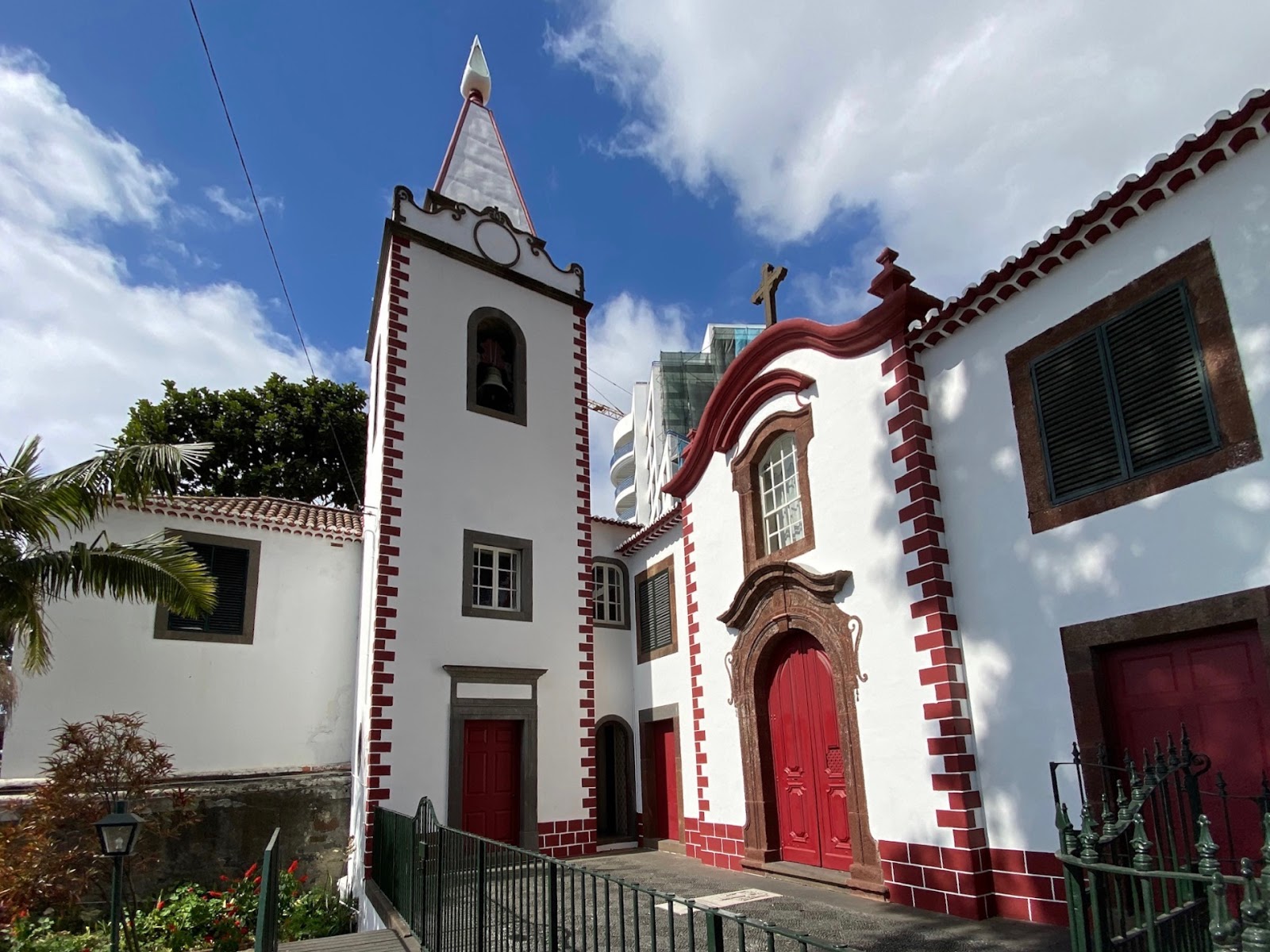
The hotel includes the old family compound and gardens, new hotel structures with guest rooms, along with a little church. Unfortunately, the complex is now surrounded by tall and ‘modern’ tourist hotels (which can be seen hovering over the church). Views from the gardens to the hills are long past; there is just a wall of endless, curving hotel balconies. And because of some missed real estate opportunity, local hero Cristiano Ronaldo has been able to insert a grey and white box, blocking the sea views from the upper pool.
The hotel is near Parque de Santa Catarina. On the map, it looks like it’s set along the broad boardwalk along the port, but it is several dozen feet up a sheer stone rise. Along the seaside, there is a extra-wide paved plaza, and an extra-long hotel. We learn that Ronaldo has somehow turned the planned cruise port into the CR7 hotel, as well as a museum (to CR7), and there is a statue of himself in the plaza - a hero and a corporation. The airport is named for him, too.
After lunch, we decide to walk to the Fortaleza de São João Baptista do Pico. It will give us a good introduction and a big view of the city. The streets and alleys leading to the Fortaleza are steep enough that the sidewalks are stairs. The sun is stronger, and the air heavier than Lisbon. The weather app suggests the difference should be minimal, but it is quite significant. The structure atop its hill is picturesque, in an imposing way, but not all that interesting when we get there. The local curators have set aside a dark hall inside the Fortaleza and made a good effort to enliven its history; it’s not really impactful. But the views are wonderful.
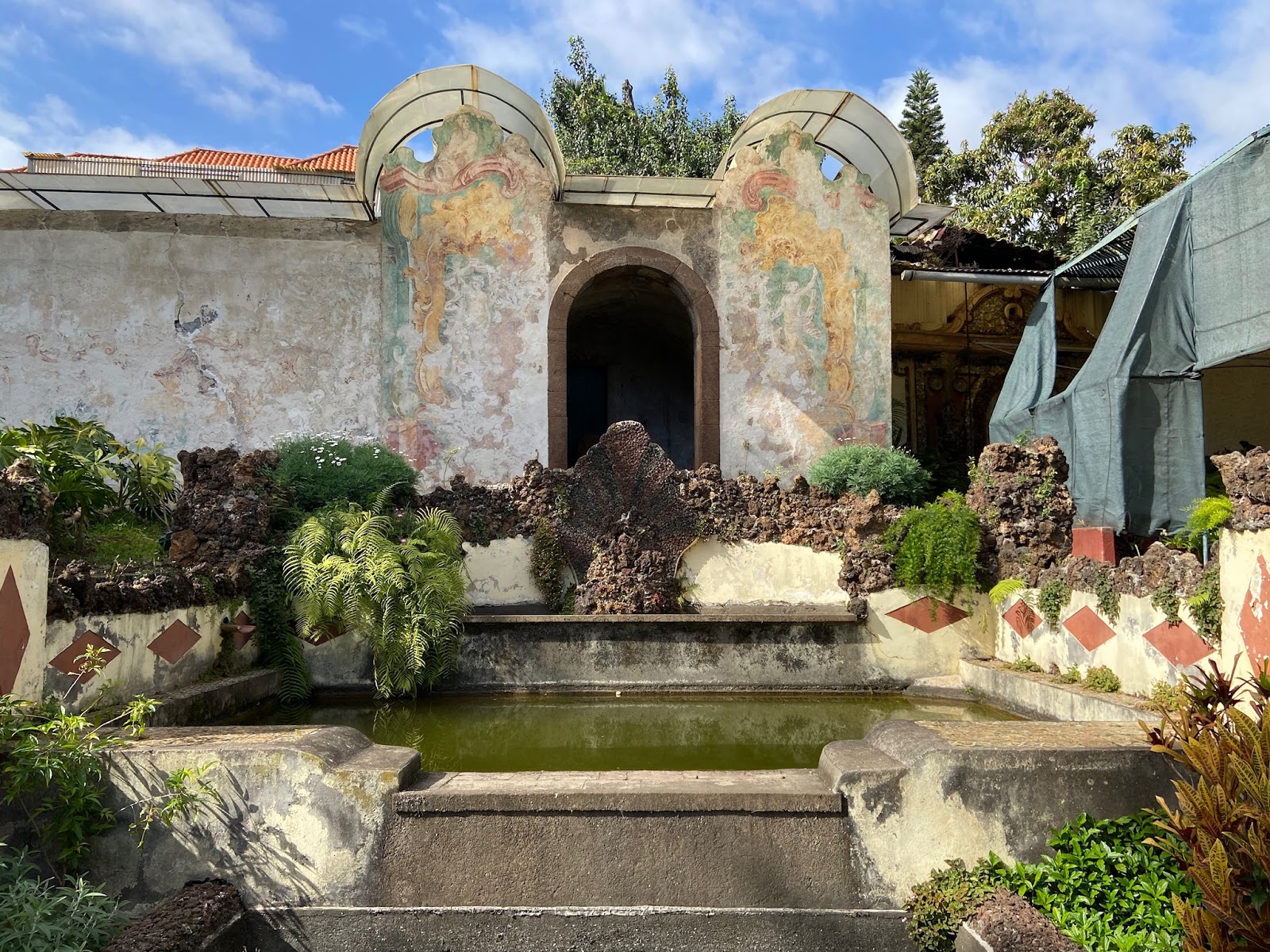
We head down the hill to the Museu Qunita das Cruzes, a large, old manor home. We are making our way to the Convento de Santa Clara, and this Museu is on the route. We don’t enter the Quinta, but we do enjoy the wonderful gardens, with some imaginative follies and several ancient-looking trees.
Well, we find that the Convento is closed for renovations, so we decide to enter the Casa-Museu Frederico de Freitas, with no idea what to expect. Past the entry gate, there is a splash fountain and a ramp up to a courtyard. You can choose the Casa da Calçadas (the noble family that owned the house) or the Casa dos Azulejos. We choose Azulejos, and find several levels of tantalizing tiles, arranged in cases for horizontal viewing (floor, counter, and ceiling heights), as well as panels on the walls or on stands - very eclectic, and arranged by country and age. Sorry, no photos are allowed. These are accompanied by a few videos showing the tiles in-situ as well as behind the scenes material. There are also several mirror boxes where patterned panels are multiplied with reflections.
The manor house is also interesting, with lots of little collections in very grand rooms: saint statues, nativities, books, mugs (yes, mugs - so many mugs), ivory carvings, and more. There is also a small garden above street level. In all, this is a captivating small museum, with lots of eclectic sections - more like an anthology than a novel.
Next door to the Museu (the campanário is basically part of the garden) is the Igreja de São Pedro. Though small in scale, the church has a fully tiled nave, a luminous altarpiece, and a captivating, Renaissance-style side chapel. I particularly enjoy the chapel as the pews are set parallel to the colonnades, so there’s no way to ignore the architecture. The stained glass panels are excellent and the back-lit, ‘hovering’ Jesus is set upon a cloud and held, mid-flight, in a marbleized alcove. The inverted volutes of the column capitals release the weight and seem to spring him upward.
At dinner we learn that all these places are meaningful to José Miguel. Besides being able to catalog the furniture in the hotel, he took his first communion in São Pedro and played in the Frederico de Freitas as a boy. He recalls a time before the Casa da Calçadas became a museum - the mugs were off-limits even then.
We receive an alert during the weekend to let us know, literally: 'surf's up'. So today's bus trip is to the fishing village of Nazaré, now renowned for big-wave surfing. Though not included in Saramago's Journey, it is included in Rick Steves' Tours, so I am happy to make another day trip – even though I am not particularly interested in surfing. Over a decade in the Bay Area, we never went to Mavericks, for example, but then I don't think there was standard bus service. Today, Rede Expressos orders up an extra autocarro for the morning run.
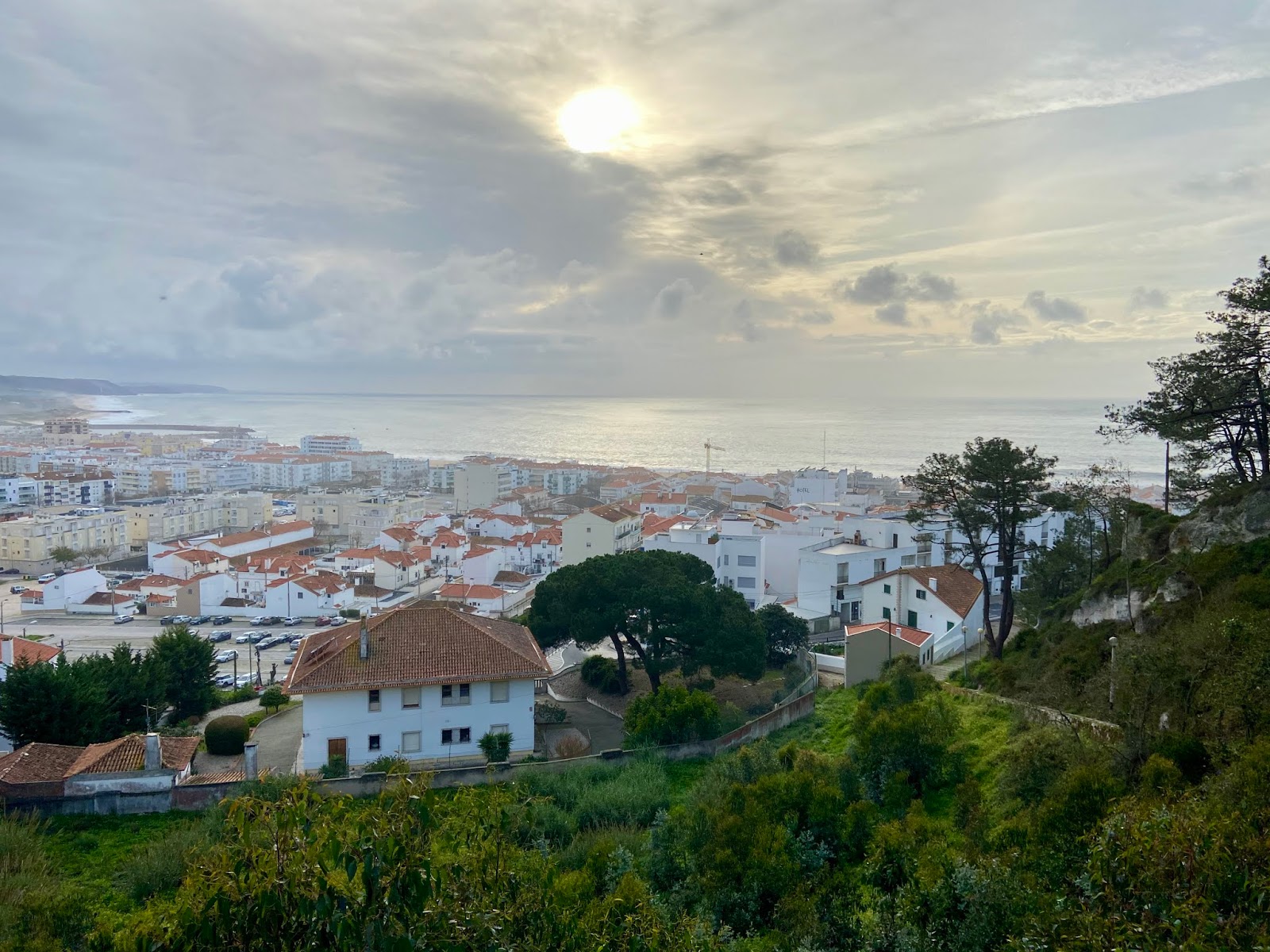
The bus sets us down at the southern end of the old Praia (beach) neighborhood, so we walk first west to the ocean, then north towards the high-ground known as Sitio. The big waves are along the Praia do Norte, on the other side. To the east, above Praia, is the neighborhood of Pederneira, which is less travelled by tourists, but may offer good views over the town and the shore.
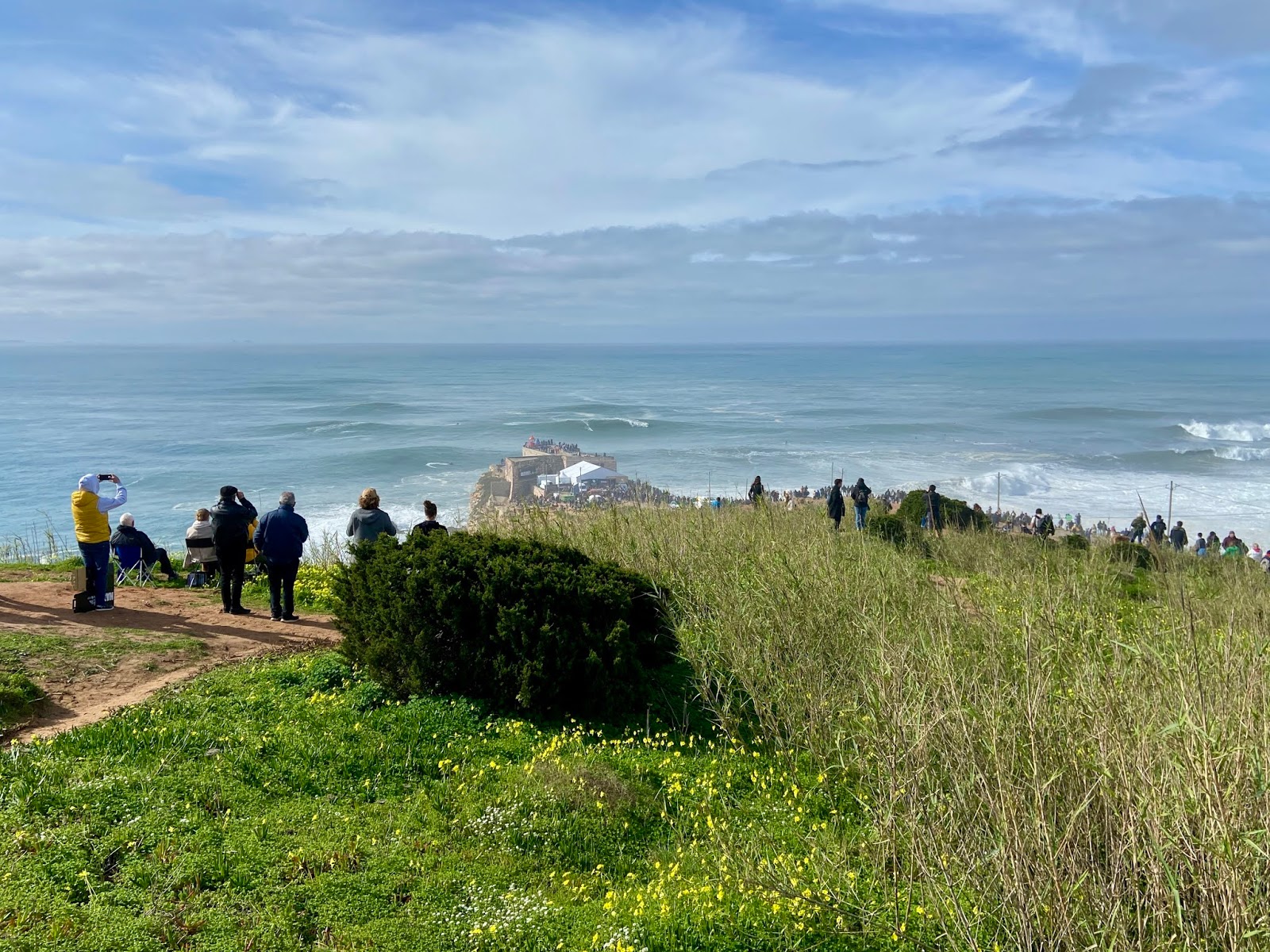
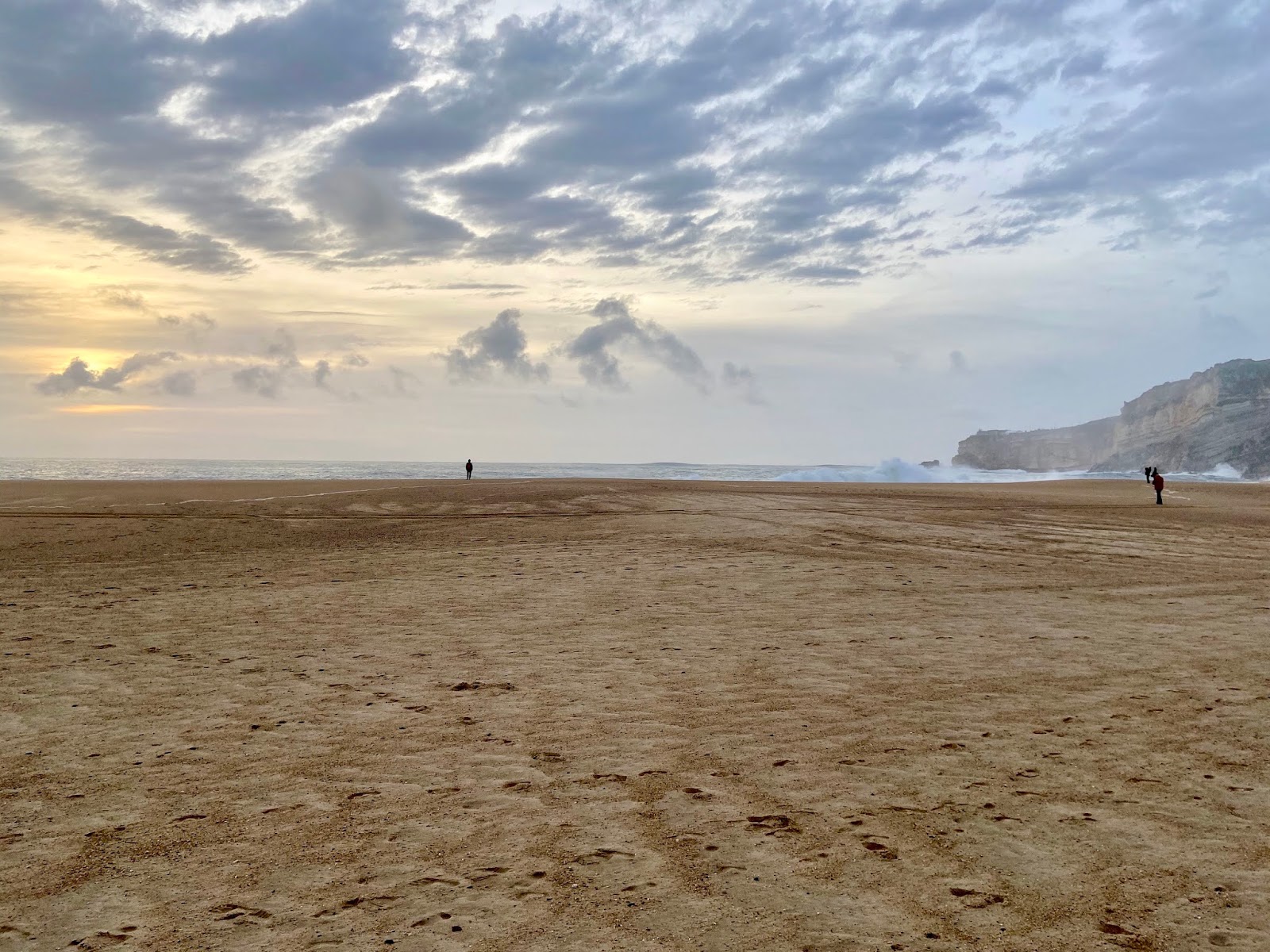
We reach the ocean, make our turn, and our gaze is stopped by the perfectly vertical wall of the cliff. The escarpment cuts the foam and mist to our left; one can imagine that diagonal edge piercing the ocean's floor and plowing up the sea. Past lands end and above the ocean's horizon, we see dark, compact hills set on the line. The hills grow frosty with spray, then collapse against the outcrops - it's the surf. Along with video, the audio soon follows – the hiss and hammer of the water's rhythmic rush. Both the cliff and the waves are beyond expectation.
As the beach walk starts uphill, we turn east into the alleys to find the funicular station, a silvery glass gap in the weathered streetscape. At the top, the lift delivers us to the Largo de Nossa Senhora da Nazaré. Where I was expecting a wide, cliff-top plaza and distant beach views, we find a regular town square, arranged around the solid, twin-spires of the Santuário de Nossa Senhora de Nazaré. The keepers by their shops and street vendors fill the perimeter, compressing the scale further; obviously, they also got the surf alert.
Just to one side of the Largo is the Ermida da Memória, a tiny stone capela covered with tiles, and with a short stairway down to a cramped shrine. In the wall of the lower level there is a teeny, hazy window that looks back over the beach. The chapel marks the grotto (hermitage) involved in the 'Miracle of Nazaré', which is summarized by a pamphlet distributed at the Santuário:
On September 14th, 1182, the knight Dom Fuas Roupinho, governor of Porto de Mós, was out hunting in the woods near the coast covered by heavy fog, when he saw a deer which he immediately began chasing. The deer ran towards the top of a cliff and the knight in the midst of the fog was cut off from his companions. When he realized he was on the edge of the cliff, he recognized where he was. He was next to a small grotto where, some time ago, he had found a statue of the Virgin Mary on an altar. Thus he prayed out loud – Our Lady Help Me! And all of a sudden, the horse miraculously stopped at the end of the rocky point suspended over the void, the Point of the Miracle, saving the rider and his mount from a long drop that would certainly cause their death.
The 'Point of the Miracle' is just to the right of the chapel, but it is marked with a cross and the prohibition zona interdita, as the rock does truly overhang the cliff's edge. While the sign is serious enough, the cross adds a level of authority. I suspect it is no longer structurally viable, though I did see some nonbelievers walk to the parapet. It's a day of chances.
We follow the crowds through the plaza. The roads turn into grassy foot paths, and devolve into scoured, stoney surfaces trailing down to the lighthouse. There are a few green tufts that make good lookouts, and we can finally take in some action. I check the wave forecast for Nazaré, and it says 5.5m, less than twenty feet, but those waves look like fifty (WSL later reports forty-five feet). We stare alertly at each shadowy swell looking for the seam of white that signals a surfer.
I go as far down to the lighthouse as my view over the increasing crowd allows. The power cables don't help the sight lines, either. These are the hard core. They are deeply focused, with an announcer calling the action, eliciting gasps and applause. I wonder about the applause – does it help? Can the riders hear anything beyond the thunder of the surf, the buzz from the jet-skis? Adding to the commotion, there are drones whizzing around, but are soon comically drowned-out by fighter jet passes from the Força Aérea Portuguesa. That cannot help a surfer's concentration.
I am able to grab just a few videos and attach them below. In the first video, watch left of the emergency van, just at the start of the clip, you'll see a surfer trying to outrun the crest. In the second video, look right above the light at the 0:36 mark, and watch the surfer ride the face of the wave down, and safely out at about 0:53 (with apologies for the play by play). Also check: World Surfing League Nazaré Tow Surfing Challenge (Praia do Norte, Nazaré; recap, images, and videos from SurferToday).
For lunch, we choose one of the many pop-up eateries along the mid-way just outside the event gate. Luckily, this is a fishing town, and it's hard to be disappointed by fresh seafood, especially if it comes with fries. After lunch, Donna and I begin our exploration, and return to the Largo to check out the Santuário The facade is marked by two broad wings, a striking conical stair, and the two grey towers.
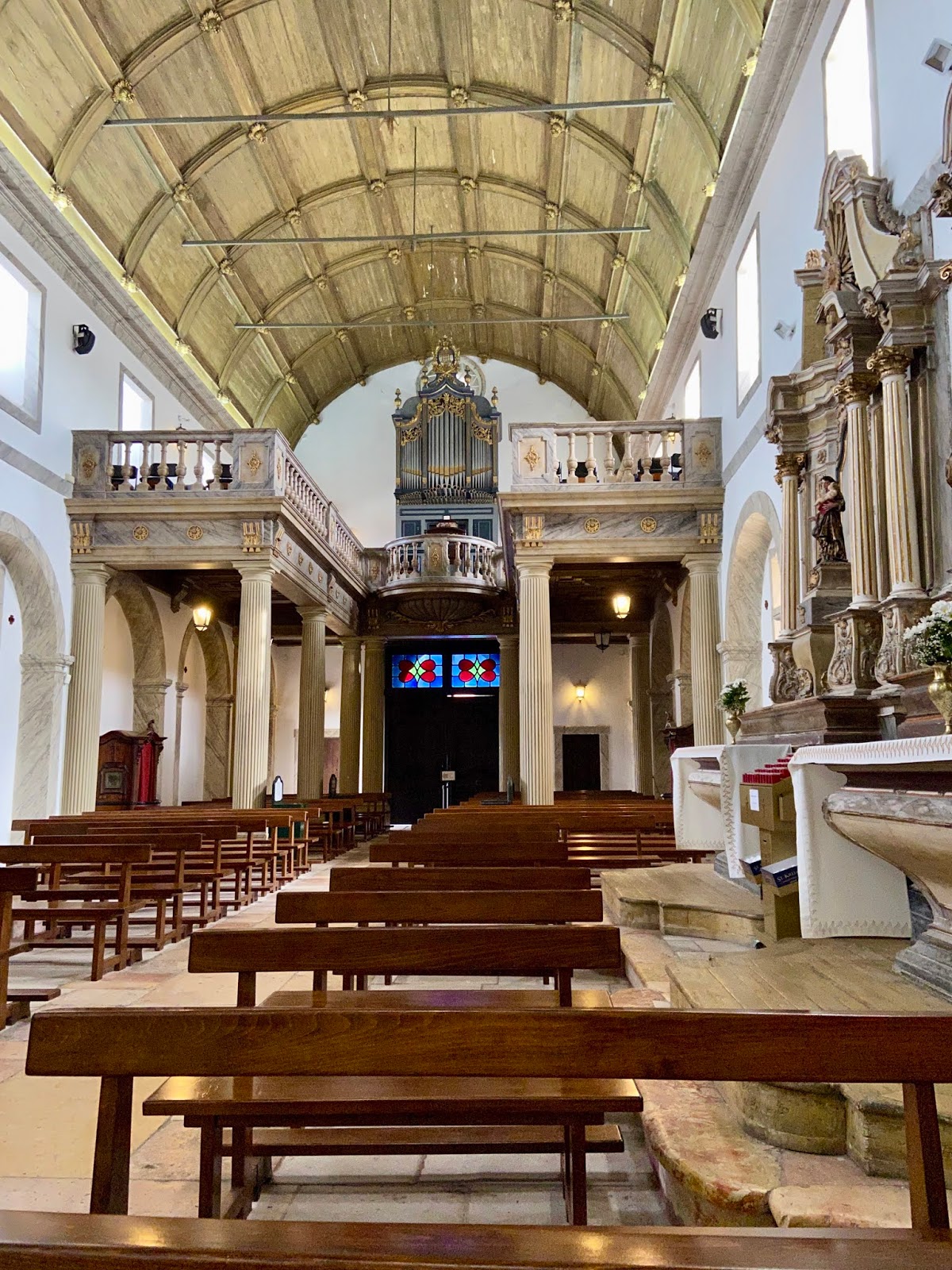
The interior sparkles with gold embellishments. The aisles abruptly end where Doric portico terminates, so the chapels are like Baroque kiosks, standing in the nave. A gold-trimmed, coffered dome is framed by barrel vaults within the transepts. The ends of the transepts are brimming with azulejos panels depicting old testament stories (the images of David and Goliath, Jonah and the Whale are particularly good).
The church attendant sits underneath the Jonah panel, happily explaining the stories to his guests. For a euro each, he lets us enter the porcelana passage that leads to the sacristy. We enter beneath a delicate iron stair structure. The stairs take us up to a pair of skinny portals that work, restaurant-like, in or out. There is a low landing space, then a doorway out to a platform above the church altar. There we find the Virgem Negra, the small figurine that saved Dom Fuas and his leaping steed. The legend states:
According to the old parchment the statue must have been venerated since the beginning of Christianity in Nazareth, Holy Land. In the fifth century the Greek monk Ciriaco brought it to Spain, to the monastery of Cauliniana, near Mérida, where it remained until 711, the year of the battle of Guadalete.
(T)he defeated king, Roderic … asked for shelter at the monastery of Cauliniana. When he requested one of the friars, Romano, to hear him in confession … the friar suggested they flee together to the Atlantic Coast, taking with them some relics and the holy sculpture of the Virgin of Nazareth.
So the name Nazaré comes from Nazareth, or whatever was the ancient version of that city's name.
Leaving the church, we cross the Largo and follow the railing wall to the Ladeira do Sitio, and follow that down to the passages of Praia. Old ladies with baskets of beans and nuts offer samples. We continue out of the Praia, to the Escadaria da Pedralva, taking us to what I hope will be a nice sunset in Pederneira. But it is growing misty again, and there is a clamorous construction site at the Miradouro. A shame that an enjoyable walk come to an unsatisfying end.
We try to quiet and content ourselves by stepping into the Igreja da Misericórdia da Pederneira. The church is very simple and homey. Perhaps the only unusual items are the wall-mounted pulpit, the spooky statue of Jesus with the cross, and the colored glass picture window behind the Ionic pass-through (architecturally annoying: interior columns turned ninety-degrees to the others; four bays results in a column at the center rather than an opening). It's cooler now, and the machine sounds rattle around, so we escape to the cemetery, hoping there are views – but the grounds are walled-in, there are few good vistas, and we are about to lose the light.
Donna needs a break before we walk down. I have a moment to reflect, and now looking at my photos, the images look surprisingly appealing. Maybe my disappointment is unwarranted.
So, we descend the Escadaria to Praia, once more into the alleys. We find them filled with the honey-shades of sunset, which finally breaks the mist and the cloud deck. We pass post card stands and surf shops. Tent cards in doorways advertise hostels and quartos.
We have time to grab a snack before our return bus to Lisboa. As we collect our thoughts, and scrub through our photos, I learn that a surfer, Alex Botelho, is in the hospital after he was caught in whitewater while being towed – his jet ski apparently tossed over and struck him. As one of the few Portuguese in the competition, I hope he knew enough to invoke the help of Nossa Senhora. Our best wishes to Alex for a speedy recovery.
This awesome landscape certainly inspires risk: waves, cliffs, wipe-outs, and miracles. The seaside villages settled on these beaches and hills are well adapted to its dangers and its bounty, and this may be at the heart of Portugal's saudade. These masters of surf and their armies of fans bring unique opportunities. Nazaré is all about its customs and legends, as well as its industrious residents.