Friday, February 21, 2020

Madeira - O Terceiro Dia


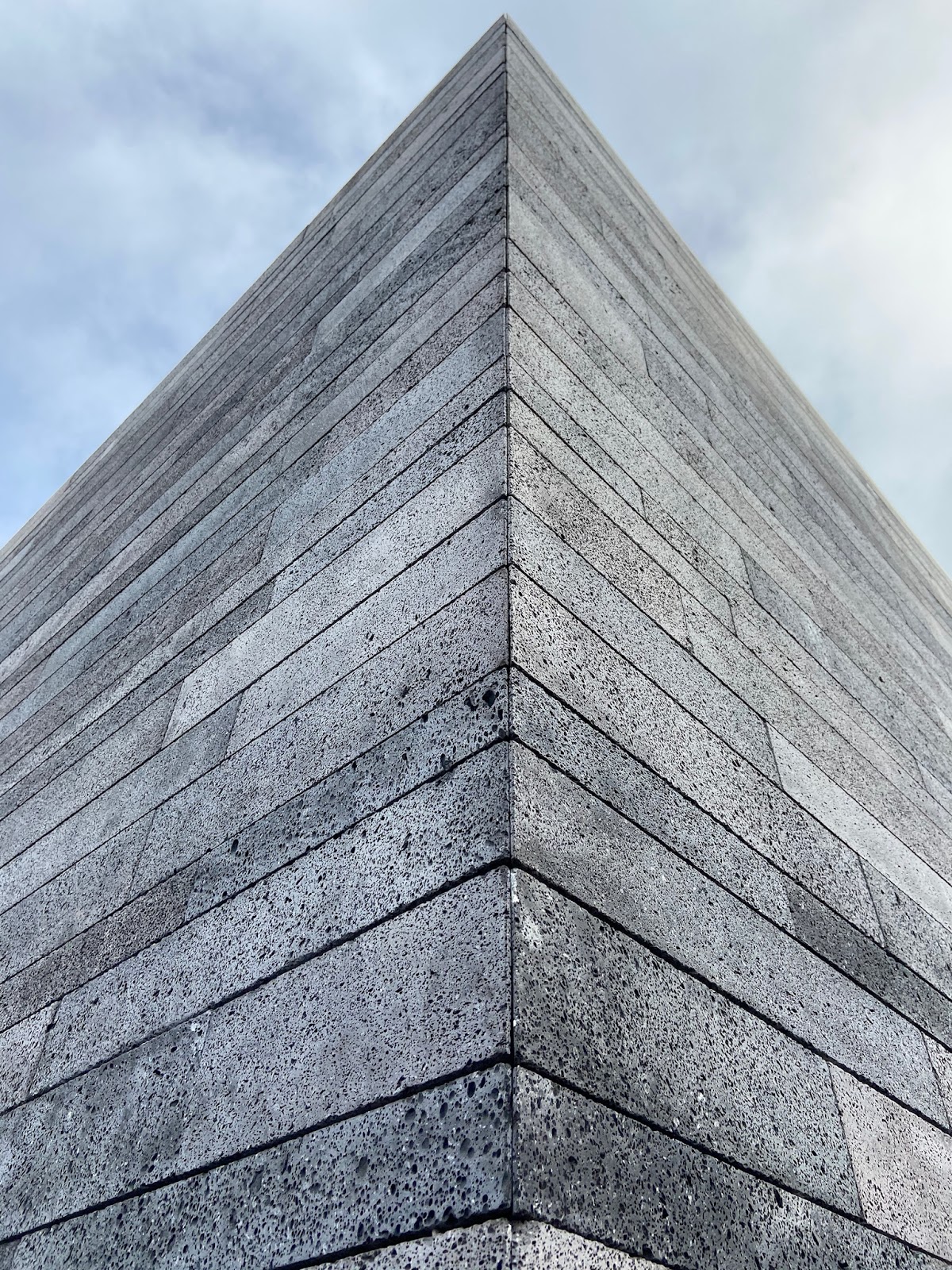
Today’s theme is rain avoidance. We decide on a good museum: the Mudas, Museu de Arte Contemporânea de Madeira in Calheta. It is a modern art museum designed by architect is Paulo David in the form of a cliff-top “forteleza”, as we’ve seen in a few locations around Madeira. The stone seems to be a pumice-like, honed volcanic rock that we’ve seen in a more natural, ‘nubby’ form all over Funchal, on landscaping dividers and feature walls.

The top is a level lookout over a striped garden of local shrubs and grasses. Into this stone block, the architect cuts a maze of framed views and balconies, where guests can take in the terraced hills and the marina at Calheta.


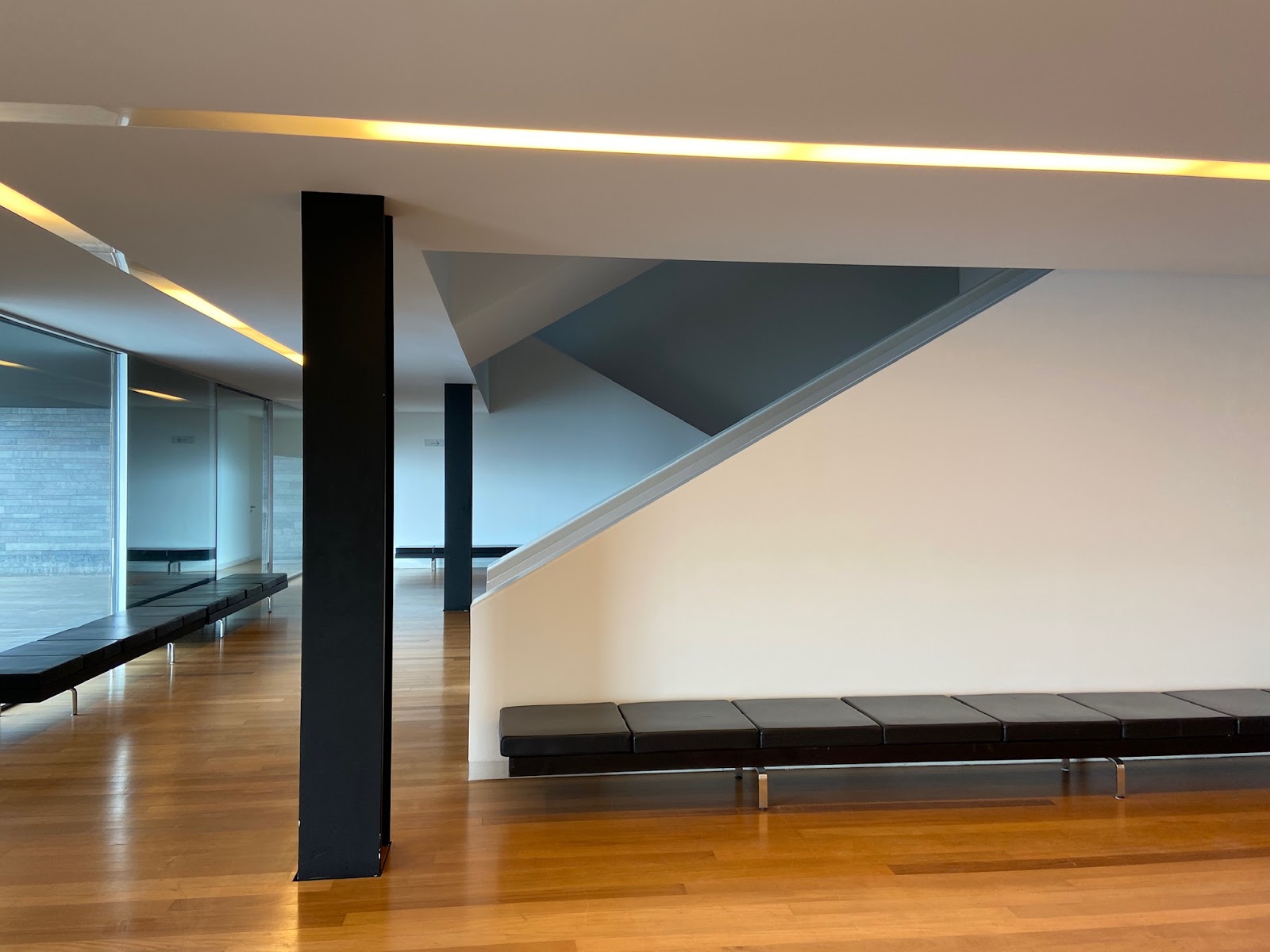
The galleries are well-scaled to the artwork, with tall slots of natural lights illuminating the end walls. As on the upper level, tight connecting spaces unfold into wider galleries. The lighting works as an inverse of the planting stripes, with energetic bolts illuminating the stair rails.


However, most of the galleries are closed; there is some snafu with the collection. It’s a real shame as the building and the collection on display are fascinating. Perhaps designing a museum like a fort is a stretch - but forts react to and fit a landscape as much as they are imposed upon it. These are places of refuge, for people and things, their stories and their preservation. Best not to let these places fall into abandoned decay.

With our museum trip is cut short and we are sent back out into the weather. Luckily it is starting to clear, so we head down the coast to see what we can see. We arrive at the Ponta do Pargo and the Miradouro do Fio. There is a little cafe and a kind of paved platform. Look closely at the last image there, and you’ll see the “farol” (lighthouse) at the top of the escarpment.


The Farol do Ponta do Pargo is a rather dumpy beacon, but it marks the southwestern tip of the island. Views from the “miradouro” there are excellent. The grassy, flat field simply drops away. I hope they don’t lose too may cows - the tourists who wander beyond the warning signs can watch out for themselves.


Now we turn north, along the western coast, and signs of the recent fires are all around. The smell of the charcoal is fresh, and a reminder of California. The scarring goes on for miles until we pass Achadas da Cruz, turn eastward, and continue along the north coast. We reach Porto Moniz in a heavy squall, another regret as I really would like to see the natural pools there. So we continue on.


The coast highway along the north has been re-routed into tunnels.The old highway is still there, just gated with slash-circle signs. At each tunnel entrance we can see the old road off to the left, with scattered fallen rocks, slowly fading into ruin. As we exit the tunnel near São Vicente, the downpours have created a rushing cascade just to one side of the road, as if the hill has sprung a leak. We decide to stop and have lunch here and wait out the rain.


After lunch the rain has slackened, and we decide we can take the old mountain road home, as opposed to the new highway and more tunnels. As we climb, the views and the weather get better and better.


As we reach the interior mountains, and approach Serra da Água, we see the bright roof of an enormous lodge; this is the Estalagem Encumeada. It seems to be a hot spot for serious hikers, but it is truly in the middle of nowhere. On the other hand, the mountain views are absolutely breathtaking.


Our last stop before we reach the coast is a place called the Dorisol Pousada Dos Vinhaticos. It’s a stunning little inn, with views of some of the most unique formations in the valley. This seems just as much a place for hikers and as for poets.


Thursday, February 20, 2020

Madeira - O Segundo Dia


We are testing the limits of technology. First, by grinding through the heights and depths of the south coast of Madeira in a Fiat 500. We’ll even make it the diesel. Manual. How much landscape can you cover? Second, we’ll test the ‘ultra-wide’ lens of the iPhone 11. Today is all about “miradouros”: prospects and promontories, lighting effects and framing views. How much landscape can you cover?

We upgraded from the iPhone 6s last year for several reasons, but one of them (for me) is that the ‘Pano’ function basically required other tourists staying out of frame while I swiveled the camera across my field of view. The iPhone 11 adds an ‘ultra wide’ (f/2.4, 0.5x zoom) to the ‘regular’ camera (f/1.8), and is able take these comprehensive shots in one go. But it also adds some distortion when looking up or down - the ’key-stoning’ is hard to avoid with tall or wide structures. The closer your subject, the greater the distortion, but today that should not be an issue. Today is an ultra-wide kind of day.

Our first stop is Câmara de Lobos, just west of Funchal. This small city features a kind of sea-side butte, quite striking, called the Ilheu de Câmara de Lobos. At the foot of this ‘island’ is the Igreja Matriz de São Sebastião, with its elegant “campanário” breaking above the roof tiles. The aspect ratio of the ‘ultra-wide’ image stays the same four-by-three, so capturing a wide landscape is a framing challenge. Sometime you can have ‘too much’ foreground. The regular lens gives me the Ilheu and the Igreja, but I can’t add the steeps slopes at east and west. The ‘ultra-wide’ give me one side, but not both, and adds more roof tile than might be desirable. The ‘Pano’ gives me both, but it is very strange to see the street nearly folded in two (the road is arrow strait, and quite steep). I suppose the ‘Pano’ tool wins this one, but again, seeing that benefit also requires the viewer ‘un-Pano’ by zooming and scrolling.


Next stop is Cabo Girão. It’s a cliff-top balcony made of steel grating and, in the center section, of glass. I am trying to show the cliff: the ‘regular’ camera in portrait, the ‘ultra-wide’ in landscape, and a ‘Pano’. Here, the ‘ultra-wide’ shot really make things feel ‘big’; the railing in the foreground is still the price you pay - it gives context but is also distracting. However, the ‘Pano’ grabs the railing, too, without adding much else. I appreciate the ‘ultra-wide’ lens’ adding some drama in the clouds, seeing the shrubby hills and additional Atlantic Ocean seems to make a better shot. It has more mass, more remoteness. I should add that the regular portrait shot does nicely emphasize the vertical. Point to ‘ultra-wide’, so it’s tied 1-1.


Speaking of best uses of technology, I wonder about that glass balcony. I’m sure it does its job of attracting tourists, but it doesn’t work as a visual enhancement - you really can’t see through it (the dirt, the dots, the reflections). Better to look over the edge so you can guage the colors, textures, and distance. Look at the colors in the water. The glass is only good for the vertigo.


Pico dos Barcelos is a “miradouro” in Santo António, inland from Funchal. Similar to the Fortelza de São João Baptista do Pico, there is a “parque infantil” just below the Pico, so another foreground issue, but this time for ‘Pano’. I am trying to add the hills and the church to the right, but you hardly notice those to all the stuff added by the playground. The kids sure to get a great view, though. ‘Ultra-wide’ wins this round, too.


Now we head for a stop along the north coast, to Porto da Cruz, which features another curious formation called the Penha da Águia. Again, the ‘Pano’ suffers from folded-foreground syndrome, without adding a whole lot except a sense of distance. I will add that the ‘regular’ lens misses the desirable foreground and, if you capture the little beach, cuts off the mountain rolling up to the left. The ‘ultra-wide’ also incorporates those clouds - love those clouds.


Our last stop is the “miradouro” over the east-facing bay at Machico. Here, again I’ll show the ‘regular’ picture just to show what the camera misses. The ‘regular’ takes the looming headland as it meets the bay, and the group of decreasingly thin jetties that dissolve into the sea, but misses the shore of the bay. The ‘ultra-wide’ adds the shore as well as the city, the mountains, and a bit of the railing. The ‘Pano’ adds a bunch of features from the “miradouro”, but doesn’t add too much to the view, except to connect the thinning jetties with the islands in the distance. Also, it is nice to see the sun and the horizon, even if you must add a trash can. It’s almost a toss-up, but I got to give it to the ‘ultra-wide’. Of course, the day is set up for this outcome - cover a lot of ground and see as much of Madeira as possible.


Covering ground is also the mission of the little Fiat. Three adults travel over 100 kilometers, maybe sixty-something miles, between breakfast and dinner (rest at lunch), and just a bit or rain. I’ll say the Fiat is a trooper, but it does not inspire confidence. Climbing in and out of the two-door hatch at the stops is a chore. The seats don’t seem to remember where they started, and everything needs to be reset each time. The island is a collection of steep climbs and drops, switchbacks, and quite a few tunnels. The little engine complains mightily on the climbs; the brakes respond by squealing on the drops. There is a touch of ‘roller-coaster’ anxiety involved. The bright-dark of the tunnels, adds to the carnival feel. The Fiat is enthusiastic and whiny, but it makes it through the ride. Though I am not driving, I see downshifts on smooth freeways - uphill, yes, but seemingly older and lesser cars easily pass us. It does a great job with the parking, though. I’ll conclude with: the Fiat may be just enough car for us and this island, just enough.

There is a moment during lunch, as we are in a enjoyable restaurant with a sweeping view of the valley (the first image is from lunch). I am staring at the shadows of the clouds as they drift over the small buildings. José Miguel wonders what fascinates me. I tell him that as a boy, I would mow the lawn, and after,  lay on the freshly shorn grass. As I watched the clouds wander past, directly overhead, I could feel the Earth behind me, like an insect being pushed by a truck in low gear, flowing through space-time. These views are the same. I feel like I’m riding this island afloat on the water. Barely perceptible, but when things are quiet, I feel the globe’s spinning.