We are wandering the old town center of Funchal. We stop first at the Sé - the Sé Catedral de Nossa Senhora da Assunçao. This is a good-sized church, but a third of it is curtained-off for repairs. It seems to be a Gothic shell filled with Baroque or Rococo art. The masonry blocks on the outside seem to be that airy, pumice-like stone that we’ve seen on many local buildings, used quite well to offset the whitewash and generate visual interest. The lacey, carved ceiling adds drama, while the gold-trimmed altar piece and narrow stained glass windows add warmth. I assume the renovation will bring everything up to a similar standard; when done, the Sé should be a real triumph.


Next, we visit the Igreja do Carmo, a small, bright, well-kept church near the “Mercado”. The architecture is fairly minimal, just simple shapes and trim, and all the decoration concentrated in the altar and chapels. But I am drawn to the gold ‘commas’ reflected in the patterned ceiling, and, strange to admit, but I like seeing the linens and flowers in front of the figures, rather than just candles. Someone is taking care of this church.


We check out the late morning action at the Mercado dos Lavradores. After seeing the farms along the north coast, my hopes are high, but it turns out the market is very much a tourist attraction - not necessarily a bad thing. It is a lively, active place, but the stall-keepers are a bit over aggressive offering samples. Even the trees are wearing over-sized "carnaval" masks.


Just down the Rua da Boa Viagem from the Mercado is the Capela de Nossa Senhora da Oliveira. It is teeny, and it is partially closed. The crowning olive tree is a nice touch. I sure hope all these renovations are a good sign for Funchal.


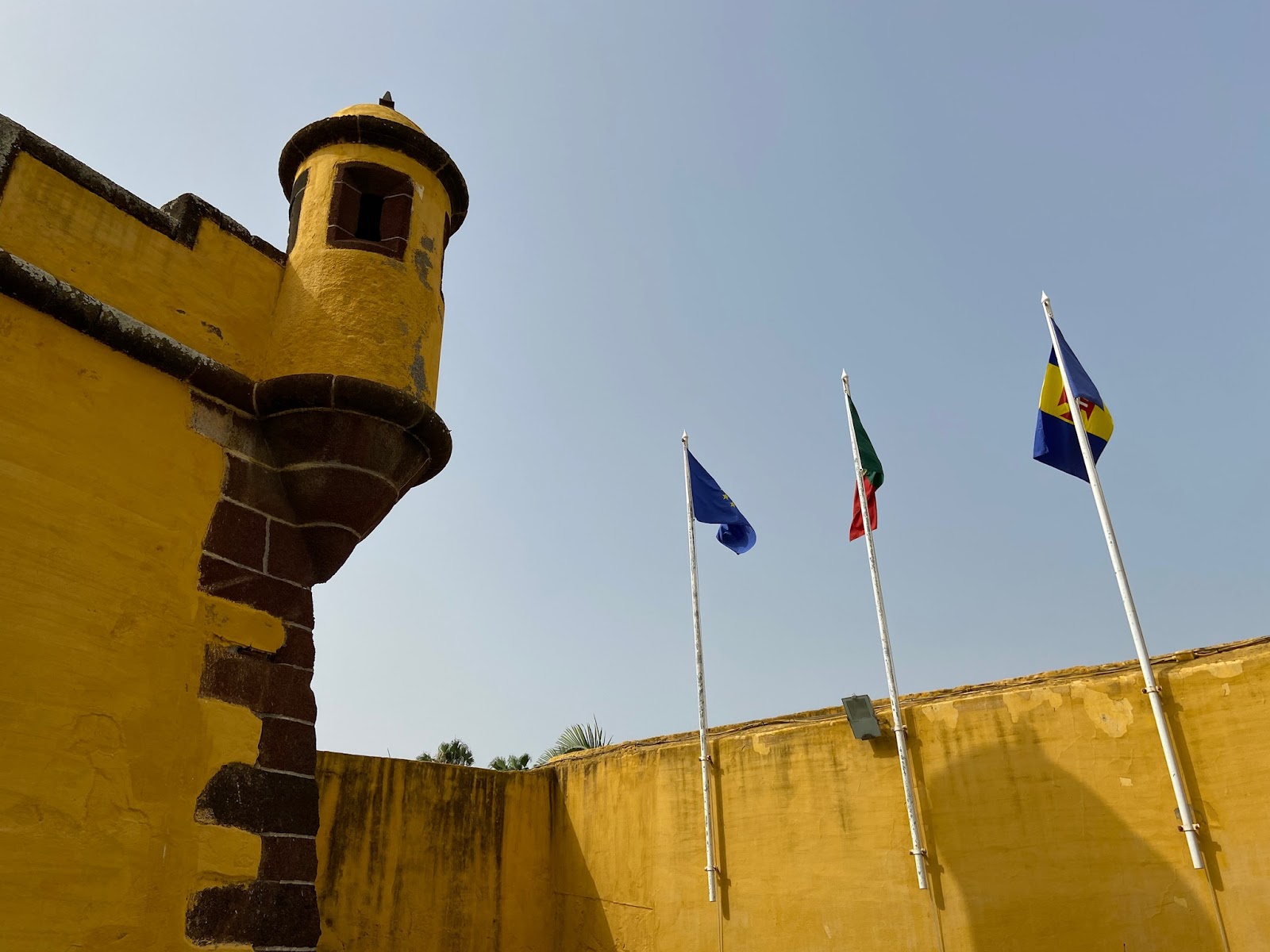
On down along the shore to the east is the Fortaleza de São Tiago, a bright yellow collection of arches and turrets. Again, here the fort is not as interesting as the the framed views it creates. Still, it is an outdoor break, including the sound of waves lapping at the rocks, from the parade of beautiful churches. Oddly, there are two pre-war cars on display: a Plymouth sedan and an MG convertible with suicide doors. Evidently they belong to the restaurant.



Turning uphill and westward now, and we arrive at the Praça do Município. Unfortunately, today, the Praça is occupied by the ‘creACTivity’ bus - though it sure does not seem very creative or active. The square itself is enclosed by a series of double-height blocks. On the east side is the Câmara Municipal do Funchal. The entry gate frames a tall sculpture in the courtyard. Upon closer inspection, it is a female nude and a large goose, kissing. What a strange figure to put at the center of town hall.
[Later, we are told that one of the island’s discoverers had an image of Leda in his coat of arms.]


I believe there is a museum in the Câmara, but I’ve heard the Igreja de São João Evangelista do Colégio do Funchal next door is better - and sometimes those Tripadvisor ratings are right. This church is a world unto itself. There is the gold-on-gold altar set in a deep, coffered, triumphal arch and trimmed in blue azulejos. Above that is a trompe-l’oiel dome on the painted, wood-strap ceiling. In the semi-circular pediment, directly above the altar, is a false-perspective painting of a triple-vaulted colonnade (what supports the two interior beams is anyone’s guess). In a totally ‘meta’ move, the ceilings of the painted vaults are painted.
The colonnades, archways, and domes on the actual painted ceiling are dizzy-ing. Reading from the altar to the facade: a dome framed by triple-vaulted colonnade, a series of arches leading to a central circular roof opening (on each side), and another brightly colored false-dome above the organ balcony. The arched spaces between are filled with images of, what looks like, college students with mortar boards. In the middle of all that is a heroic Christogram, with ribbons and angles, but the text (AMDG) seems to be in mirror image, unless my phone is playing some kind of trick on me.
[Later, we determine that viewers can more easily study the ceiling with a mirror than by craning their necks upward.]


The chapels are also filled with interesting stories and images - tiles, gold-leaf on wood, painted ceiling, and so many statues. I suppose this is what happens when you decorate a large church that’s part of a college. There is so much information embedded in the art, and there is so much art incorporated in the architecture.


But wait - there’s more: through the left transept is a doorway to the sacristy. Here is yet another ceiling to consider: the center medallion seems to contain the four evangelists, and then blooms outward with a swirl of tiny bodies and flowers. The vaulting around the edges is also interesting, with the primary arches bearing on the centers of the wall, with secondary points at the corners.


But wait - this church is still not done: pass through the sacristy, and take the stairs up to the tower. There are excellent views out to the hills and the sea (look closely at the nearby ridge to find the towers for the gondola cables). On the way out, we discover a model of the facade lovingly recreated in Legos; one of the best applications of plain, white mini-figs I’ve ever seen. I wonder: in what Lego set do you get plain, white mini-figs?