Saturday, October 28, 2023

The Veneto Revisited – Ravenna Day 1


The last stop on our Veneto tour is Ravenna (pop 158,784 in 2014), which is in the regione of Emilia-Romagna. A couple of YouTube lectures help us catch up on its unique past. Arriving late in the day, we find food and wine markets in every little square. The place is alive with tourists and locals browsing the stalls; the regional delicacies are tempting, especially the cheeses.

After checking into our hotel, we make our way to the Museo arcivescovile di Ravenna, located in the Palazzo Arcivescovile behind the Duomo (eighteenth century). Inside, the late Roman and early medieval stonework speaks to the history. Many of the carved elements are from the demolished, early fifth century basilica that pre-dates the Duomo. Then at the end of the fifth century, Teodorico il Grande establishes the Regno Ostrogoto (d'Italia) around the Adriatic.


The centerpiece of the Museo is the Cappella Arcivescovile di Sant'Andrea (late fifth century), an 'Orthodox' chapel built during Teodorico's 'Arian' reign. The Cappella consists of a narrow barrel-vaulted entrance hall, and the cruciform chapel – all the ceiling surfaces covered in exquisite mosaics.

Hearing the name of Sant'Andrea, we assume the 'kilted' figure over the door is the saint, but it is 'Cristo-guerriero' (warrior), clean-shaven, in Roman armor, and with the cross-halo. He stands on a lion and a snake, slings a ferula over his shoulder, and holds a book open: Ergo sum via veritas et vita [I am the way, the truth, and the life]. The entrance vault is a dazzling grid of flowers and birds.

Turning left into the chapel, four angels hold a large Christogram on a blue medallion. The beautifully rendered symbols of the Four Evangelists lay in the triangular spaces between (St John's eagle, St Matthew's angel, St Luke's ox, and St Mark's lion). All of this is on a shimmering field of gold.

The half-dome of the altar has a mosaic with the cross and a radial burst of white and gold stars, while the arch has Christ at the center, with six saints (Pertus, Andreas, Filippus, Paulus, Iacobus, Iohannis). Over the entry door is Christ and six more saints, and the dedication to Sant'Andrea in the lunette.

In the arch mosaics on either the side, Christograms replace the image of Christ, with additional male saints on the right, and female saints on the left. Unfortunately, there are twentieth century frescos in place of mosaics in these two lunettes. This is our first taste of Ravenna's famous mosaics. Though the recently installed lights on aluminum stands might be too harsh, after fifteen centuries, the imagery and the effect still impress – like the opening salvo of a fireworks show.


The remaining rooms of the Museo contain fascinating pieces. The Cattedra vescovile di Massimiano (fifth century) is a chair covered in intricate, ivory relief panels. Il Calendario Pasquale (sixth century) is a nineteen-petal, circular calculator, carved in a marble slab, that tells the dates to celebrate Easter. The Vergine Orante (twelfth century) is stunning mosaic figure of the praying Maria. And in nearby cases are fragments that allow close inspection of the tesserae.


Friday, October 27, 2023

The Veneto Revisited – Venezia Day 4


Our final, full day in Venezia is spent with Andrea Palladio. We reunite with Palladio after touring his Villa Almerico Capra, as well as the Teatro Olimpico in Vicenza a few days ago. But Venezia is home to his churches, where he takes the greatest pains to design his best buildings:
If upon any fabrick labour and industry may be bestowed, that it may be comparted with beautiful measure and proportion; this, without any doubt, ought to be done in temples; in which the maker and giver of all things, the almighty and supream God, ought to be adored by us, and be praised and thanked for his continual benefactions to us, in the best manner that our strength will permit. If, therefore, men in building their own habitations, take very great care to find out excellent and expert architects and able artificers, they are certainly obliged to make use of still much greater care in the building of churches. (Andrea Palladio, The Four Books of Architecture, trans Isaac Ware, Bible and Sun, 1738)
Our blog post from 2017 describes the development of the syncopated, superimposed temple fronts, beginning with the Chiesa di San Francesco della Vigna (facade by Palladio, 1562). On this trip, we skip that church (Palladio had nothing to do with the interior), and head across the lagoon to the Isola di San Giorgio Maggiore. This vaporetto route offers some of the best views of the Piazetta di San Marco.

The Basilica di San Giorgio Maggiore (sixteenth century) is the bright temple visible from the Piazetta, which we saw yesterday. Though told by our guide that the facade is an interpretation of Palladio's design by Scamozzi, it looks tidy and resolved – except perhaps that the cornice line of the lower pediment drives into the half-round columns of the giant order (something he does not do on his other church facades).


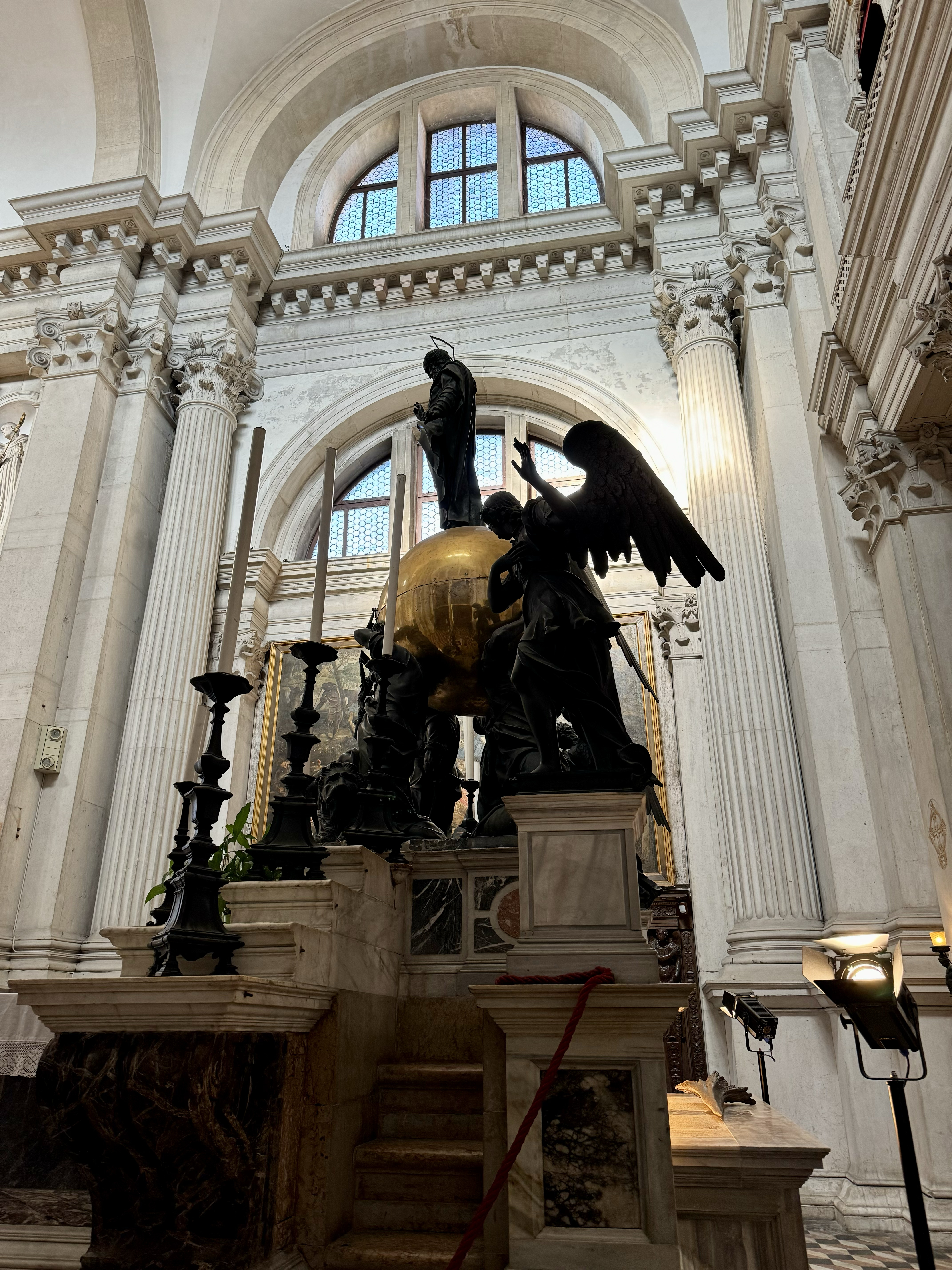
The interior is a study in proportion, rhythm, and light. The Composite order of the taller temple front marks the nave, while the Corinthian arches and pilasters of the lower temple front form the piers and arches of the aisles.

The interplay between the major and minor orders is fascinating. Where the column bundles turn the corners, at the domed crossing and the altar, elements change from half-round to half-square pilasters. At the altar, to frame the most important areas, the supports become full-round fluted columns. The windows hide in the clerestory and behind the ends of the transept, so the light is diffuse and even, reflected by the white surfaces.


There is an art installation and a reflecting pool at the crossing – either a crown of thorns or some squirmy, spikey caterpillars. In one the chapels in the back is another with a gathering of stumps around a small marble post. Both pieces seem to concentrate energy, one of water and one of sunlight.

We enter the choir space, where the Benedictine friars gather away from the laity. San Giorgio does battle with the dragon on the railing and on the music stand.


Another vaporetto takes us to La Giudecca, the crescent-shaped island south of the main body of Venezia. We pass the Chiesa delle Zitelle (sixteenth century), which our guide had also enthusiastically attributed to Palladio, though its design and construction occurred after Palladio's death. There are major renovations underway, and only the central portion of the facade is visible.

Nearby is Palladio's masterpiece, the Tempio del Santissimo Redentore. The noble temple-fronts resolve into a flatter, more graphic facade. An extra layer is provided by the dressed buttresses and the flat cornice above, both echoing the Pantheon in Rome. Only two saints adorn the front: San Marco (with lion on the left) and San Francesco (Capuchin friars belong to the Franciscan order).

We discuss the way Palladio resolves the two orders by lifting the temple fronts onto a shared level by installing a grand stairway – thus eliminating the raised pedestals. It's a cleaner and more harmonious composition. Another woman approaches us and concurs, saying that it looks so spare as to be modern, and we enthusiastically agree.

As we buy tickets, this woman and her companion walk by, and take pictures. We try to stop them to let them know they need tickets and that photos aren't allowed. Then the lady in the ticket booth tells us that photos are allowed, and that those women already have tickets. We take out our phones and step inside.


Of Palladio's large churches, this may be the closet to a single-space or central plan: it has a nave with attached chapels, no aisles, and shallow semi-circular transepts. While providing the processional layout of a pilgrimage church, the latin-cross basilica form is opened, compressed, and reduced to its functional minimum. 

The two classical orders of the facade, which repeat from San Giorgio, do not carry into the interior, where it's all Corinthian. Behind the elegantly curved colonnade of the presbiterio is the coro dei frati. Flat pilasters and an entablature without modillions express the 'minor scale' around the chapels.

For the 'major scale', rather than having a consistent entablature, the architrave is in grey stone, the frieze is in marmorino plaster, and the cornice is in stone. Thus, a white band separates the architrave and cornice, so the ceiling vault visually floats, while an ethereal luminosity plays across the veneer. Palladio represents redemption as a blend of mathematical clarity and divine light.

The larger columns are half-round, and march in pairs down the nave. The sharpness and minimalism of the classical detailing is contradicted by their jazzy, rule-breaking application. For anyone who enjoys architecture, it is figuratively and literally a 'come to Jesus' building.

Near the altar, we rejoin the two women and try to apologize for our earlier interference. Turns out, one of the women is a writer for the New York Times, and she waves off our apology, adding her appreciation for meeting fellow Palladio fans. We are forgiven.


The day remains bright and sunny. We squint across the Canale della Giudecca: the dome of Salute, the campanile of San Marco, the Palazzo Ducale, all rising above the cadence of the arches and colonnades facing the water. Intentionally, we take the vaporetto in the wrong direction, the long way home. Our last taste of Venezia could not be sweeter.